Why Student-Centered Learning Is Shaping the Future of Education: A Complete Guide to Personalized Learning and Academic Success

Education is undergoing a remarkable transformation as institutions move away from traditional teacher-focused instruction toward student-centered learning. In this modern educational approach, students become active participants in the learning process rather.
The future workforce demands graduates who are adaptable, innovative, digitally skilled, and capable of lifelong learning. Employers increasingly value communication, leadership, teamwork, analytical thinking, and the ability to solve complex real-world challenges. Student-centered learning prepares students for these expectations by creating flexible learning environments where they can explore ideas, ask questions, collaborate with peers, participate in internships, engage in research, and apply classroom knowledge to practical situations. Colleges that embrace student-centered education provide more meaningful learning experiences and better prepare graduates for professional success. This comprehensive guide explains why student-centered learning is shaping the future of education and how it contributes to stronger academic outcomes, career readiness, and lifelong personal growth.
What Is Student-Centered Learning?
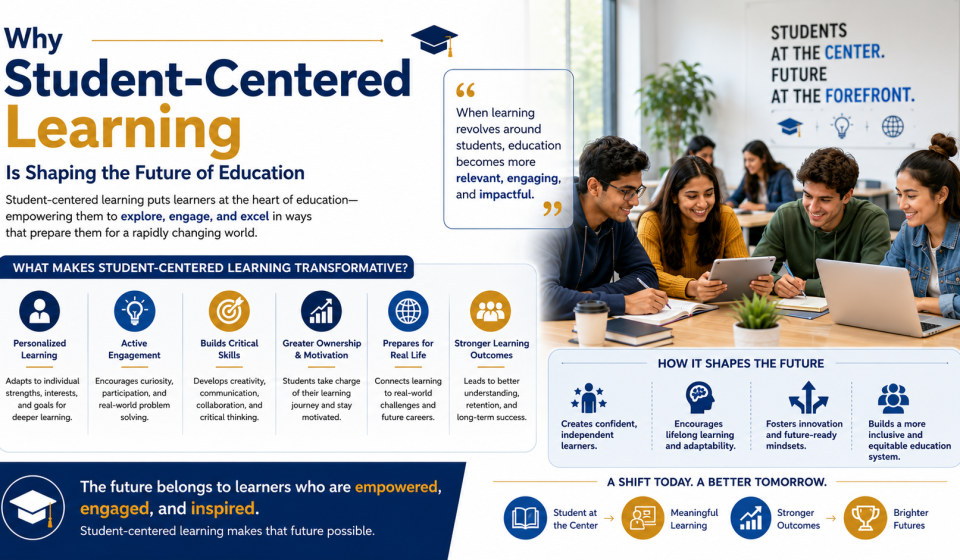
Student-centered learning is an educational approach that places students at the center of the learning experience.
Instead of focusing only on teaching, this model emphasizes:
- Active participation
- Personalized learning
- Critical thinking
- Collaboration
- Practical application
- Independent learning
- Continuous feedback
- Skill development
- Goal setting
- Lifelong learning
Students take greater responsibility for their own educational journey.
Why Student-Centered Learning Matters
Every student learns differently.
Student-centered education helps students:
- Improve academic performance
- Increase engagement
- Develop confidence
- Build problem-solving skills
- Strengthen communication
- Prepare for future careers
Personalized learning improves educational outcomes.
Personalized Learning Experience
Modern education recognizes individual learning preferences.
Students benefit from:
- Flexible learning pathways
- Self-paced learning
- Personalized academic support
- Adaptive teaching methods
- Individual goal setting
Personalized education encourages continuous improvement.
Active Learning Promotes Better Understanding
Students retain knowledge more effectively when they actively participate.
Active learning strategies include:
- Group discussions
- Classroom debates
- Case studies
- Research projects
- Practical assignments
- Interactive learning activities
Participation strengthens knowledge retention.
Critical Thinking and Problem-Solving
Student-centered learning develops higher-order thinking skills.
Students learn to:
- Analyze information
- Evaluate evidence
- Solve complex problems
- Make informed decisions
- Generate innovative ideas
Critical thinking prepares graduates for modern careers.
Project-Based Learning
Projects connect academic theory with practical application.
Students gain experience through:
- Team projects
- Industry assignments
- Community engagement
- Design challenges
- Innovation competitions
Projects enhance both technical and soft skills.
Technology Enhances Personalized Education
Educational technology supports student-centered learning.
Common tools include:
- Learning management systems
- Virtual classrooms
- Digital libraries
- Artificial intelligence tutors
- Interactive simulations
- Online assessments
Technology improves accessibility and engagement.
Collaboration Develops Professional Skills
Teamwork is essential in nearly every profession.
Collaborative learning encourages:
- Communication
- Leadership
- Conflict resolution
- Team management
- Shared responsibility
Collaboration prepares students for workplace success.
Faculty Become Learning Facilitators
In student-centered education, faculty guide learning rather than simply deliver information.
Faculty responsibilities include:
- Mentoring students
- Providing personalized feedback
- Encouraging research
- Supporting innovation
- Facilitating discussions
Faculty mentorship strengthens academic development.
Experiential Learning Builds Confidence
Practical experiences reinforce classroom learning.
Examples include:
- Internships
- Laboratory work
- Industrial visits
- Field research
- Service learning
- Entrepreneurship programs
Experiential education increases employability.
Continuous Assessment Improves Learning
Student-centered education emphasizes regular feedback rather than relying only on final examinations.
Assessment methods include:
- Presentations
- Portfolios
- Project evaluations
- Peer assessments
- Reflective journals
Continuous evaluation encourages improvement.
Student Well-Being and Academic Success
Learning environments that support student well-being often achieve stronger academic outcomes.
Support services may include:
- Academic advising
- Counseling
- Career guidance
- Mentorship programs
- Wellness initiatives
Healthy students learn more effectively.
Future-Ready Skills
Student-centered learning prepares graduates with skills employers value.
These include:
- Adaptability
- Digital literacy
- Leadership
- Communication
- Creativity
- Emotional intelligence
- Lifelong learning
These competencies support long-term career growth.
Questions to Ask Before Admission
Before choosing a college, students should ask:
- Does the college use project-based learning?
- Are internships integrated into the curriculum?
- What personalized academic support is available?
- How are students assessed?
- Are research opportunities available?
- Does the institution encourage innovation and entrepreneurship?
These questions help evaluate the quality of student-centered education.
Common Mistakes Students Make
Many students focus only on rankings, tuition fees, or placement statistics while overlooking teaching methodology. Choosing a college without evaluating its learning approach, faculty engagement, academic support, and experiential learning opportunities may limit personal and professional growth. A student-centered institution often provides a more engaging and career-focused educational experience.
The Future of Student-Centered Learning
Artificial intelligence, adaptive learning systems, virtual reality classrooms, competency-based education, personalized learning analytics, blended education, interdisciplinary learning, digital collaboration platforms, experiential education, and lifelong learning ecosystems will continue transforming higher education while placing students at the center of the educational experience.
Source
https://www.ugc.gov.in
https://www.aicte-india.org
https://www.education.gov.in
https://www.naac.gov.in
Conclusion
Student-centered learning is redefining higher education by creating personalized, engaging, and practical learning experiences that prepare students for future careers and lifelong success. By emphasizing active participation, critical thinking, collaboration, innovation, technology integration, and experiential learning, this educational approach helps students develop both academic excellence and professional competencies. Colleges that adopt student-centered learning models empower students to become confident, independent learners capable of adapting to a rapidly changing world. When selecting a college, evaluating its commitment to student-centered education is an important step toward achieving long-term academic, personal, and career success.
FAQ
1. What is student-centered learning?
Student-centered learning is an educational approach where students actively participate in the learning process through personalized instruction, collaboration, critical thinking, project-based learning, and practical experiences.
2. Why is student-centered learning important in higher education?
It improves engagement, academic performance, communication skills, creativity, problem-solving abilities, leadership, and career readiness while supporting lifelong learning.
3. How is student-centered learning different from traditional teaching?
Traditional teaching focuses mainly on lectures and teacher-led instruction, while student-centered learning encourages active participation, independent learning, collaboration, continuous feedback, and personalized educational experiences.
4. Does student-centered learning improve employability?
Yes. Students develop workplace skills such as teamwork, adaptability, communication, digital literacy, critical thinking, leadership, and practical problem-solving that employers highly value.
5. What should students evaluate before choosing a college?
Students should examine teaching methods, project-based learning opportunities, faculty mentorship, research facilities, internships, technology integration, academic support services, and student engagement initiatives.
6. Why is student-centered learning considered the future of education?
Modern careers require continuous learning, innovation, adaptability, and practical skills. Student-centered education prepares graduates for these changing demands by providing flexible, personalized, and experience-based learning environments.