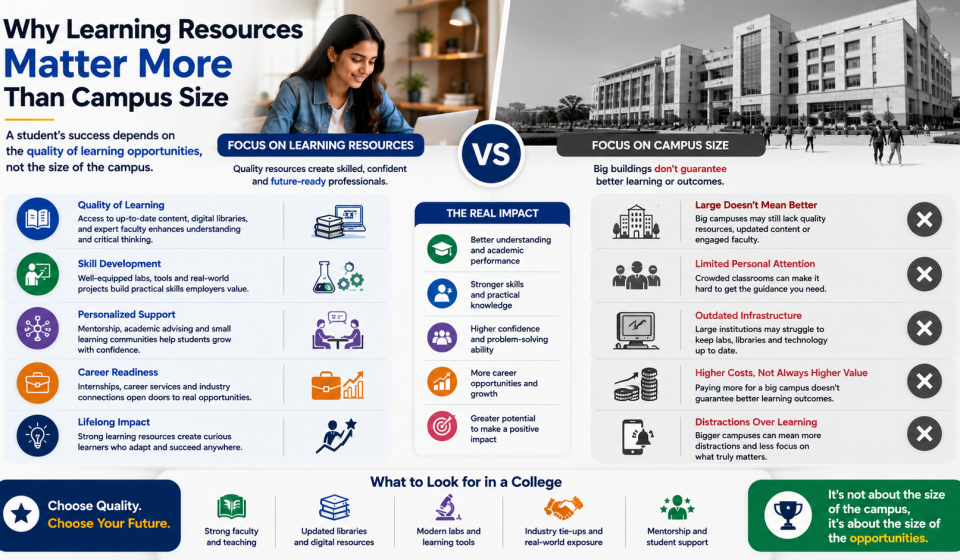

When choosing a college or university, many students are naturally impressed by large campuses, modern buildings, beautiful landscapes, and impressive infrastructure. While an attractive campus can enhance the college experience, it should never be the primary factor in selecting an educational institution.
In today’s knowledge-driven economy, employers value graduates who possess practical skills, critical thinking abilities, digital literacy, and real-world experience rather than simply attending a large or prestigious campus. Colleges that invest in high-quality learning resources create environments where students can explore new ideas, conduct research, collaborate on projects, gain industry exposure, and continuously develop their abilities. Understanding why learning resources matter more than campus size helps students make informed decisions that lead to stronger academic performance, better career opportunities, and lifelong success.
What Are Learning Resources?
Learning resources are the tools, facilities, technologies, services, and educational support systems that help students acquire knowledge, develop practical skills, and achieve their academic and career goals. These resources extend beyond textbooks and classrooms, creating an environment where students can learn effectively and apply their knowledge in real-world situations.
Common learning resources include:
- Libraries
- Digital libraries
- Learning Management Systems (LMS)
- Computer laboratories
- Science laboratories
- Innovation centres
- Research facilities
- Industry-standard software
- Online learning platforms
- Faculty mentorship
- Career guidance services
- Academic counselling
- Workshops and seminars
- Skill development programmes
The quality and accessibility of these resources significantly influence student outcomes.
Why Campus Size Is Often Overrated
Many students assume that a larger campus automatically offers a better education. While spacious campuses may provide more facilities, size alone does not guarantee educational quality.
A large campus may have:
- Extensive buildings
- Beautiful landscapes
- Multiple sports grounds
- Large hostels
- Impressive architecture
However, without quality teaching, updated learning materials, industry exposure, and student support, these features contribute little to academic or career success.
The Real Value Lies in Learning Resources
Learning resources directly influence how students understand concepts, develop skills, and prepare for future careers.
High-quality resources help students:
- Learn more efficiently
- Conduct meaningful research
- Build technical expertise
- Improve problem-solving abilities
- Stay updated with industry trends
- Develop professional confidence
These advantages have a lasting impact throughout a student’s academic and professional journey.
Access to Modern Libraries
Libraries remain one of the most valuable educational resources.
A well-equipped library provides:
- Academic textbooks
- Research journals
- Reference materials
- Digital databases
- E-books
- Study spaces
- Multimedia resources
Students who regularly use library resources often perform better academically because they gain access to reliable and diverse sources of information.
Digital Learning Platforms Enhance Education
Technology has transformed higher education.
Modern colleges provide access to:
- Online course platforms
- Learning Management Systems
- Recorded lectures
- Interactive quizzes
- Virtual classrooms
- AI-powered learning tools
These platforms allow students to learn anytime and from anywhere, increasing flexibility and engagement.
Well-Equipped Laboratories Improve Practical Skills
Practical learning is essential for many academic disciplines.
Quality laboratories allow students to:
- Conduct experiments
- Test theories
- Develop technical competence
- Solve practical problems
- Gain hands-on experience
Whether studying engineering, healthcare, computer science, or environmental science, laboratory resources strengthen practical understanding.
Experienced Faculty Are the Most Valuable Resource
Buildings do not teach students—educators do.
Knowledgeable faculty members provide:
- Academic guidance
- Personal mentoring
- Career advice
- Research supervision
- Industry insights
Strong faculty support often has a greater influence on student success than expensive campus infrastructure.
Research Opportunities Foster Innovation
Research encourages students to think critically and explore new ideas.
Colleges with strong research facilities offer opportunities for:
- Independent studies
- Scientific investigations
- Product development
- Industry collaboration
- Innovation projects
Research experiences improve analytical thinking and prepare students for advanced studies and professional careers.
Career Development Resources Improve Employability
Career support services play an important role in student success.
Effective career centres provide:
- Career counselling
- Resume writing assistance
- Interview preparation
- Internship guidance
- Placement support
- Employer networking events
These services help students transition successfully from education to employment.
Industry Partnerships Provide Real-World Learning
Learning extends beyond campus boundaries.
Colleges with strong industry connections offer:
- Internships
- Industrial visits
- Guest lectures
- Live business projects
- Professional mentoring
Industry exposure allows students to understand workplace expectations before graduation.
Skill Development Programmes Build Future-Ready Graduates
Employers seek graduates with both technical and soft skills.
Learning resources should include training in:
- Communication
- Leadership
- Critical thinking
- Digital literacy
- Project management
- Entrepreneurship
- Teamwork
Continuous skill development enhances career readiness.
Innovation Centres Encourage Creativity
Innovation hubs provide students with opportunities to:
- Develop prototypes
- Launch startups
- Participate in hackathons
- Solve business problems
- Collaborate across disciplines
Creative environments inspire entrepreneurship and innovation.
Academic Support Services Improve Student Performance
Many students need additional academic assistance during college.
Support services may include:
- Tutoring programmes
- Writing centres
- Peer mentoring
- Academic advising
- Study workshops
These resources help students overcome challenges and improve academic outcomes.
Online Learning Resources Expand Knowledge
Modern students benefit from access to:
- MOOCs
- Online certification courses
- Educational videos
- Digital libraries
- Professional webinars
- Industry reports
Continuous access to online learning keeps students updated with emerging trends.
Collaborative Learning Spaces Promote Teamwork
Education increasingly emphasises collaboration.
Modern learning environments include:
- Group study rooms
- Innovation labs
- Discussion spaces
- Project collaboration centres
Working together helps students develop communication and teamwork skills.
Technology Infrastructure Supports Better Learning
Reliable technology enhances every aspect of education.
Important technology resources include:
- High-speed internet
- Smart classrooms
- Cloud computing platforms
- Virtual laboratories
- Digital assessment systems
Technology enables flexible and interactive learning experiences.
Mental Health and Student Support Services
Student success depends on emotional well-being.
Support services should include:
- Counselling
- Wellness programmes
- Stress management workshops
- Peer support groups
Healthy students are more focused, motivated, and productive.
How Learning Resources Improve Career Readiness
Students with access to quality learning resources often graduate with:
- Practical experience
- Industry knowledge
- Strong technical skills
- Professional confidence
- Better communication
- Portfolio projects
- Internship experience
These qualities increase employability and long-term career growth.
Questions Students Should Ask Before Choosing a College
Instead of asking how large the campus is, students should ask:
- Does the college have modern laboratories?
- What digital learning platforms are available?
- How strong are the library resources?
- Are internships provided?
- What placement support exists?
- How experienced are the faculty members?
- Are research opportunities available?
- What certifications can students earn?
These questions provide a clearer picture of educational quality.
Common Mistakes When Selecting a College
Avoid making decisions based only on:
- Campus size
- Attractive buildings
- Marketing brochures
- Social media images
- Popularity
Instead, evaluate the institution’s educational resources, teaching quality, industry partnerships, and student support systems.
The Future of Learning Resources
Higher education continues to evolve with technological innovation.
Future learning resources will increasingly include:
- Artificial Intelligence tutors
- Adaptive learning platforms
- Virtual Reality laboratories
- Augmented Reality simulations
- Personalised learning analytics
- Digital credential systems
- Cloud-based collaboration
- Global virtual classrooms
These innovations will further enhance student learning experiences.
Long-Term Benefits of Strong Learning Resources
Students who study in resource-rich environments often experience:
- Better academic achievement
- Higher employability
- Stronger technical knowledge
- Greater confidence
- Improved research abilities
- Better communication skills
- Enhanced digital literacy
- Increased innovation
- Lifelong learning habits
- Successful professional careers
The quality of learning resources continues to influence success long after graduation.
Source
https://www.unesco.org
https://www.oecd.org
https://www.weforum.org
https://www.aacu.org
https://www.naceweb.org
https://www.coursera.org
https://www.edx.org
Conclusion
While a large and visually impressive campus may create a positive first impression, it is the quality of learning resources that truly shapes a student’s academic journey and future career. Access to experienced faculty, modern laboratories, digital learning platforms, research opportunities, career services, libraries, innovation centres, and industry partnerships provides students with the knowledge, practical skills, and confidence needed to succeed in today’s competitive world. These resources encourage continuous learning, critical thinking, collaboration, and innovation, ensuring that students graduate with far more than just a degree.
As higher education becomes increasingly focused on preparing graduates for rapidly changing industries, students should prioritise institutions that invest in meaningful learning experiences rather than simply offering expansive campuses. By choosing a college with strong educational resources, students gain access to the tools, mentorship, and opportunities that support academic excellence, career readiness, and lifelong personal growth. In the long run, the strength of a college’s learning ecosystem matters far more than the size of its campus.
FAQ
1. Why are learning resources more important than campus size?
Learning resources directly improve education by providing access to quality teaching, libraries, laboratories, digital platforms, research opportunities, career services, and practical learning experiences that support academic and professional success.
2. What are examples of learning resources in higher education?
Examples include libraries, digital learning platforms, laboratories, experienced faculty, career counselling, innovation centres, research facilities, online courses, workshops, and mentoring programmes.
3. Does a larger campus always mean better education?
No. A large campus may have impressive infrastructure, but educational quality depends more on teaching standards, learning resources, industry exposure, and student support services.
4. How do learning resources improve student outcomes?
They enhance knowledge, strengthen practical skills, improve critical thinking, support research, increase engagement, and prepare students for successful careers.
5. What role do digital learning resources play?
Digital resources such as online courses, Learning Management Systems, virtual classrooms, AI-powered tools, and e-libraries provide flexible, accessible, and personalised learning experiences.
6. Why are experienced faculty considered an important learning resource?
Experienced educators provide mentorship, research guidance, career advice, practical insights, and personalised academic support that significantly contribute to student success.
7. How do industry partnerships benefit students?
Industry collaborations offer internships, live projects, guest lectures, mentorship, and placement opportunities that help students gain real-world experience and improve employability.
8. What should students prioritise when choosing a college?
Students should focus on the quality of learning resources, faculty expertise, career services, research opportunities, practical training, industry partnerships, and student support rather than simply considering the size or appearance of the campus.