Why Interdisciplinary Learning Is the Future of Higher Education: The Complete Guide to Building Future-Ready Skills and Career Success

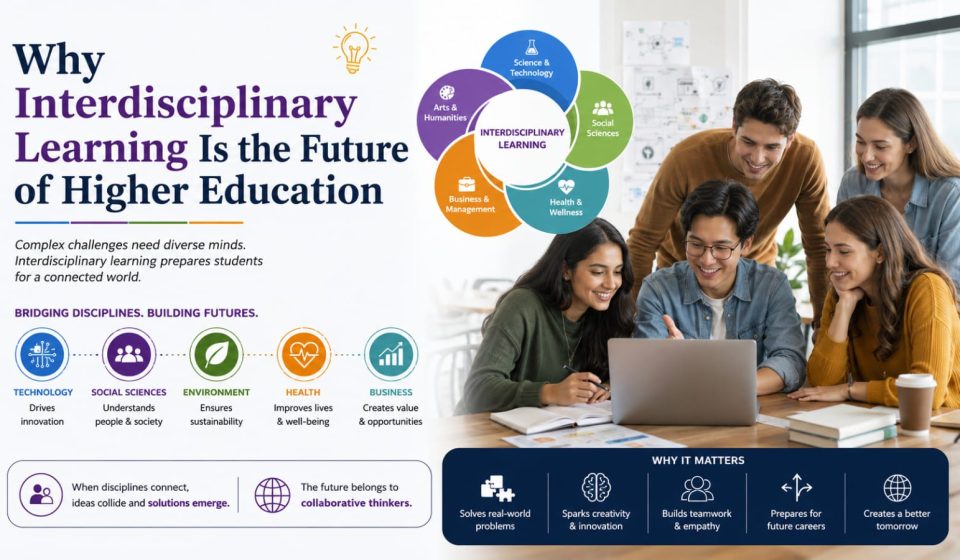
The world is changing faster than ever, and the challenges of the 21st century no longer fit neatly into the boundaries of a single academic discipline. From artificial intelligence and climate change to healthcare innovation, sustainable development, cybersecurity, and digital transformation.
Modern employers increasingly seek graduates who possess technical expertise alongside communication, adaptability, leadership, problem-solving, and analytical skills. Interdisciplinary education prepares students for this reality by exposing them to diverse perspectives, encouraging collaboration across academic domains, and helping them develop the flexibility needed to succeed in a rapidly changing workforce. Whether pursuing careers in engineering, business, healthcare, technology, social sciences, or entrepreneurship, students who embrace interdisciplinary learning are often better equipped to navigate complex professional environments. This comprehensive guide explores why interdisciplinary learning is shaping the future of higher education, its benefits, implementation strategies, and how it prepares students for lifelong success.
What Is Interdisciplinary Learning?
Interdisciplinary learning is an educational approach that combines knowledge, skills, and methods from two or more academic disciplines to understand complex topics or solve real-world challenges.
Rather than studying subjects separately, students integrate learning across multiple fields.
Examples include:
- Engineering and Artificial Intelligence
- Business and Data Analytics
- Biology and Computer Science
- Psychology and Marketing
- Environmental Science and Public Policy
- Healthcare and Information Technology
This integrated approach encourages broader thinking and innovation.
Why Traditional Education Is Evolving
Traditional education has long emphasized specialized knowledge within individual disciplines.
While specialization remains valuable, modern careers increasingly require professionals who can work across different areas of expertise.
Factors driving educational change include:
- Rapid technological advancement
- Globalization
- Digital transformation
- Automation
- Complex societal challenges
- Industry collaboration
Higher education is adapting to prepare graduates for these evolving demands.
Benefits of Interdisciplinary Learning
Students gain numerous academic and professional advantages.
Key benefits include:
- Stronger critical thinking
- Better problem-solving
- Greater creativity
- Improved communication
- Adaptability
- Collaboration skills
- Broader knowledge
- Career flexibility
- Innovation mindset
- Lifelong learning habits
These qualities are highly valued by employers worldwide.
Encourages Critical Thinking
Interdisciplinary education teaches students to examine problems from multiple perspectives.
Instead of relying on one approach, learners evaluate information using concepts from different fields.
This improves:
- Analysis
- Decision-making
- Reasoning
- Evidence evaluation
Critical thinking supports both academic and workplace success.
Promotes Real-World Problem Solving
Modern problems rarely belong to a single discipline.
For example:
Climate change involves:
- Environmental science
- Economics
- Engineering
- Public policy
- Sociology
Healthcare innovation combines:
- Medicine
- Artificial Intelligence
- Data Science
- Engineering
- Ethics
Interdisciplinary learning prepares students for such complex challenges.
Develops Creativity
Innovation often occurs when ideas from different fields are combined.
Students become more creative by exploring diverse perspectives and applying knowledge in new ways.
Creative thinking drives technological advancement and entrepreneurship.
Improves Communication Skills
Working across disciplines requires students to explain ideas clearly to people with different backgrounds.
Communication improves through:
- Group discussions
- Presentations
- Collaborative projects
- Research activities
Strong communication skills benefit every profession.
Strengthens Teamwork
Interdisciplinary projects involve collaboration among students with different expertise.
Teamwork develops:
- Leadership
- Cooperation
- Conflict resolution
- Shared decision-making
- Respect for diverse viewpoints
Collaborative learning reflects real workplace environments.
Supports Innovation
Innovation depends on combining knowledge from multiple disciplines.
Examples include:
- Smart healthcare systems
- Sustainable cities
- Renewable energy
- Autonomous vehicles
- Financial technology
Interdisciplinary education nurtures innovative thinking.
Increases Career Flexibility
Graduates with interdisciplinary knowledge can adapt more easily to changing industries.
They often qualify for roles that require:
- Technical skills
- Business understanding
- Communication
- Project management
Career flexibility supports long-term employability.
Prepares Students for Emerging Careers
Many future careers combine multiple disciplines.
Examples include:
- AI Ethics Specialist
- Health Data Analyst
- Sustainability Consultant
- Cybersecurity Policy Advisor
- Digital Healthcare Manager
- Robotics Engineer
Interdisciplinary education aligns with future workforce needs.
Encourages Lifelong Learning
Technology and industries continue evolving.
Students who learn across disciplines become comfortable acquiring new knowledge throughout their careers.
Continuous learning improves professional resilience.
Integrating Technology into Education
Technology enables interdisciplinary collaboration through:
- Virtual laboratories
- Online learning platforms
- Artificial Intelligence tools
- Simulation software
- Data visualization
Digital tools expand learning opportunities across academic fields.
Research Opportunities
Interdisciplinary research encourages students to investigate complex issues using diverse methodologies.
Research develops:
- Analytical thinking
- Scientific inquiry
- Innovation
- Academic writing
Many groundbreaking discoveries result from interdisciplinary collaboration.
Entrepreneurship and Innovation
Successful entrepreneurs often combine expertise from several disciplines.
Business founders benefit from knowledge in:
- Finance
- Marketing
- Technology
- Design
- Customer psychology
Interdisciplinary education strengthens entrepreneurial thinking.
Industry Collaboration
Modern universities increasingly partner with industry to develop interdisciplinary learning experiences.
Examples include:
- Internship programs
- Industry projects
- Innovation challenges
- Corporate mentorship
- Applied research
Industry collaboration improves career readiness.
Personalized Learning Pathways
Many universities now allow students to customize their education through:
- Elective courses
- Minor specializations
- Dual majors
- Interdisciplinary certificates
Flexible pathways encourage personalized career development.
Global Perspective
Interdisciplinary education helps students understand global challenges from multiple viewpoints.
Topics include:
- Sustainable development
- Climate action
- Public health
- International business
- Human rights
Global awareness prepares graduates for international careers.
Building Leadership Skills
Leaders often work with professionals from different disciplines.
Interdisciplinary learning develops:
- Strategic thinking
- Collaboration
- Decision-making
- Emotional intelligence
These qualities contribute to effective leadership.
Supporting the National Education Policy (NEP)
Many higher education reforms, including India’s National Education Policy (NEP) 2020, encourage multidisciplinary and interdisciplinary education by promoting flexible curricula, multiple entry and exit options, skill development, research, innovation, and holistic student learning. These reforms aim to prepare graduates for evolving global career opportunities while supporting lifelong learning.
Challenges of Interdisciplinary Learning
Although interdisciplinary education offers many benefits, institutions must address challenges such as curriculum coordination, faculty collaboration, assessment methods, and balancing depth with breadth of knowledge. Successful implementation requires strong institutional planning, flexible academic structures, and continuous collaboration among departments.
The Future of Higher Education
The future of higher education will increasingly focus on integrated learning, digital education, artificial intelligence, global collaboration, experiential learning, and industry partnerships. Universities that embrace interdisciplinary education are better positioned to prepare students for careers that demand adaptability, innovation, and cross-functional expertise. As technology continues transforming every industry, graduates with interdisciplinary skills will remain highly competitive in both domestic and international job markets.
Source
https://www.ugc.gov.in
https://www.aicte-india.org
https://www.unesco.org
https://www.oecd.org
Conclusion
Interdisciplinary learning represents the future of higher education because it prepares students to solve complex real-world problems through integrated knowledge, collaboration, creativity, and innovation. By combining insights from multiple academic disciplines, students develop stronger critical thinking, communication, leadership, and problem-solving skills while becoming more adaptable to rapidly changing industries. As universities continue embracing flexible curricula, technology-enabled learning, research collaboration, and industry partnerships, interdisciplinary education will play a central role in shaping future-ready graduates. Students who actively engage in interdisciplinary learning gain not only broader academic knowledge but also the practical competencies needed for lifelong career success and meaningful contributions to society.
FAQ
1. What is interdisciplinary learning?
Interdisciplinary learning is an educational approach that combines knowledge, methods, and perspectives from multiple academic disciplines to better understand complex topics and solve real-world problems.
2. Why is interdisciplinary learning important in higher education?
It helps students develop critical thinking, creativity, collaboration, communication, adaptability, and problem-solving skills that are highly valued in today’s workforce.
3. How does interdisciplinary learning improve career opportunities?
Graduates gain broader knowledge, transferable skills, and the flexibility to work across industries, making them more competitive for emerging and multidisciplinary career roles.
4. What are some examples of interdisciplinary programs?
Examples include Business Analytics, Bioinformatics, Environmental Engineering, Health Informatics, Artificial Intelligence and Ethics, Data Science, Cognitive Science, and Sustainable Development Studies.
5. Does interdisciplinary learning replace specialization?
No. It complements specialization by allowing students to combine deep expertise in one field with knowledge and skills from other disciplines, creating a more well-rounded education.
6. How does NEP 2020 support interdisciplinary education?
India’s National Education Policy 2020 encourages multidisciplinary learning, flexible curricula, academic credit systems, research, innovation, skill development, and student choice to create a more holistic higher education system.