
Discover why college location matters for student opportunities, including internships, networking, jobs, industry exposure, transportation, living costs, and career growth.
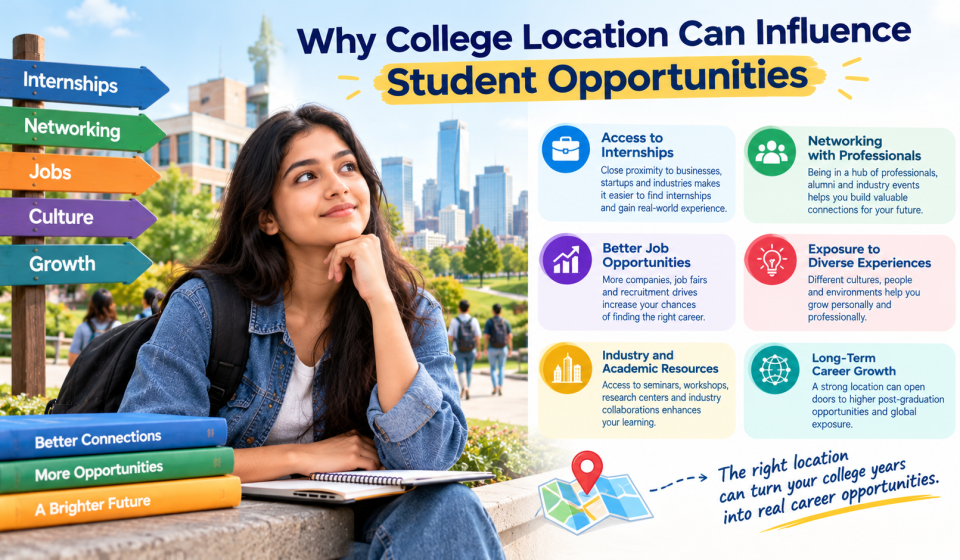
Choosing a college is an important decision that can influence a student’s academic experience, professional development, and future career opportunities. Students usually compare colleges based on course quality, fees, faculty, rankings, placements, infrastructure, and campus facilities. However, another factor deserves equal attention: college location. The city or region where a college is situated can affect access to internships, companies, networking events, cultural experiences, transportation, part-time opportunities, and professional communities.
College location does not automatically determine whether a student will succeed. A strong student can build a successful career from almost any location by developing relevant skills, using online resources, completing internships, and networking actively. However, location can make certain opportunities easier or harder to access. Research on university participation has found that transportation and commuting constraints can affect how frequently students travel to campus and participate in university activities. This is why students should consider location as one part of a broader college-selection decision.
What Does College Location Mean?
College location refers to the geographical setting of an institution and its surrounding environment.
This can include:
- City or town
- State or region
- Distance from major business centers
- Availability of public transportation
- Nearby companies and industries
- Cost of living
- Housing availability
- Local cultural environment
- Access to professional events
- Distance from airports and railway stations
- Availability of part-time work
- Local startup and entrepreneurship ecosystem
A college located in a large metropolitan area may provide access to a different set of opportunities than one located in a smaller town. Similarly, a college in an industrial region may offer different industry exposure from one located primarily around government, education, healthcare, tourism, or agriculture.
Why College Location Matters for Students
The location of a college can influence the opportunities available outside the classroom. It can also affect everyday convenience, expenses, and the amount of time students have for academic and professional activities.
1. Access to Internship Opportunities
Internships are one of the most valuable ways students can gain practical experience before graduation.
A college located near business districts, technology companies, hospitals, financial institutions, design studios, manufacturing companies, research organizations, or startups may provide students with more opportunities to explore local internships.
The Ministry of Education has highlighted the role of internships and industry-academia connections in developing practical experience and employability.
Location can be particularly useful when students need to attend internships physically during the academic year.
For example, a student studying in a major technology hub may find it easier to attend evening networking events or part-time internships with nearby companies than a student who needs to travel several hours to reach an industry center.
2. Proximity to Companies and Industries
Being close to relevant industries can create opportunities for students to observe how their field operates.
Students may have access to:
- Company visits
- Industry seminars
- Guest lectures
- Career fairs
- Workshops
- Networking events
- Internship opportunities
- Industry projects
- Professional conferences
For example, a student interested in technology may benefit from studying near a strong technology ecosystem, while a student interested in finance may value proximity to financial institutions and business centers.
The important point is to match the location with the student’s career field.
3. Networking Opportunities
Networking is an important part of professional development.
Students can build relationships with:
- Industry professionals
- Alumni
- Entrepreneurs
- Recruiters
- Professors
- Researchers
- Startup founders
- Other students
A college located in a city with an active professional ecosystem may provide more opportunities to attend events, conferences, workshops, meetups, and career sessions.
Networking should not be understood simply as asking someone for a job. It can help students learn about industries, understand employer expectations, identify useful skills, and discover career paths.
4. Exposure to the Local Job Market
Location can influence students’ understanding of the job market.
Students who live near a large employment market may observe:
- Which industries are growing
- What skills companies are hiring for
- Which job roles are common
- What salary expectations exist
- Which companies recruit graduates
- What professional qualifications are valued
This exposure can help students make better decisions about electives, certifications, internships, and career preparation.
However, students should not assume that being in a major city automatically guarantees better employment outcomes. Skills, academic performance, experience, networking, and employer demand remain important.
5. Transportation Can Affect Student Participation
Transportation is one of the most practical reasons location matters.
A college may be excellent academically, but if students spend several hours commuting every day, they may have less time for:
- Studying
- Assignments
- Clubs
- Sports
- Internships
- Networking
- Rest
- Personal development
Research on university students found that longer home-campus travel times and employment commitments can negatively affect how frequently students visit campus and participate in university activities.
Therefore, students should consider not only the distance from home to college but also the quality and reliability of transportation.
6. Public Transportation Can Create More Flexibility
A college located near reliable public transportation can make student life easier.
Students may benefit from access to:
- Metro services
- Buses
- Trains
- Shared transportation
- Cycling routes
- Walking-friendly areas
Good transportation can make it easier to attend internships, workshops, interviews, competitions, and professional events.
When comparing colleges, students should consider the actual travel time rather than simply measuring geographical distance.
A college that is 15 kilometers away but connected by efficient public transport may be more convenient than one that is only 8 kilometers away but requires unpredictable travel.
7. Cost of Living Can Affect the College Experience
Location also affects living expenses.
Students moving to large cities may face higher costs for:
- Rent
- Hostels
- Food
- Transportation
- Utilities
- Entertainment
- Daily necessities
A smaller city may offer lower living expenses, potentially allowing students to spend more of their budget on education, courses, certifications, or professional development.
However, lower living costs should be balanced against access to opportunities.
Students should calculate the total cost of education, including tuition and living expenses, rather than comparing tuition fees alone.
8. Part-Time Work Opportunities
Some students may want part-time employment while studying.
Depending on local regulations, course requirements, and personal circumstances, students may explore opportunities such as:
- Tutoring
- Retail
- Content creation
- Design work
- Freelancing
- Administrative work
- Research assistance
- Industry-related part-time roles
Large employment markets may provide more options, but they can also have greater competition.
Students should ensure that any part-time work does not negatively affect their academic responsibilities.
9. Access to Professional Events
Location can influence how easily students can attend professional events.
Major cities often host:
- Conferences
- Career fairs
- Hackathons
- Startup events
- Design exhibitions
- Technology meetups
- Business seminars
- Research conferences
- Workshops
Attending these events can help students learn beyond the classroom and meet people working in their target industries.
The Government of India’s higher-education initiatives also emphasize industry collaboration, internships, mentorship, and practical exposure as ways to connect education with changing sector requirements.
10. Startup and Entrepreneurship Ecosystem
Students interested in entrepreneurship may benefit from a location with a strong startup ecosystem.
Such environments can provide access to:
- Startup communities
- Incubators
- Accelerators
- Investors
- Founders
- Mentors
- Innovation events
- Co-working spaces
- Business competitions
Students may be able to turn academic projects into practical ideas by interacting with entrepreneurs and other innovators.
However, students should also check whether their college itself provides entrepreneurship support, because a good location alone does not guarantee access to the ecosystem.
11. Research Opportunities
Location can also influence research exposure.
Students may benefit from being close to:
- Research institutes
- Universities
- Laboratories
- Hospitals
- Technology centers
- Government research organizations
- Industry research facilities
For students interested in postgraduate education or research careers, access to research communities can be valuable.
At the same time, the college’s own faculty and research infrastructure may be more important than location alone.
12. Cultural and Social Exposure
College is also a period of personal development.
Studying in a different city or region can expose students to:
- Different languages
- Cultures
- Food
- Communities
- Professional environments
- Social perspectives
- Public events
The National Education Policy’s approach to multidisciplinary and holistic education emphasizes broader learning, flexibility, critical thinking, adaptability, and exposure across disciplines.
Living in a diverse environment can complement classroom learning by helping students become more adaptable and confident.
13. Location Can Influence Personal Independence
Moving to a new city can require students to manage:
- Money
- Transportation
- Time
- Accommodation
- Food
- Daily responsibilities
This can encourage independence and decision-making.
However, students should also consider their comfort, safety, support systems, and financial situation.
A location that is exciting professionally may not be suitable if living conditions create excessive financial or personal stress.
14. Distance From Family Can Matter
Students should consider how far the college is from their family.
A college in another city or state may provide greater independence and exposure, but travel home may become more expensive and time-consuming.
Students should consider:
- Travel frequency
- Transportation availability
- Travel costs
- Emergency accessibility
- Family responsibilities
- Personal preferences
There is no universally correct distance from home. The right choice depends on the student’s circumstances.
15. Location Can Influence College-Industry Connections
Location may make it easier for colleges to develop relationships with nearby employers and organizations.
These connections can support:
- Guest lectures
- Industry projects
- Internships
- Recruitment
- Mentorship
- Workshops
- Career events
However, students should verify what the college actually provides instead of assuming that nearby companies automatically recruit from the institution.
Research on internships and campus recruitment in Indian higher education also highlights internships and career-preparation initiatives as important employability interventions.
16. Online Learning Reduces Some Location Limitations
The importance of location has changed because students can now access many learning opportunities online.
Students can participate in:
- Online certifications
- Virtual internships
- Online conferences
- Remote projects
- Digital communities
- Webinars
- Industry courses
- Online networking
For example, SWAYAM Plus is a Ministry of Education initiative focused on employment-oriented learning and industry-aligned courses, providing learners access to professional development opportunities beyond their immediate geographical location.
This means students should not reject a college solely because it is outside a major city.
17. Location Should Be Matched With Career Goals
The best college location depends on what a student wants to achieve.
For example:
Technology student: May value proximity to technology companies, startups, hackathons, and developer communities.
Design student: May benefit from access to agencies, studios, creative events, and cultural spaces.
Management student: May value proximity to business centers, companies, conferences, and networking events.
Healthcare student: May benefit from access to hospitals, healthcare organizations, and research environments.
Research-oriented student: May prioritize research institutions, laboratories, faculty expertise, and academic communities.
The goal is not to find the “best city” but to find a location that supports the student’s specific goals.
How to Evaluate a College Location Before Admission
Students can use a simple checklist.
Check the Industry Environment
Search for companies and organizations near the college that are relevant to your field.
Check Transportation
Calculate actual travel time from the college to major employment areas, railway stations, airports, and residential areas.
Check Living Costs
Research hostel fees, rent, food, transportation, and other daily expenses.
Check Internship Availability
Look for evidence of internships, industry projects, career fairs, and employer partnerships.
Check Professional Events
Search for conferences, workshops, hackathons, meetups, and other events available nearby.
Check Safety and Student Life
Consider the safety of the neighborhood, accommodation options, healthcare facilities, and general student environment.
Check the College’s Own Resources
Do not judge a college only by its city. Research its faculty, laboratories, career center, placement support, internships, alumni network, clubs, and industry connections.
Common Mistakes Students Should Avoid
Students should avoid assuming:
- A metro city automatically means better opportunities
- A smaller city means fewer opportunities
- High rent means better education
- A famous city guarantees placement
- Nearby companies automatically hire college students
- Location is more important than academic quality
Location is an important factor, but it should be evaluated alongside the complete educational experience.
A Simple College Location Comparison Checklist
Before admission, compare:
- Distance from home
- Daily commute time
- Public transportation
- Hostel availability
- Cost of living
- Nearby industries
- Internship opportunities
- Professional events
- Startup ecosystem
- Research facilities
- Healthcare access
- Safety
- College-industry partnerships
- Alumni network
- Career services
This approach allows students to evaluate location objectively rather than choosing a college simply because the city is popular.
Source
Ministry of Education – Industry-Academia
Ministry of Education – Apprenticeship
SWAYAM Plus – Ministry of Education
Conclusion
College location can influence student opportunities by affecting access to internships, companies, professional networks, transportation, events, research communities, part-time opportunities, and industry exposure. A college located near a strong employment or industry ecosystem may make it easier for students to participate in professional activities, while a college in a smaller or more remote location may offer other advantages such as lower living costs, a quieter learning environment, or strong institution-specific resources.
However, location should never be the only factor used to select a college. Students should compare location with curriculum quality, faculty, fees, infrastructure, internships, placement support, research opportunities, alumni networks, and career goals. Online learning has also expanded access to industry-aligned courses and professional opportunities, reducing some of the limitations created by geography. The best college is therefore not necessarily the one in the biggest city, but the one whose location and educational environment together provide meaningful opportunities for the student’s future goals.
FAQ
1. Why does college location matter for students?
College location can influence access to internships, companies, networking events, transportation, professional communities, and job markets.
2. Is a college in a big city always better?
No. A big city may provide greater industry exposure, but it can also have higher living costs and competition. The quality of the college itself remains extremely important.
3. Can college location affect internships?
Yes. Being close to companies and organizations can make it easier to access certain internships, especially opportunities requiring regular physical attendance.
4. Does location affect placement opportunities?
It can influence access to local employers and recruitment events, but placement outcomes also depend on the college, student’s skills, academic performance, internships, and employer requirements.
5. Should students choose a college near their hometown?
Not necessarily. Staying near home can reduce travel and living costs, while studying elsewhere can provide independence and exposure to a different professional environment.
6. Why is transportation important when choosing a college?
Long or unreliable commutes can reduce the time students have for studying, campus activities, internships, networking, and other opportunities.
7. Does a smaller city provide fewer opportunities?
Not always. A smaller city may have fewer large companies but can still offer strong opportunities through the college’s faculty, alumni, internships, research, online learning, and local industries.
8. What should students check about college location?
Students should check transportation, living costs, nearby industries, internships, professional events, safety, accommodation, research opportunities, and access to relevant employment markets.
9. Can online learning reduce the importance of college location?
Yes. Online courses, virtual events, digital communities, and industry-oriented learning platforms can provide opportunities beyond a student’s immediate geographical area.
10. What is the most important factor when choosing a college location?
The most important factor is how well the location supports the student’s academic, professional, financial, and personal goals. Location should be considered together with the overall quality and opportunities provided by the college