Why Choosing a College With Practical Learning Opportunities Is the Smartest Decision for Your Future Career

Choosing the right college is one of the most important decisions in a student’s life, and one factor that deserves special attention is the availability of practical learning opportunities.
The modern workplace is changing rapidly due to technological advancements, automation, artificial intelligence, and globalization. Companies are looking for graduates who can adapt quickly, collaborate effectively, and apply classroom concepts to real-life situations. Colleges that integrate practical learning into their curriculum help students bridge the gap between education and employment. These institutions create opportunities for students to develop technical expertise, leadership qualities, teamwork, and critical thinking while building professional networks that support long-term career growth. Selecting a college with strong practical learning opportunities is therefore an investment in lifelong success.
What Is Practical Learning?
Practical learning is an educational approach that allows students to apply theoretical knowledge in real-world situations. Instead of relying only on textbooks and lectures, students actively participate in activities that improve their understanding through experience.
Practical learning may include:
Internships
Industrial training
Laboratory experiments
Field visits
Live projects
Case studies
Research projects
Workshops
Seminars
Business simulations
Capstone projects
Community service
Entrepreneurship programs
These experiences help students understand how academic concepts are used in professional environments.
Why Practical Learning Is Important in Higher Education
Higher education is no longer focused solely on academic performance. Employers seek graduates who can contribute from the first day of work.
Practical learning helps students:
Understand industry expectations
Apply classroom knowledge
Develop confidence
Strengthen communication skills
Improve problem-solving abilities
Build teamwork skills
Enhance creativity
Increase employability
Graduates with practical experience often adapt more quickly to workplace responsibilities.
Bridges the Gap Between Theory and Practice
Textbooks explain concepts, but practical learning demonstrates how those concepts solve real-world problems.
For example:
Engineering students build working prototypes.
Business students analyze real company case studies.
Computer science students develop software applications.
Healthcare students participate in clinical training.
Architecture students design practical projects.
This approach improves understanding and long-term knowledge retention.
Improves Critical Thinking Skills
Practical learning encourages students to analyze situations, evaluate information, and develop effective solutions.
Students learn to:
Identify challenges
Research solutions
Test ideas
Evaluate outcomes
Improve decision-making
Think creatively
Critical thinking is one of the most valuable skills employers seek across industries.
Builds Problem-Solving Abilities
Real-world projects expose students to challenges that cannot always be solved using textbook examples.
Practical learning develops the ability to:
Analyze problems
Find innovative solutions
Work under deadlines
Adapt to changing situations
Collaborate with teams
Problem-solving skills remain essential in every profession.
Develops Technical Skills
Industry-focused education helps students gain practical technical experience.
Examples include:
Programming
Machine operation
Laboratory techniques
Graphic design
Financial analysis
Marketing tools
Data analysis
Artificial Intelligence applications
Cybersecurity practices
Technical competence increases career opportunities after graduation.
Strengthens Communication Skills
Practical learning involves frequent interaction with instructors, teammates, clients, and industry professionals.
Students improve:
Public speaking
Presentation skills
Professional writing
Listening
Negotiation
Interpersonal communication
Effective communication improves workplace performance and leadership potential.
Encourages Teamwork and Collaboration
Most professional environments require employees to work in teams.
Group projects and practical assignments teach students how to:
Share responsibilities
Respect diverse perspectives
Resolve conflicts
Support team goals
Lead collaborative projects
These experiences prepare students for modern workplaces.
Builds Leadership Qualities
Leadership develops through experience rather than theory alone.
Students gain leadership opportunities by:
Managing group projects
Leading student organizations
Organizing events
Presenting research
Mentoring peers
Participating in innovation competitions
Leadership skills contribute to long-term career advancement.
Enhances Career Readiness
Practical learning prepares students for recruitment processes by providing valuable workplace experience.
Career readiness includes:
Professional behavior
Workplace ethics
Time management
Adaptability
Industry knowledge
Professional communication
Interview confidence
Students become better prepared for internships and campus placements.
Importance of Internships
Internships are among the most valuable practical learning experiences.
Benefits include:
Real workplace exposure
Professional networking
Resume enhancement
Technical skill development
Career exploration
Mentorship opportunities
Potential job offers
Internships often help students clarify career goals before graduation.
Industrial Visits Expand Knowledge
Industrial visits allow students to observe professional operations firsthand.
Students gain insights into:
Manufacturing processes
Corporate management
Production systems
Technology implementation
Quality control
Business operations
These visits connect classroom learning with industry practices.
Laboratory Learning Improves Understanding
Science, engineering, healthcare, and technology students benefit greatly from laboratory education.
Laboratory work develops:
Observation skills
Analytical thinking
Scientific methods
Technical accuracy
Experimental confidence
Hands-on experience makes theoretical concepts easier to understand.
Live Projects Build Professional Experience
Many colleges partner with industries to provide live projects.
Students learn by solving actual business challenges while developing:
Project management
Client communication
Research skills
Professional responsibility
Innovation
These experiences strengthen resumes and portfolios.
Research Opportunities Promote Innovation
Research encourages students to explore new ideas and contribute to knowledge creation.
Research activities improve:
Critical thinking
Data analysis
Scientific writing
Creativity
Innovation
Problem-solving
Students interested in higher education or research careers greatly benefit from these opportunities.
Entrepreneurship and Innovation
Practical learning also supports entrepreneurial development.
Students learn:
Business planning
Market research
Financial management
Product development
Leadership
Risk assessment
Innovation centers and startup incubators encourage students to transform ideas into successful businesses.
Importance of Industry Collaboration
Colleges with strong industry partnerships provide students with valuable learning opportunities.
Industry collaboration may include:
Guest lectures
Internships
Placement programs
Workshops
Industrial visits
Skill certification programs
Research collaborations
Students gain updated knowledge about industry trends and employer expectations.
Improves Employability
Employers value candidates who possess practical experience alongside academic qualifications.
Practical learning helps students build:
Professional portfolios
Internship experience
Technical skills
Soft skills
Industry certifications
Workplace confidence
Graduates become more competitive in the job market.
Soft Skills Developed Through Practical Learning
Practical education strengthens essential workplace skills such as:
Communication
Leadership
Adaptability
Time management
Decision-making
Creativity
Critical thinking
Professional ethics
Collaboration
These transferable skills benefit every career path.
Role of Technology in Practical Learning
Modern colleges increasingly use advanced technology to enhance practical education.
Examples include:
Virtual laboratories
Artificial Intelligence tools
Simulation software
Learning Management Systems
Cloud computing platforms
3D printing
Virtual reality training
Data analytics tools
Technology prepares students for digital workplaces.
How to Evaluate Practical Learning Opportunities Before Choosing a College
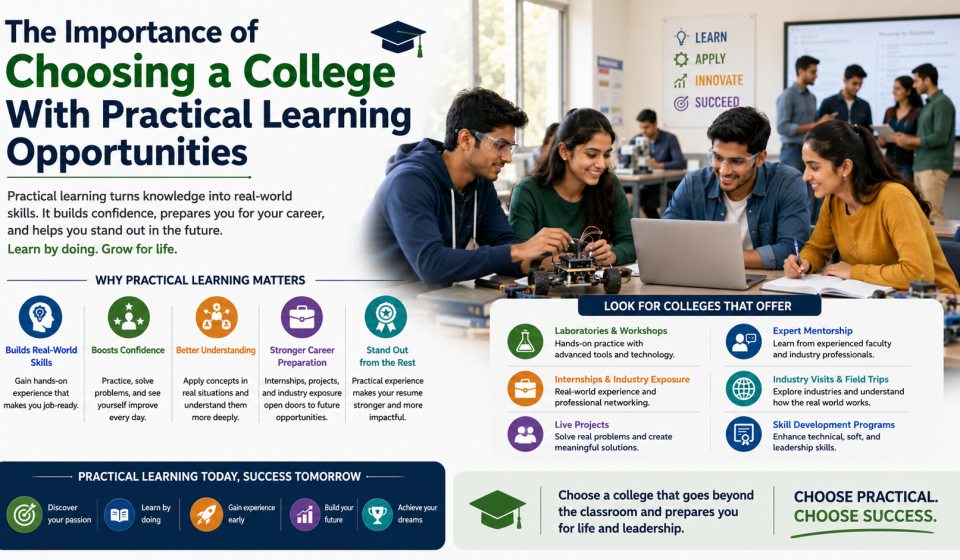
Before taking admission, students should evaluate whether a college offers:
Mandatory internships
Industry partnerships
Modern laboratories
Research facilities
Innovation centers
Entrepreneurship support
Placement assistance
Experienced faculty
Skill development programs
Industrial training
Career counseling
Choosing a college with these features increases long-term career success.
Common Mistakes Students Should Avoid
Many students focus only on rankings or tuition fees while ignoring practical learning opportunities.
Common mistakes include:
Choosing colleges without internship support
Ignoring laboratory facilities
Not researching placement records
Overlooking industry collaborations
Ignoring career services
Selecting programs based only on popularity
A balanced evaluation helps students make informed decisions.
Long-Term Benefits of Practical Learning
Students who receive practical education often experience:
Higher employability
Better salaries
Greater confidence
Improved technical expertise
Professional networking
Career flexibility
Leadership growth
Continuous learning
Practical learning creates graduates who are prepared for both current and future workplace challenges.
Source
https://www.naceweb.org
https://www.careeronestop.org
https://www.unesco.org
https://www.aacu.org
Conclusion
Choosing a college with strong practical learning opportunities is one of the best decisions students can make for their academic and professional future. While theoretical knowledge remains important, employers increasingly value graduates who can apply concepts in real-world situations, communicate effectively, solve problems, and adapt to changing workplace demands. Internships, laboratory work, research projects, industry collaborations, field visits, and live assignments help students build confidence, strengthen technical and soft skills, and become career-ready before graduation. By carefully evaluating practical learning opportunities during the college selection process, students can gain a competitive advantage and build a successful, future-ready career.
FAQ
1. What is practical learning in college?
Practical learning is an educational approach that allows students to apply theoretical knowledge through internships, laboratory work, projects, industrial visits, workshops, and real-world experiences.
2. Why is practical learning important for students?
Practical learning helps students develop technical skills, improve problem-solving abilities, build confidence, and become better prepared for professional careers.
3. How do internships benefit college students?
Internships provide workplace experience, strengthen resumes, develop professional skills, expand industry networks, and often improve employment opportunities after graduation.
4. What practical learning opportunities should students look for when choosing a college?
Students should look for internships, industry partnerships, laboratories, research projects, live projects, innovation centers, entrepreneurship programs, and career development services.
5. Does practical learning improve employability?
Yes. Employers prefer candidates who have practical experience because they adapt more quickly to workplace responsibilities and require less initial training.
6. What soft skills can students develop through practical learning?
Practical learning strengthens communication, teamwork, leadership, adaptability, time management, creativity, and professional ethics.
7. How do industry collaborations improve higher education?
Industry collaborations provide students with internships, guest lectures, live projects, workshops, networking opportunities, and exposure to current industry practices.
8. How can students evaluate whether a college offers good practical learning opportunities?
Students should review internship programs, placement records, laboratory facilities, faculty expertise, research opportunities, industry partnerships, and career support services before taking admission.