Why Career Assessments Are Essential Before Choosing a Degree Program: A Complete Student Guide

Choosing a degree program is one of the most important decisions in a student’s academic and professional journey. The degree you select can influence your future career opportunities, earning potential, job satisfaction, and overall quality of life. However, many students.
In today’s competitive and rapidly evolving job market, selecting the right degree requires careful planning and self-awareness. This is where career assessments play a crucial role. Career assessments help students gain valuable insights into their personality, interests, skills, values, and career preferences, allowing them to make informed educational choices that align with their long-term goals.
What Are Career Assessments?
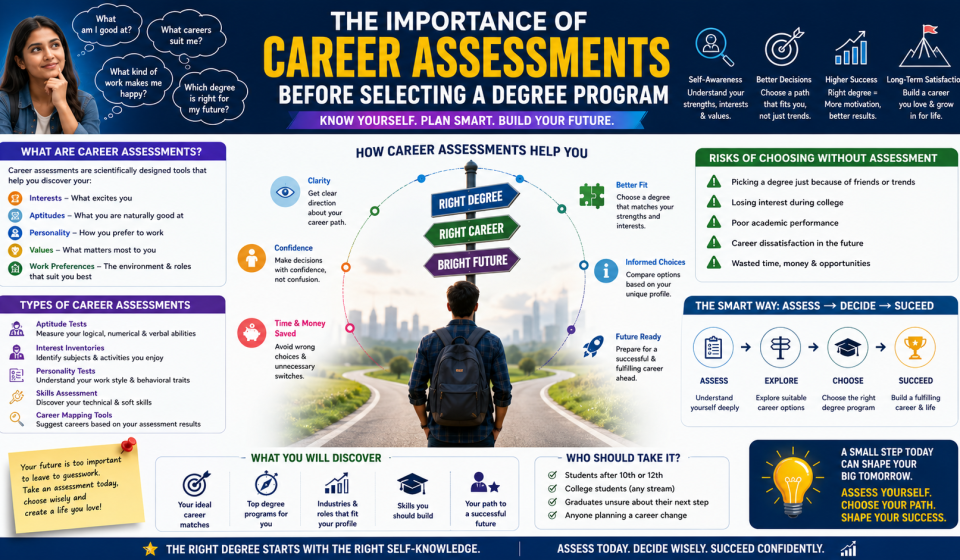
Career assessments are structured tools designed to evaluate various aspects of an individual’s personality, interests, abilities, values, and work preferences. These assessments provide personalized insights that help students identify careers and educational pathways that align with their unique characteristics.
Career assessments may include:
- Personality tests.
- Interest inventories.
- Aptitude assessments.
- Skills evaluations.
- Values assessments.
- Career readiness surveys.
The purpose of these assessments is not to dictate a student’s future but to provide guidance and clarity during the decision-making process.
Why Degree Selection Matters More Than Ever
The modern workforce is changing rapidly due to technological advancements, automation, artificial intelligence, globalization, and evolving industry demands. New career opportunities are emerging while some traditional roles are becoming less relevant.
As a result, students face increasing pressure to choose degree programs that prepare them for future success. Selecting the wrong degree can lead to:
- Lack of motivation.
- Poor academic performance.
- Increased stress and frustration.
- Career dissatisfaction.
- Financial losses.
- Delayed professional growth.
Career assessments help minimize these risks by ensuring educational choices align with personal strengths and market opportunities.
Understanding Yourself Before Choosing a Degree
One of the greatest benefits of career assessments is self-discovery. Many students have limited awareness of their natural talents, preferences, and potential career paths.
Career assessments help answer important questions such as:
- What subjects do I genuinely enjoy?
- What are my strongest skills?
- What motivates me?
- What type of work environment suits me best?
- What careers align with my personality?
By gaining a deeper understanding of themselves, students can make educational decisions with greater confidence and purpose.
Identifying Personal Strengths and Weaknesses
Every student possesses unique strengths and areas for improvement. Career assessments provide objective insights into these characteristics.
For example:
- Analytical thinkers may excel in engineering, technology, finance, or data science.
- Creative individuals may thrive in design, media, marketing, or the arts.
- Strong communicators may succeed in education, law, public relations, or management.
- Empathetic individuals may find fulfillment in healthcare, counseling, or social work.
Understanding personal strengths allows students to choose degree programs that maximize their potential while identifying areas where additional development may be needed.
Matching Interests with Academic Programs
Students often choose degrees based on perceived prestige or earning potential rather than genuine interest. While financial considerations are important, long-term success typically depends on sustained engagement and motivation.
Career assessments help students identify fields that align with their interests.
For example:
- Students interested in technology may explore computer science or cybersecurity.
- Those fascinated by human behavior may consider psychology or sociology.
- Individuals passionate about business may pursue management, finance, or entrepreneurship.
- Creative students may explore graphic design, animation, or communications.
When students enjoy what they study, they are more likely to remain motivated and achieve academic success.
Reducing the Risk of Choosing the Wrong Degree
Many students switch majors or degree programs after realizing their initial choice was not a good fit. This can lead to additional tuition costs, extended graduation timelines, and unnecessary stress.
Career assessments reduce this risk by helping students evaluate their options before making commitments.
Benefits include:
- Improved decision-making.
- Reduced uncertainty.
- Greater academic confidence.
- Increased degree completion rates.
- Better career alignment.
Making informed choices early can save both time and money while supporting long-term success.
Aligning Education with Career Goals
A degree should serve as a stepping stone toward future career aspirations. Career assessments help students connect academic choices with professional objectives.
For example:
- Students interested in healthcare careers can identify the educational pathways required for nursing, medicine, public health, or healthcare administration.
- Aspiring engineers can explore specialized engineering disciplines.
- Future entrepreneurs can identify business and innovation-focused programs.
Career assessments create a roadmap that links educational decisions to desired career outcomes.
Understanding Work Environment Preferences
Success in a career often depends on more than technical skills. Personality and workplace preferences play a significant role in job satisfaction.
Career assessments help students understand whether they prefer:
- Team-based or independent work.
- Structured or flexible environments.
- Leadership or support roles.
- Indoor or outdoor work settings.
- Analytical or creative tasks.
This information helps students choose degree programs that lead to careers compatible with their preferred working styles.
Improving Academic Performance
Students who choose degree programs aligned with their interests and abilities are generally more engaged in their studies.
Benefits include:
- Higher grades.
- Increased classroom participation.
- Greater motivation.
- Stronger problem-solving skills.
- Improved retention rates.
Career assessments contribute to academic success by helping students pursue fields that genuinely match their capabilities.
Supporting Mental and Emotional Well-Being
Educational dissatisfaction can negatively impact mental health and overall well-being. Students who feel disconnected from their studies often experience stress, anxiety, and reduced motivation.
Career assessments provide clarity and direction, helping students feel more confident about their choices. This increased confidence contributes to:
- Reduced stress.
- Better focus.
- Increased self-esteem.
- Improved academic satisfaction.
Students who understand their goals are more likely to remain engaged and resilient throughout their educational journey.
Identifying Emerging Career Opportunities
The future workforce will look significantly different from today’s job market. New industries and occupations continue to emerge due to technological innovation and economic transformation.
Career assessments often incorporate labor market insights that help students explore high-growth fields such as:
- Artificial Intelligence.
- Data Science.
- Cybersecurity.
- Renewable Energy.
- Healthcare Technology.
- Digital Marketing.
- Cloud Computing.
- Robotics Engineering.
This future-focused guidance helps students select degree programs that remain relevant and valuable in changing economic conditions.
Enhancing Career Readiness
Employers increasingly seek graduates who possess both technical knowledge and transferable skills. Career assessments help students identify competencies they need to develop during their education.
These may include:
- Communication skills.
- Leadership abilities.
- Problem-solving capabilities.
- Teamwork.
- Adaptability.
- Critical thinking.
Students can then choose degree programs and extracurricular activities that support comprehensive professional development.
The Role of Technology in Modern Career Assessments
Advancements in technology have significantly improved the accuracy and accessibility of career assessments.
Modern platforms use:
- Artificial Intelligence.
- Machine Learning.
- Data Analytics.
- Behavioral Assessments.
- Predictive Modeling.
These technologies provide highly personalized recommendations based on extensive data analysis, helping students make smarter educational decisions.
Career Assessments and Lifelong Learning
Career planning is no longer a one-time decision. Professionals increasingly need to update their skills and adapt to changing industry requirements throughout their careers.
Career assessments encourage a mindset of continuous growth and lifelong learning. Students learn to evaluate opportunities, assess their strengths, and adapt to evolving circumstances.
This adaptability is essential for long-term success in today’s dynamic workforce.
Common Misconceptions About Career Assessments
Despite their benefits, some students misunderstand the purpose of career assessments.
Common misconceptions include:
- Assessments determine your future.
- Results are always fixed and permanent.
- Only struggling students need career assessments.
- Assessments limit career options.
In reality, career assessments serve as guidance tools that support exploration and informed decision-making rather than restricting opportunities.
Making the Most of Career Assessment Results
To maximize the value of career assessments, students should:
- Approach assessments honestly.
- Reflect carefully on results.
- Discuss findings with counselors.
- Research recommended careers.
- Explore related academic programs.
- Remain open to new possibilities.
Combining assessment insights with personal reflection and professional guidance leads to more effective decision-making.
Source
https://www.careeronestop.org
https://www.collegeboard.org
https://www.oecd.org
https://www.weforum.org
Conclusion
Career assessments are valuable tools that help students make informed decisions before selecting a degree program. By evaluating personality traits, interests, strengths, values, and career aspirations, these assessments provide personalized guidance that supports academic success and professional fulfillment. In an increasingly competitive and rapidly changing job market, understanding oneself is just as important as understanding educational opportunities. Students who utilize career assessments before choosing a degree are better equipped to align their education with their goals, reduce uncertainty, and build a strong foundation for future success. Investing time in self-discovery today can lead to more rewarding educational experiences and meaningful careers tomorrow.
FAQ
What is a career assessment?
A career assessment is a tool that evaluates a student’s interests, personality, skills, values, and strengths to help identify suitable career paths and educational programs.
Why should students take career assessments before choosing a degree?
Career assessments help students understand their strengths and interests, making it easier to select degree programs that align with long-term career goals.
Can career assessments predict future success?
Career assessments do not predict success but provide valuable insights that support informed decision-making and career planning.
Are career assessments accurate?
Most professionally developed career assessments provide reliable guidance when completed honestly and interpreted correctly.
How do career assessments help with degree selection?
They identify academic fields and career options that match a student’s abilities, interests, and work preferences.
Can career assessments reduce the risk of changing majors?
Yes. Students who understand their strengths and goals before selecting a degree are less likely to switch programs later.
Do employers value career assessments?
Employers value self-awareness, career planning, and skill development, all of which can be supported through career assessments.
Are career assessments useful for all students?
Yes. Career assessments can benefit students at various educational levels by providing clarity, direction, and confidence in academic and career decision-making.