
Learn what an academic calendar is, why students should check it regularly, and how important dates for admissions, classes, exams, assignments, holidays, registration, and results can help students stay organized.
An academic calendar is one of the most important documents students should check at the beginning of every academic year or semester. It provides a structured schedule of important academic activities and helps students understand when classes begin, when examinations are expected, when registration takes place, and when important academic deadlines occur. Although students may receive information about individual events through notices, emails, or college announcements, the academic calendar provides a broader picture of the academic year.
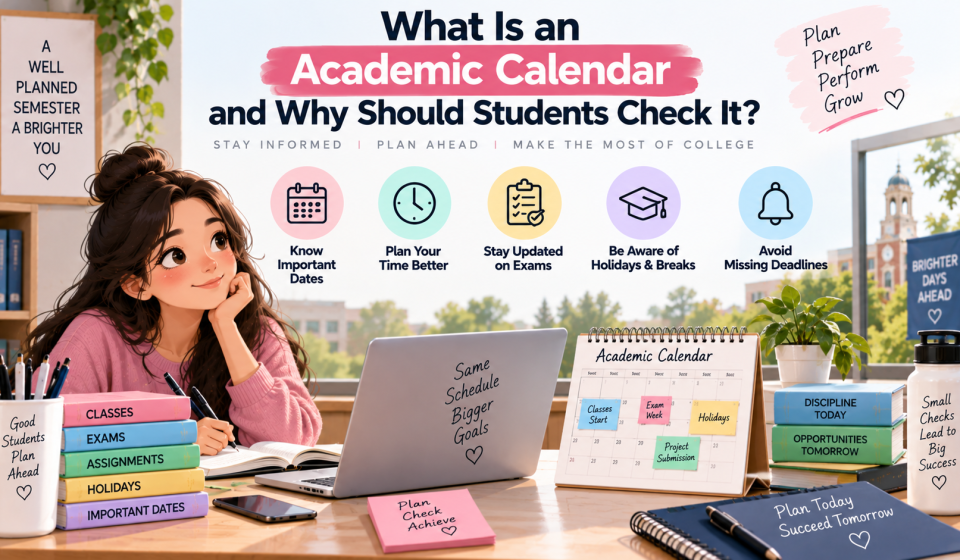
Many students focus mainly on their class timetable and examination dates, but an academic calendar contains much more information. Depending on the institution, it may include admission dates, semester commencement, teaching periods, holidays, assignment deadlines, internal assessments, examinations, result announcements, registration periods, vacations, and other academic activities. Checking the calendar regularly can help students plan their studies, avoid missed deadlines, and manage academic responsibilities more effectively.
What Is an Academic Calendar?
An academic calendar is an official schedule that outlines important dates and activities for an educational institution during an academic year or semester.
Universities and colleges use academic calendars to organize academic activities in a systematic way. The exact format varies from one institution to another, but most calendars provide students with important information about the academic cycle.
An academic calendar may include:
- Admission dates
- Orientation programmes
- Semester start dates
- Teaching periods
- Examination periods
- Internal assessment dates
- Assignment deadlines
- Registration deadlines
- Holidays
- Vacation periods
- Result announcements
- Re-registration dates
- Academic events
- Semester-end activities
The UGC maintains guidelines and regulatory resources related to higher education, while individual universities and colleges publish their own calendars according to their academic structure and applicable requirements.
Why Is an Academic Calendar Important?
An academic calendar gives students a clear overview of the academic year.
Instead of finding out about important dates at the last minute, students can use the calendar to plan ahead.
For example, if examinations are scheduled at the end of a semester, students can create a study plan several weeks in advance. If registration closes on a specific date, students can complete the required process before the deadline.
The calendar therefore acts as a planning tool that connects different academic responsibilities.
Helps Students Know When Classes Begin
One of the first things students should check is the semester commencement date.
Knowing when classes begin helps students prepare their schedules, arrange transportation or accommodation, purchase required study materials, and organize their personal commitments.
For new students, the calendar may also include orientation or induction dates.
Missing the beginning of a semester can sometimes mean missing important academic instructions, introductory lectures, registration activities, or course information.
Helps Students Track Examination Dates
Examinations are among the most important dates on an academic calendar.
Students can use the calendar to identify expected examination periods and start preparing early.
Rather than waiting for a detailed examination timetable, students can understand approximately when examinations will occur and plan their study schedule accordingly.
However, students should remember that an academic calendar may provide a general examination period rather than the exact date and time of every individual subject.
The detailed examination timetable issued by the university or college should always be checked separately.
Helps With Assignment and Project Planning
Academic calendars can help students plan assignments, projects, presentations, and other academic work.
When students know important academic periods in advance, they can divide larger projects into smaller tasks.
For example, a student can:
- Select a topic.
- Conduct research.
- Prepare notes.
- Create a first draft.
- Review the work.
- Complete the final submission.
Planning early can reduce last-minute pressure and improve the quality of academic work.
Helps Students Manage Registration Deadlines
Registration is another important area where students should pay attention to the academic calendar.
Depending on the institution, students may need to complete semester registration, course registration, examination registration, re-registration, or other academic processes.
Missing a registration deadline can create unnecessary problems.
Students should therefore check whether registration must be completed online, through the college office, through a university portal, or through another system.
They should also check whether late registration is permitted and whether additional charges or approvals apply.
Helps Students Plan Holidays and Breaks
Academic calendars usually provide information about holidays, vacations, and academic breaks.
Students can use this information to plan personal activities, family visits, travel, internships, or other commitments.
However, students should also check whether their programme has special schedules.
Professional courses, practical programmes, internships, clinical training, research programmes, and other academic activities may follow schedules that differ from a general institutional calendar.
Helps Students Understand the Academic Year
An academic calendar provides students with a broader understanding of how the academic year is organized.
For example, a semester-based programme may divide the year into teaching periods, examination periods, and breaks.
The UGC Distance Education Bureau’s academic-year planners demonstrate how activities such as admissions, study periods, assignments, examinations, results, and re-registration can be organized across an academic cycle.
Understanding this structure helps students manage their time more effectively.
Academic Calendar vs Class Timetable
Students sometimes confuse an academic calendar with a class timetable.
They are not the same.
A class timetable tells students when individual classes take place.
For example:
- Monday: Mathematics at 10:00 AM
- Tuesday: Programming at 11:00 AM
- Wednesday: Database Management at 9:00 AM
An academic calendar provides a much broader schedule.
It may tell students:
- When the semester begins
- When examinations take place
- When holidays occur
- When registration opens
- When results are expected
- When the semester ends
Both documents are important, but they serve different purposes.
Academic Calendar vs Examination Timetable
An academic calendar should also not be confused with an examination timetable.
An academic calendar may indicate the examination period, such as a particular month or range of dates.
An examination timetable normally provides the exact details for individual subjects, including dates, times, and sometimes examination locations.
Students should therefore use the academic calendar for long-term planning and the final examination timetable for detailed examination preparation.
Why Students Should Check the Calendar Regularly
Checking the academic calendar only once may not be enough.
Universities and colleges can issue revised schedules, updated notices, or additional instructions.
Students should therefore regularly check official communication channels.
Useful sources may include:
- College website
- University website
- Student portal
- Official email
- Department notices
- Examination portal
- Academic office announcements
- Official student communication platforms
Students should always prioritize the latest official announcement when a date changes.
Academic Calendars Can Change
An academic calendar is a planning document, but students should understand that dates can sometimes change.
Changes may happen because of administrative decisions, examinations, public events, emergencies, holidays, or other institutional circumstances.
For this reason, students should not rely on an old screenshot or outdated calendar.
Whenever possible, students should download or bookmark the latest official version published by their institution.
How Academic Calendars Help With Time Management
Time management becomes easier when students know what is coming next.
Suppose a student knows that examinations are scheduled several weeks away. They can divide their study workload across those weeks instead of studying everything at the last minute.
Similarly, if an assignment deadline is approaching, students can reserve time for research, writing, editing, and submission.
An academic calendar can therefore become the foundation for a personal study planner.
How to Create a Personal Academic Planner
Students can make their academic calendar more useful by creating a personal planner.
Start by copying all important dates from the official calendar.
Then add:
- Assignment deadlines
- Presentation dates
- Internal tests
- Project milestones
- Personal study targets
- Application deadlines
- Internship deadlines
- Scholarship deadlines
- Examination preparation dates
Students can use a notebook, digital calendar, spreadsheet, or productivity application.
The goal is to transform institutional dates into a practical personal schedule.
Important Dates First-Year Students Should Check
First-year students should pay particular attention to the academic calendar because they may be unfamiliar with university procedures.
Important dates may include:
- Orientation
- Admission confirmation
- Document verification
- Semester commencement
- Course registration
- Student ID collection
- Library registration
- Internal assessments
- Examinations
- Holidays
- Results
- Next-semester registration
New students should also learn where official announcements are published.
How Academic Calendars Help With Internships
Students often need to balance academic responsibilities with internships.
An academic calendar can help them understand when they are likely to have classes, examinations, holidays, or semester breaks.
This information can be useful when planning internship applications and discussing availability with organizations.
However, students should always follow the attendance, academic, and internship rules applicable to their programme.
How Academic Calendars Help With Projects
Final-year students often work on long-term projects.
An academic calendar can help them divide project work into stages.
For example:
Stage 1: Topic selection
Stage 2: Research
Stage 3: Proposal preparation
Stage 4: Development or experimentation
Stage 5: Testing and documentation
Stage 6: Presentation
Stage 7: Final submission
Planning project activities around academic deadlines can make the overall process more manageable.
What Happens If Students Ignore the Academic Calendar?
Ignoring the academic calendar can create several avoidable problems.
Students may miss registration deadlines, submit assignments late, overlook examination periods, fail to prepare for important academic activities, or make travel plans during required academic sessions.
Not every missed deadline has the same consequences, but students should not assume that late submissions or late registrations will always be accepted.
The safest approach is to know important dates in advance and confirm requirements through official institutional notices.
How Parents Can Use the Academic Calendar
Parents can also benefit from understanding the academic calendar.
Knowing semester dates, examination periods, and major academic breaks can help families plan travel, accommodation, finances, and other responsibilities.
For students living away from home, the calendar can also help families understand when students may have vacations or examination commitments.
What Students Should Do When Dates Conflict
Sometimes students may notice conflicting dates between different notices.
For example, an old academic calendar may show one examination period while a newer examination notice shows another.
In such cases, students should not rely on assumptions.
They should check the date of publication and follow the latest official communication from the university or college.
If the situation remains unclear, students should contact the academic office, examination department, or relevant department.
Best Practices for Using an Academic Calendar
Students can follow a few simple habits to make better use of their academic calendar.
First, save the official calendar as soon as it is published.
Second, mark all important dates in a personal calendar.
Third, set reminders before major deadlines.
Fourth, check the official website regularly for updates.
Fifth, keep separate records for assignments, examinations, registration, and personal commitments.
Finally, verify important dates before making travel or other long-term plans.
Why Academic Calendar Awareness Is an Academic Skill
Knowing how to use an academic calendar is part of becoming an independent student.
College education often requires students to take greater responsibility for their schedules, deadlines, registrations, assignments, and examinations.
Unlike school, students may not always receive individual reminders for every academic responsibility.
Learning to monitor official schedules can therefore improve organization, independence, time management, and academic responsibility.
Source
UGC – Guidelines and Academic Calendar Resources
UGC – Regulations and Higher Education Framework
UGC Distance Education Bureau – Academic Year Planner
UGC – Official Higher Education Portal
Conclusion
An academic calendar is an essential planning tool that helps students understand the structure and important dates of their academic year. It can provide information about semester commencement, examinations, registration, assignments, holidays, results, and other academic activities.
Students should not treat the academic calendar as a document that needs to be checked only at the beginning of the semester. Regularly reviewing the latest official calendar and related university notices can help students avoid missed deadlines and prepare for important academic responsibilities.
The best approach is to save the official calendar, transfer important dates into a personal planner, set reminders, and check for updates regularly. By developing this simple habit, students can improve time management, reduce last-minute stress, and take greater responsibility for their academic journey.
FAQ
1. What is an academic calendar?
An academic calendar is an official schedule that lists important academic dates and activities for a university or college during an academic year or semester.
2. Why should students check the academic calendar?
Students should check it to keep track of important dates such as semester start dates, examinations, registration, holidays, assignments, results, and other academic activities.
3. Is an academic calendar the same as a class timetable?
No. A class timetable provides the schedule for individual classes, while an academic calendar provides a broader schedule for the academic year or semester.
4. Does an academic calendar include examination dates?
It may provide the examination period or expected examination schedule. Students should check the official examination timetable for the exact subject-wise dates and times.
5. Can an academic calendar change?
Yes. Universities and colleges may revise dates because of administrative decisions, holidays, examinations, emergencies, or other circumstances. Students should always check the latest official announcement.
6. Where can students find their academic calendar?
Students can usually find it on the official university or college website, student portal, academic office, department website, or official communication channels.
7. How can an academic calendar improve time management?
It allows students to see important deadlines and academic events in advance, making it easier to create study plans, prepare for examinations, complete assignments, and manage personal commitments.
8. Should first-year students check the academic calendar?
Yes. First-year students should check it carefully because it can help them understand orientation, registration, semester dates, examinations, holidays, and other important academic procedures.
9. How often should students check the academic calendar?
Students should check it regularly, especially before examinations, registration periods, assignment deadlines, holidays, and other important academic events.
10. What should students do if two official dates are different?
Students should check which notice is more recent and confirm the correct date with the relevant university or college department if necessary.