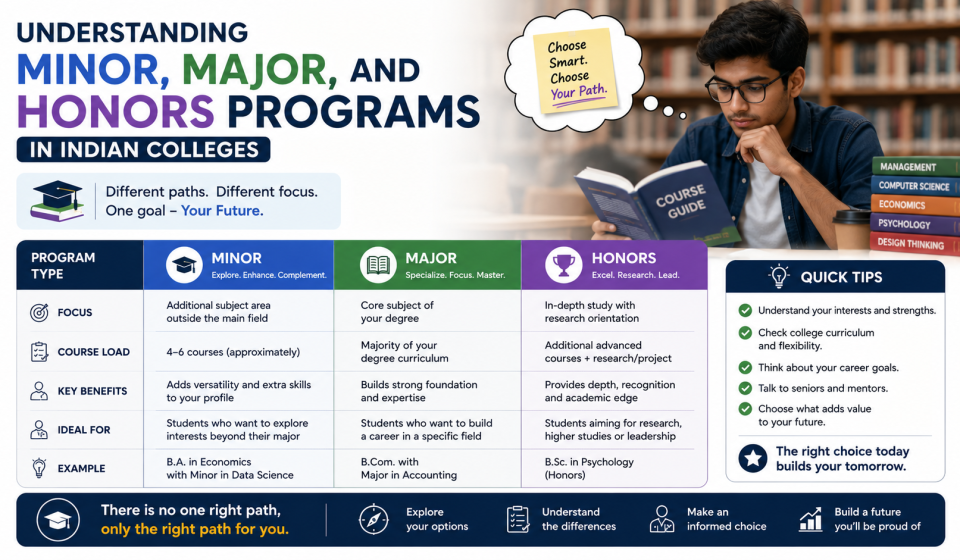
Understanding Minor, Major, and Honors Programs in Indian Colleges: A Complete Guide for Students Choosing the Right Academic Path

Choosing the right college and academic program is one of the most important decisions students make after completing school. With the implementation of the National Education Policy (NEP) 2020, higher education in India has become more flexible, multidisciplinary.
However, many students and parents remain confused about what these terms actually mean. Questions like “What is a Major?”, “How is a Minor different from a Major?”, “Should I choose an Honors program?”, and “Which option is best for my career?” are becoming increasingly common during the college admission process.
What Are Major, Minor, and Honors Programs?
Under the flexible education system introduced in many Indian universities, students can personalize their academic journey by selecting a primary specialization (Major), an additional area of study (Minor), and in some cases, pursuing an Honors program for advanced learning.
These options encourage multidisciplinary education and help students gain both depth and breadth of knowledge.
What Is a Major Program?
A Major is the primary subject or specialization in your degree program. It is the area in which you complete the highest number of credits and develop in-depth knowledge.
For example:
- B.Sc. Major in Computer Science
- B.Com Major in Accounting
- B.A. Major in Economics
- B.Tech Major in Mechanical Engineering
- BBA Major in Finance
Your Major largely determines your academic expertise and forms the foundation for future employment or postgraduate studies.
Benefits of Choosing a Major
A Major program offers several advantages:
- In-depth subject knowledge
- Strong foundation for higher education
- Better career specialization
- Industry-relevant expertise
- Greater research opportunities
- Improved employability
Employers generally evaluate candidates based on the skills developed through their major specialization.
What Is a Minor Program?
A Minor is a secondary field of study that complements your Major. It requires fewer credits and allows students to develop additional skills outside their primary discipline.
Examples include:
- Computer Science Major with Mathematics Minor
- Economics Major with Data Science Minor
- Commerce Major with Digital Marketing Minor
- Psychology Major with Sociology Minor
- Biology Major with Biotechnology Minor
A Minor broadens your knowledge and makes your academic profile more versatile.
Benefits of Choosing a Minor
Adding a Minor to your degree can help you:
- Learn interdisciplinary skills
- Increase career flexibility
- Explore personal interests
- Improve problem-solving abilities
- Build a diverse professional profile
- Prepare for emerging job markets
A well-chosen Minor can complement your Major and enhance your career opportunities.
What Is an Honors Program?
An Honors program is an advanced version of a regular degree that includes more specialized coursework, higher academic standards, research projects, dissertations, or advanced electives.
Students pursuing Honors programs usually complete additional academic requirements beyond the standard curriculum.
Examples include:
- B.A. (Hons.) English
- B.Sc. (Hons.) Physics
- B.Com (Hons.)
- B.A. (Hons.) Political Science
Honors programs are designed for students who wish to gain deeper expertise in their chosen field.
Advantages of an Honors Degree
Honors programs provide:
- Advanced subject knowledge
- Greater research exposure
- Higher academic rigor
- Better preparation for postgraduate education
- Improved competitiveness for scholarships
- Enhanced career opportunities
Many universities and employers recognize Honors graduates for their advanced academic preparation.
Major vs Minor vs Honors
Understanding the differences helps students make informed choices.
Major
- Primary specialization
- Highest number of credits
- Core focus of the degree
- Essential for graduation
Minor
- Secondary specialization
- Fewer credits
- Complements the Major
- Adds interdisciplinary skills
Honors
- Advanced version of a Major
- Additional coursework and research
- Higher academic expectations
- Greater specialization
Each option serves a different purpose within a student’s academic journey.
Role of the National Education Policy (NEP) 2020
The National Education Policy has transformed higher education by encouraging flexibility and multidisciplinary learning.
Key features include:
- Multiple entry and exit options
- Choice-based credit system
- Interdisciplinary education
- Academic flexibility
- Skill-based learning
- Research opportunities
- Credit transfer mechanisms
Students can now personalize their education more effectively than before.
How to Choose the Right Major
When selecting a Major, consider:
- Personal interests
- Career goals
- Subject strengths
- Industry demand
- Higher education plans
- Future earning potential
Choosing a Major simply because it is popular may not lead to long-term satisfaction.
How to Select the Best Minor
A Minor should complement your Major while expanding your skill set.
Examples include:
- Finance + Data Analytics
- Computer Science + Artificial Intelligence
- Economics + Statistics
- Biology + Public Health
- English + Journalism
Combining complementary disciplines creates broader career opportunities.
Who Should Choose an Honors Program?
Honors programs are suitable for students who:
- Enjoy academic challenges
- Plan to pursue master’s or doctoral degrees
- Are interested in research
- Want advanced specialization
- Maintain strong academic performance
Students seeking deeper subject expertise often benefit most from Honors education.
Career Benefits of Major, Minor, and Honors Programs
Employers increasingly appreciate graduates with interdisciplinary knowledge.
Benefits include:
- Strong technical expertise
- Better adaptability
- Improved analytical thinking
- Diverse skill sets
- Enhanced leadership potential
- Greater employability
A balanced academic profile prepares students for rapidly changing industries.
Popular Major and Minor Combinations
Some highly valuable combinations include:
- Computer Science + Mathematics
- Economics + Data Science
- Commerce + Finance
- Psychology + Human Resource Management
- Biotechnology + Chemistry
- Political Science + International Relations
- English + Mass Communication
- Business Administration + Entrepreneurship
These combinations support both traditional and emerging career paths.
Common Mistakes Students Should Avoid
Avoid these common errors:
- Choosing a Major based solely on peer pressure
- Ignoring long-term career goals
- Selecting a Minor unrelated to career interests
- Assuming Honors is mandatory for success
- Failing to research curriculum details
- Ignoring industry demand
Careful planning leads to better academic outcomes.
Tips for Making the Right Choice
To choose wisely:
- Assess your interests and strengths.
- Research career opportunities.
- Compare college curricula.
- Consult academic advisors.
- Understand credit requirements.
- Explore internship opportunities.
- Review postgraduate eligibility.
- Think about long-term career goals.
An informed decision today can shape your future success.
Source
https://www.ugc.gov.in
https://www.education.gov.in
https://www.aicte-india.org
https://www.nad.gov.in
https://www.studyinindia.gov.in
Conclusion
Major, Minor, and Honors programs have transformed higher education in India by giving students greater flexibility to design an education that matches their interests and career aspirations. A Major provides specialized knowledge in your primary field, a Minor broadens your expertise through interdisciplinary learning, and an Honors program offers advanced academic depth and research opportunities. Understanding the differences between these options helps students make informed academic decisions that support higher education, skill development, and long-term career success. By carefully evaluating your interests, strengths, and professional goals, you can create a meaningful educational journey that prepares you for the evolving demands of the modern workforce.
FAQ
1. What is the difference between a Major and a Minor in Indian colleges?
A Major is your primary field of study with the highest number of academic credits, while a Minor is a secondary specialization that requires fewer credits and complements your Major.
2. What is an Honors program?
An Honors program is an advanced version of a degree that includes additional coursework, specialized subjects, research projects, or dissertations to provide deeper knowledge in a particular discipline.
3. Is choosing a Minor compulsory?
No. Whether a Minor is compulsory depends on the university and its curriculum. Many institutions offer it as an optional choice under flexible education systems.
4. Does an Honors degree improve job opportunities?
An Honors degree can strengthen your academic profile by demonstrating advanced subject knowledge, research skills, and specialization, which may benefit both employment and higher education opportunities.
5. Can I choose a Minor that is different from my Major?
Yes. Many universities encourage interdisciplinary learning, allowing students to combine different fields such as Computer Science with Mathematics or Economics with Data Science.
6. Which is better: a regular degree or an Honors degree?
It depends on your career goals. Students interested in research, postgraduate studies, or advanced specialization may benefit more from an Honors program, while a regular degree may be suitable for many professional careers.
7. How do I choose the right Major?
Select a Major based on your interests, strengths, career aspirations, industry demand, and future educational plans rather than following trends or peer influence.
8. How has the National Education Policy (NEP) 2020 changed higher education?
NEP 2020 has introduced greater flexibility through multidisciplinary education, choice-based credit systems, multiple entry and exit options, skill-focused learning, and opportunities to combine Major, Minor, and Honors programs.