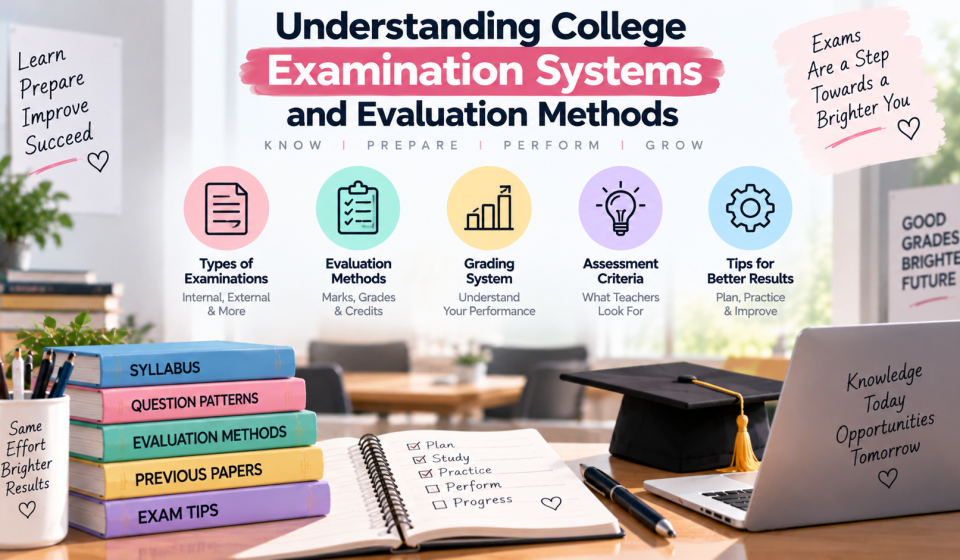
Understanding College Examination Systems and Evaluation Methods: A Complete Guide for Students

Understand college examination systems and evaluation methods, including internal assessment, semester exams, practicals, projects, grading, marks, continuous assessment, and result evaluation.
College examinations are an important part of higher education, but the examination system at college can be quite different from what students experience in school. Instead of depending entirely on one final examination, many higher education programmes use a combination of internal assessment, assignments, presentations, practical work, projects, class performance, and semester-end examinations. The exact system depends on the university, programme, course structure, and applicable academic regulations.
Understanding how college examinations and evaluation methods work can help students prepare more effectively and avoid confusion about marks, grades, internal assessments, practical examinations, and final results. Students should always check their own university’s syllabus, academic regulations, examination notifications, and course documents because the weightage and evaluation process can differ between institutions.
What Is a College Examination System?
A college examination system is the organized process used by a higher education institution to assess students’ academic performance.
The system may evaluate different aspects of learning, including:
- Knowledge of the subject
- Understanding of concepts
- Problem-solving ability
- Analytical thinking
- Practical skills
- Communication
- Application of theory
- Research ability
- Project work
- Continuous academic performance
The University Grants Commission has guidance stating that evaluation can include different units such as tests, seminars, presentations, class performance, fieldwork, and thesis or project work, depending on the programme and course structure. The relevant academic body determines the applicable weightage and should communicate the evaluation system to students.
Why Do Colleges Use Different Evaluation Methods?
A single examination may not fully measure everything a student learns during a semester.
For example, a written examination can test conceptual understanding and analytical ability, but it may not adequately measure laboratory skills, presentation ability, teamwork, research skills, or practical application.
For this reason, colleges may combine different evaluation methods.
This approach can give teachers a broader understanding of a student’s academic performance.
Internal Assessment
Internal assessment is evaluation conducted during the academic term or semester rather than only at the end.
Depending on the programme, internal assessment may include:
- Unit tests
- Assignments
- Class tests
- Presentations
- Seminars
- Quizzes
- Case studies
- Group discussions
- Class participation
- Projects
- Practical records
- Attendance-related academic requirements where applicable
The exact components and their weightage vary between institutions.
For example, the University of Allahabad’s published student evaluation guidance describes an examination structure involving internal assessment and semester-end examination, with internal assessment including activities such as assignments, seminars, case studies, quizzes, and unit tests.
Semester-End Examination
The semester-end examination is generally conducted after the teaching period for a semester has been completed.
It may be written, practical, oral, or a combination depending on the course.
A theory examination may test:
- Conceptual understanding
- Definitions
- Problem solving
- Application of theories
- Analytical reasoning
- Interpretation
- Subject knowledge
The UGC guidance emphasizes that examinations should assess more than simple memorization and can include questions requiring understanding, synthesis, analysis, application, and original thinking.
Students should therefore prepare not only by memorizing notes but also by understanding how concepts can be applied.
Continuous Assessment
Continuous assessment means that student performance is evaluated at different points throughout the academic period.
Instead of placing all emphasis on a single examination, students may receive marks for multiple academic activities.
This can include assignments, tests, presentations, practical work, and other course-related activities.
Continuous assessment encourages students to remain academically engaged throughout the semester.
It also gives students opportunities to demonstrate learning in different ways.
Formative and Summative Assessment
Two common terms students may encounter are formative assessment and summative assessment.
Formative Assessment
Formative assessment takes place during the learning process.
Its purpose is generally to monitor learning progress and provide opportunities for improvement.
Examples include:
- Quizzes
- Assignments
- Class tests
- Draft submissions
- Presentations
- Practice activities
- Classroom discussions
Summative Assessment
Summative assessment generally takes place toward the end of a learning period.
It is used to evaluate overall achievement after a course or academic period.
Examples include:
- Semester-end examinations
- Final projects
- Final practical examinations
- Term-end examinations
Some UGC regulations, particularly in distance and online education frameworks, explicitly distinguish continuous or formative assessment from summative end-semester or term-end assessment.
Practical Examinations
Practical examinations are particularly important in programmes where students must demonstrate hands-on skills.
They may be used in subjects such as:
- Engineering
- Computer science
- Medicine
- Nursing
- Pharmacy
- Science
- Design
- Hospitality
- Fine arts
- Laboratory-based subjects
A practical examination may involve performing an experiment, developing an application, analyzing a sample, demonstrating a technical procedure, or completing a practical task.
The evaluation may consider accuracy, procedure, technical knowledge, documentation, performance, and viva-voce responses.
Project Evaluation
Projects are another important method of evaluation in higher education.
A project can allow students to demonstrate how they apply classroom knowledge to a practical or research-oriented problem.
Project evaluation may consider:
- Topic selection
- Research
- Methodology
- Planning
- Implementation
- Documentation
- Results
- Presentation
- Viva-voce
- Problem-solving
- Originality
For example, an engineering student may be evaluated on both the development of a software project and the student’s ability to explain the design, methodology, implementation, testing, and results.
Assignment-Based Evaluation
Assignments allow students to explore topics beyond what can be covered during classroom sessions.
An assignment may require students to:
- Research a topic
- Analyze a case
- Solve problems
- Write an academic report
- Review literature
- Prepare a presentation
- Compare theories
- Develop a practical solution
Assignments can also help students improve research, writing, analytical, and communication skills.
Students should always follow the submission format, deadline, citation requirements, and instructions provided by their institution.
Presentation and Seminar Evaluation
Presentations and seminars can also form part of college evaluation.
These activities allow students to demonstrate:
- Communication skills
- Subject knowledge
- Organization
- Confidence
- Visual presentation
- Research ability
- Ability to answer questions
A student may know a subject well but still need to improve the ability to communicate that knowledge clearly.
Presentation-based evaluation can therefore assess a different set of skills from a traditional written examination.
Viva-Voce Examination
A viva-voce is an oral examination in which students answer questions from an examiner or panel.
Viva examinations are commonly associated with practical courses, projects, dissertations, research work, and professional programmes.
Questions may focus on:
- Basic concepts
- Methodology
- Practical work
- Project decisions
- Results
- Applications
- Limitations
- Future improvements
The purpose is generally to determine whether students understand the work they have completed rather than simply reproducing written material.
Grading Systems
Many colleges use marks, grades, grade points, or a combination of these systems.
In a marks-based system, students receive numerical scores for assessments.
In a grading system, marks may be converted into grades according to the institution’s approved grading scale.
A grade-point system may then be used to calculate a semester grade point average or cumulative grade point average.
The exact grading scale differs between universities.
Students should therefore refer to their university’s official regulations instead of assuming that the same grade boundaries apply everywhere.
SGPA and CGPA
Students in credit-based programmes may encounter the terms SGPA and CGPA.
SGPA generally refers to Semester Grade Point Average. It represents academic performance for a particular semester.
CGPA generally refers to Cumulative Grade Point Average. It represents cumulative performance across multiple semesters according to the institution’s prescribed calculation method.
The calculation normally considers course credits and grade points.
Because universities may use different grading scales and calculation rules, students should check their official academic regulations for the exact method.
Internal Marks and Final Examination Marks
The final result of a course may be based on more than the semester-end examination.
For example, one institution may use a combination of internal assessment and final examination, while another programme may have a different structure.
A published Guru Ghasidas Vishwavidyalaya regulation, for example, describes evaluation through continuous internal assessment and end-semester examinations and specifies a particular weightage for its programme.
This is an important point: students should never assume that one fixed internal-to-external ratio applies to every college or programme.
Always check the official syllabus or examination regulations for your course.
How Question Papers Are Designed
Question papers are generally prepared according to the prescribed syllabus and examination framework.
A well-designed examination may include different levels of questions.
These can include:
- Recall-based questions
- Conceptual questions
- Analytical questions
- Application-based questions
- Problem-solving questions
- Case-based questions
- Long-answer questions
- Short-answer questions
UGC guidance states that examination questions should cover the relevant syllabus and should assess understanding and the ability to synthesize and apply knowledge, rather than focusing only on memorization.
Evaluation of Answer Scripts
After an examination, answer scripts are evaluated according to the applicable university or institutional process.
Depending on the examination system, evaluation may involve internal examiners, external examiners, moderation, scrutiny, tabulation, or other quality-control procedures.
The specific process differs between universities.
Students should therefore refer to their institution’s examination regulations if they want to understand the exact evaluation procedure.
Moderation and Quality Control
Some universities use moderation processes to maintain consistency and fairness in examination assessment.
Moderation can involve reviewing question papers, checking evaluation standards, or ensuring consistency between different evaluators.
The exact process depends on the university’s examination regulations.
The broader purpose is to support reliable and consistent academic evaluation.
Revaluation and Rechecking
Students may sometimes believe that their marks do not accurately reflect their performance.
Many universities provide procedures such as:
- Rechecking
- Re-totaling
- Scrutiny
- Revaluation
- Photocopy of answer script
However, the availability and rules for these services vary.
Students should check the official examination notification for the applicable deadline, fee, eligibility, and procedure.
UGC regulations also recognize transparency in the evaluation system and provide for mechanisms concerning access to answer scripts in applicable contexts and procedures.
Supplementary and Backlog Examinations
Students who do not pass a course may have opportunities to appear for another examination depending on university regulations.
Such examinations may be called supplementary, backlog, improvement, or repeat examinations.
The terminology and eligibility conditions vary.
Students should check:
- Who is eligible
- Registration deadlines
- Examination fees
- Number of attempts allowed
- Maximum duration for completing the programme
- Effect on grades or marks
Official university regulations should always be treated as the final reference.
Attendance and Examination Eligibility
Attendance can sometimes be connected to examination eligibility.
Many universities and colleges prescribe minimum attendance requirements or other conditions that students must meet before appearing for examinations.
However, the exact attendance requirement varies by institution and programme.
Students should therefore understand their college’s attendance rules from the beginning of the semester rather than waiting until examination registration.
Evaluation of Different Types of Learning
Modern higher education evaluation can involve more than theoretical knowledge.
Students may be assessed on:
- Knowledge
- Understanding
- Application
- Analysis
- Creativity
- Communication
- Practical skills
- Research
- Problem-solving
- Professional abilities
This broader approach is particularly relevant for programmes where practical or professional skills are important.
How Students Can Prepare for Different Evaluation Methods
Students should avoid preparing only for final examinations.
A better approach is to prepare continuously throughout the semester.
For written examinations, students should understand concepts and practice questions.
For assignments, they should research carefully and follow academic writing requirements.
For presentations, they should practice communication and organization.
For practical examinations, they should understand procedures and practice hands-on skills.
For projects, they should understand every part of their work because they may need to explain it during a viva.
Common Mistakes Students Make
Some common examination mistakes include:
- Studying only before the final examination
- Ignoring internal assessments
- Missing assignment deadlines
- Memorizing without understanding
- Not reading the syllabus
- Ignoring practical preparation
- Not checking examination notifications
- Failing to understand grading rules
- Waiting until the last day to register for exams
- Not checking revaluation procedures after results
Avoiding these mistakes can make the academic process easier and more manageable.
Why Students Should Understand Their Evaluation Scheme
Knowing how marks are calculated allows students to prioritize their academic efforts.
If assignments contribute to the final grade, students should take them seriously.
If practical work carries significant weightage, students should regularly practice.
If presentations or projects are included, students should prepare for them rather than focusing entirely on written examinations.
Understanding the evaluation scheme helps students make better academic decisions throughout the semester.
Role of the Academic Calendar
The academic calendar can also help students manage examinations and evaluation.
It may indicate important periods for internal assessments, examinations, project submissions, and other academic activities.
Students should combine the academic calendar with their course syllabus and examination notices.
This creates a clearer picture of what they need to complete and when.
How Examination Systems Support Learning
A well-designed examination system can do more than assign marks.
It can encourage students to understand concepts, apply knowledge, practice skills, conduct research, communicate ideas, and solve problems.
The Government of India’s examination reform documents have historically emphasized assessment as a tool for understanding student development and improving teaching and learning, including reducing excessive dependence on memorization.
The exact implementation varies across institutions, but the underlying goal is to make evaluation meaningful and connected to learning.
What Students Should Check Before Every Semester
Before starting a semester, students should check:
- Course syllabus
- Evaluation scheme
- Internal assessment structure
- Assignment requirements
- Practical requirements
- Project requirements
- Examination pattern
- Grading system
- Attendance rules
- Academic calendar
- Examination registration dates
- Important university notices
Keeping this information organized can prevent unnecessary confusion later.
Source
UGC – Examination and Evaluation Guidelines
UGC – Current Regulations and Higher Education Framework
University of Allahabad – Student Evaluation and Examination
Conclusion
Understanding college examination systems and evaluation methods is essential for students because academic performance is often assessed through several different components rather than a single final examination. Internal assessments, assignments, presentations, practical examinations, projects, viva-voce, and semester-end examinations can all contribute to evaluating student learning, depending on the programme and university.
Students should remember that there is no single evaluation pattern that applies to every college or course. The weightage given to internal assessment, semester examinations, practical work, projects, and other activities can vary. Therefore, students should always check their university’s official syllabus, academic regulations, examination notifications, and course-specific evaluation scheme.
The best way to succeed is to stay consistent throughout the semester. Understanding concepts, completing assignments on time, participating in practical activities, preparing projects carefully, and checking examination notifications regularly can help students perform better across different evaluation methods.
FAQ
1. What is a college examination system?
A college examination system is the process used by a higher education institution to assess students’ academic performance through examinations, internal assessments, assignments, practicals, projects, presentations, and other approved methods.
2. What is internal assessment?
Internal assessment is evaluation conducted during the semester. It may include tests, assignments, presentations, quizzes, seminars, projects, practical work, or other academic activities depending on the course.
3. Is the same examination pattern used in every college?
No. Examination patterns and evaluation weightages can vary between universities, colleges, programmes, and courses.
4. What is a semester-end examination?
A semester-end examination is an assessment conducted toward the end of a semester. It may be written, practical, oral, or a combination depending on the course.
5. What is continuous assessment?
Continuous assessment evaluates students at multiple points during a semester instead of relying only on one final examination.
6. What is formative assessment?
Formative assessment takes place during the learning process and can include activities such as quizzes, assignments, tests, presentations, and other classroom assessments.
7. What is summative assessment?
Summative assessment generally evaluates learning at the end of a course or academic period. A semester-end or term-end examination is a common example.
8. What is a viva-voce examination?
A viva-voce is an oral examination where students answer questions from an examiner or panel. It is commonly used for projects, practical courses, dissertations, and research work.
9. What are SGPA and CGPA?
SGPA generally represents a student’s grade-point performance for a particular semester, while CGPA represents cumulative performance across multiple semesters according to the institution’s prescribed calculation method.
10. Can students request revaluation of examination papers?
Some universities provide revaluation, rechecking, scrutiny, or answer-script access procedures. The availability, eligibility, fee, and deadline depend on the university’s regulations.
11. Does attendance affect examination eligibility?
In many institutions, students must meet prescribed attendance requirements or other academic conditions before appearing for examinations. The exact rules vary by university and programme.
12. How can students prepare for college examinations effectively?
Students should study consistently throughout the semester, understand concepts instead of relying only on memorization, complete internal assessments on time, practice previous questions where appropriate, prepare for practicals and projects, and regularly check official examination notices.