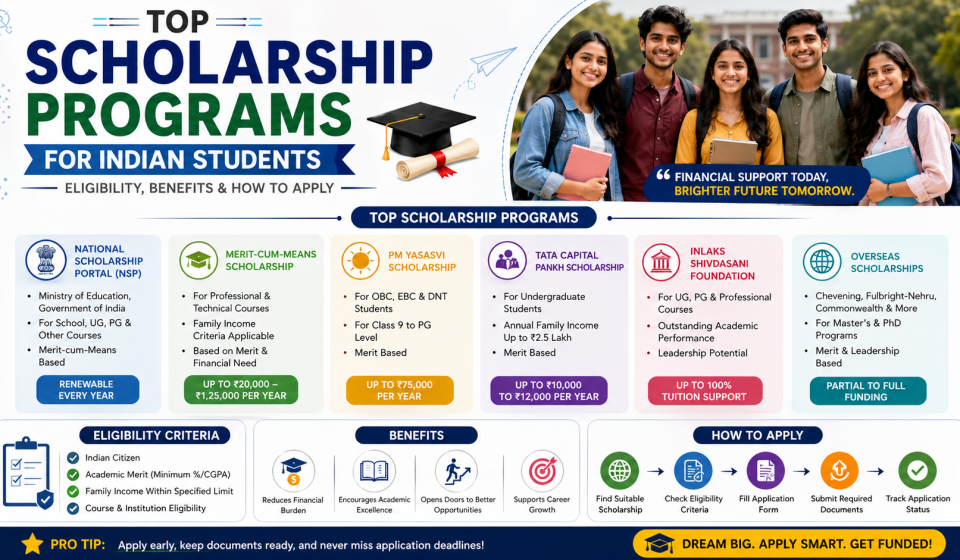
Top Scholarship Programs for Indian Students 2026: Eligibility, Benefits, Application Process & Complete Guide

Higher education is one of the most valuable investments a student can make, but the rising cost of tuition fees, accommodation, books, and other educational expenses often becomes a financial challenge for many families. Fortunately, India offers numerous scholarship programs funded.
With digital application systems and transparent selection processes, applying for scholarships has become easier than ever. However, many students miss valuable opportunities simply because they are unaware of eligibility requirements, deadlines, or application procedures. This comprehensive guide explains the top scholarship programs available for Indian students in 2026, including eligibility criteria, benefits, application process, required documents, expert tips, common mistakes to avoid, and frequently asked questions to help students maximize their chances of receiving financial assistance.
Why Scholarships Are Important
Scholarships reduce the financial burden of education and allow students to focus on academics rather than worrying about educational expenses. Unlike education loans, scholarships generally do not require repayment, making them one of the most beneficial forms of financial aid.
Major benefits include:
- Reduced tuition fees
- Financial support for books and study materials
- Hostel and accommodation assistance
- Encouragement for academic excellence
- Equal educational opportunities
- Reduced dependence on education loans
- Better access to quality institutions
- Motivation for higher studies
Types of Scholarships in India
Scholarships are available under different categories depending on eligibility and funding sources.
Merit-Based Scholarships
Awarded to students with outstanding academic performance in school, college, or competitive examinations.
Need-Based Scholarships
Designed for students belonging to economically weaker sections whose family income falls below specified limits.
Government Scholarships
Provided by Central and State Governments to support higher education across different academic levels.
Minority Scholarships
Available for eligible students belonging to notified minority communities.
SC/ST/OBC Scholarships
Special scholarship schemes are available for students from Scheduled Castes, Scheduled Tribes, and Other Backward Classes.
Sports Scholarships
Awarded to students with exceptional achievements in sports at district, state, national, or international levels.
Talent-Based Scholarships
Offered to students demonstrating excellence in arts, music, innovation, science, research, and other specialised fields.
Corporate Scholarships
Many leading companies and charitable foundations provide scholarships as part of their social responsibility initiatives.
Top Government Scholarship Programs for Indian Students
National Scholarship Portal (NSP)
The National Scholarship Portal is a single online platform where students can apply for numerous Central Government and State Government scholarship schemes.
Features include:
- Online application
- Digital verification
- Transparent selection
- Direct Benefit Transfer (DBT)
- Multiple scholarship categories
Central Sector Scheme of Scholarship
This scholarship supports meritorious students pursuing higher education after Class 12.
Benefits generally include financial assistance for undergraduate and postgraduate studies, subject to government guidelines.
Post Matric Scholarship
Available for eligible students pursuing education after Class 10.
The scholarship helps cover:
- Tuition fees
- Maintenance allowance
- Examination fees
- Study expenses
Pre Matric Scholarship
Designed for school students to encourage continuation of education and reduce dropout rates.
State Government Scholarships
Every Indian state offers scholarship schemes for eligible students based on academic performance, financial status, and category.
Students should regularly check their respective state scholarship portals.
Popular Private Scholarship Programs
Several private organisations support deserving students through scholarships.
Examples include programs funded by:
- Tata Group
- Reliance Foundation
- Aditya Birla Group
- HDFC Bank
- LIC
- Infosys Foundation
- ONGC
- Sitaram Jindal Foundation
- Mahindra Group
- L&T
Scholarship benefits and eligibility vary by organisation.
Scholarships for Engineering Students
Engineering students can apply for scholarships based on:
- JEE performance
- Academic excellence
- Financial need
- Category
- Institutional merit
Many engineering colleges also offer tuition fee waivers for high-performing students.
Scholarships for Medical Students
Medical education can be expensive, making scholarships highly valuable.
Students pursuing MBBS, BDS, Nursing, Pharmacy, and Allied Health Sciences may receive financial assistance through government and institutional scholarship schemes.
Scholarships for MBA Students
Business schools often provide scholarships based on:
- CAT percentile
- Academic performance
- Diversity
- Financial need
- Leadership achievements
- Work experience
Many institutions also collaborate with corporate sponsors.
Scholarships for International Studies
Indian students planning higher education abroad can explore scholarships offered by:
- Foreign universities
- International governments
- Global foundations
- Research organisations
These scholarships may cover tuition fees, travel, living expenses, health insurance, and research grants.
Eligibility Criteria
Eligibility differs for every scholarship programme.
Common requirements include:
- Indian citizenship
- Academic merit
- Minimum qualifying marks
- Family income limit
- Admission to a recognised institution
- Category certificate where applicable
- Bank account linked with Aadhaar where required
Students should always verify scheme-specific eligibility before applying.
Documents Required
Keep the following documents ready before applying:
- Aadhaar Card
- Passport-size photographs
- Class 10 Marksheet
- Class 12 Marksheet
- Previous academic certificates
- Income Certificate
- Caste Certificate (if applicable)
- Domicile Certificate
- Admission Letter
- Fee Receipt
- Bank Passbook
- Identity Proof
- Bonafide Certificate
Some scholarships may require additional documents.
Step-by-Step Scholarship Application Process
Step 1: Identify Suitable Scholarships
Search for scholarships based on:
- Course
- Academic level
- Category
- Financial need
- State
- Institution
Step 2: Check Eligibility
Read official guidelines carefully before beginning the application.
Step 3: Register Online
Create an account on the official scholarship portal.
Step 4: Complete the Application Form
Provide accurate personal, academic, and financial information.
Step 5: Upload Documents
Upload scanned copies in the required format and size.
Step 6: Submit the Application
Review every detail before final submission.
Step 7: Track Application Status
Most portals allow students to monitor application progress online.
Benefits of Scholarships
Scholarships provide more than financial assistance.
They help students:
- Continue higher education
- Reduce educational expenses
- Improve academic motivation
- Access better institutions
- Focus on skill development
- Participate in research
- Build stronger career opportunities
- Reduce financial stress on families
Common Reasons for Scholarship Rejection
Many applications are rejected due to avoidable mistakes.
Common reasons include:
- Incorrect information
- Incomplete application
- Missing documents
- Ineligible applicants
- Incorrect bank details
- Expired income certificates
- Missing deadlines
- Poor academic performance
Students should carefully verify every detail before submission.
Tips to Increase Scholarship Selection Chances
Apply to multiple scholarships instead of relying on one programme.
Maintain strong academic performance.
Submit applications before deadlines.
Keep all certificates updated.
Use accurate information throughout the application.
Read official guidelines thoroughly.
Retain copies of submitted applications.
Track application status regularly.
Respond promptly if additional documents are requested.
Common Myths About Scholarships
Myth 1: Scholarships are only for toppers.
Reality: Many scholarships are based on financial need, category, sports, talent, or special achievements.
Myth 2: Private college students cannot receive scholarships.
Reality: Many scholarship schemes are available for students studying in recognised private institutions.
Myth 3: Applying for scholarships is complicated.
Reality: Most applications are now completed entirely online through user-friendly portals.
Myth 4: One scholarship is enough.
Reality: Students may be eligible for multiple scholarship opportunities, depending on scheme guidelines.
Future of Scholarship Programs in India
India’s scholarship ecosystem is becoming increasingly digital, transparent, and inclusive. Online portals, Direct Benefit Transfer (DBT), Aadhaar-based verification, and digital document submission have simplified the process while reducing delays and improving transparency. Educational institutions and private companies are also expanding scholarship opportunities to encourage innovation, entrepreneurship, research, and skill development.
Students planning higher education in 2026 should actively monitor scholarship announcements throughout the year instead of waiting until admission. Applying early, maintaining academic excellence, and staying informed through official portals can significantly improve the chances of receiving financial support.
Source
https://scholarships.gov.in
https://www.education.gov.in
https://www.ugc.gov.in
https://www.aicte-india.org
Conclusion
Scholarships play a vital role in making quality education accessible to deserving students across India. Whether awarded on the basis of academic merit, financial need, category, sports achievements, or talent, these programmes help reduce educational expenses and create opportunities for academic and professional growth. Students should begin researching scholarship options early, carefully review eligibility criteria, prepare all required documents, and submit applications well before the deadlines. Staying informed through official scholarship portals and regularly checking new announcements can greatly increase the likelihood of receiving financial assistance. With proper planning and timely applications, scholarships can become a powerful stepping stone toward achieving higher education and long-term career success.
FAQ
1. Who can apply for scholarships in India?
Indian students studying in recognised schools, colleges, universities, or professional institutions may apply, provided they meet the eligibility criteria of the respective scholarship scheme.
2. Are scholarships available for private college students?
Yes. Many government and private scholarship programmes are available for eligible students enrolled in recognised private institutions.
3. Can I apply for multiple scholarships?
Yes. Students can apply for multiple scholarships, although the rules regarding receiving benefits from more than one scheme may vary depending on the scholarship guidelines.
4. What documents are commonly required for scholarship applications?
Most applications require academic marksheets, Aadhaar Card, income certificate, bank account details, admission proof, photographs, and category certificates where applicable.
5. Are scholarship amounts taxable?
Scholarships awarded solely for educational purposes are generally exempt from income tax under applicable Indian tax provisions. Students should refer to current tax regulations for specific situations.
6. How can I check my scholarship application status?
Most official scholarship portals provide online dashboards where applicants can track the status of their applications after logging into their accounts.
7. What happens if my scholarship application is rejected?
Students should review the reason for rejection, correct any deficiencies if permitted, and apply for other suitable scholarship programmes in future application cycles.
8. Where can I find authentic scholarship information?
Students should always rely on official government portals, recognised educational institutions, and verified scholarship providers for accurate information regarding eligibility, deadlines, and application procedures.