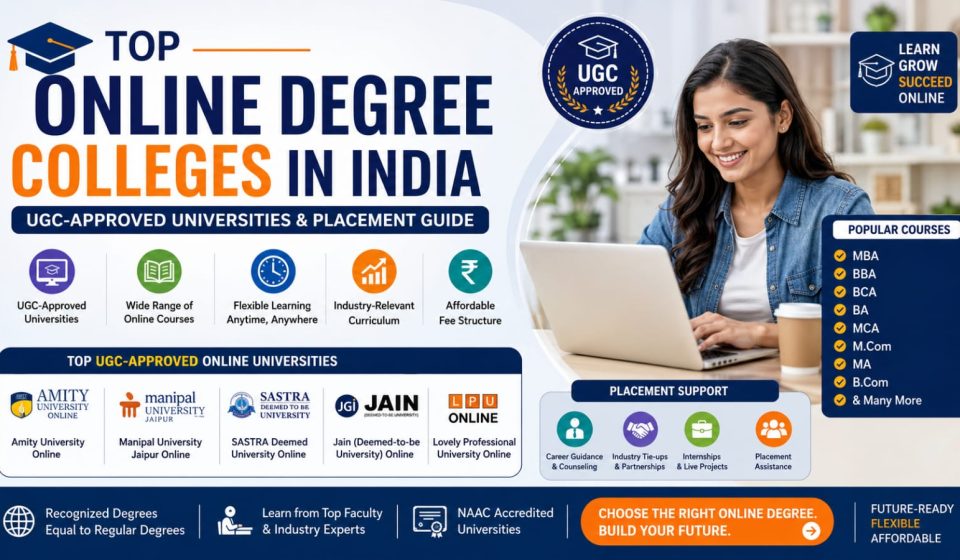
Top Online Degree Colleges in India 2026: Best UGC-Approved Universities, Fees, Placements & Admission Guide

Online degree programmes have transformed higher education in India by making quality learning accessible, flexible, and affordable for students and working professionals.
The Indian government has also promoted digital education through initiatives that encourage recognised universities to offer online programmes with updated curricula, virtual classrooms, recorded lectures, digital libraries, and online examinations where applicable. However, students must verify UGC approval, accreditation, placement assistance, faculty quality, curriculum, and industry relevance before enrolling. This comprehensive guide explains the best online degree colleges in India for 2026, UGC-approved universities, eligibility, admission process, fee structure, placement support, career opportunities, scholarships, and expert tips to help students select the right online programme.
Why Choose an Online Degree?
Online education has become a practical option for learners who want flexibility without compromising on quality. Modern online programmes provide interactive learning experiences through live classes, discussion forums, recorded sessions, assignments, and virtual assessments.
Major advantages include:
- Flexible learning schedule
- Learn from any location
- Affordable education
- Opportunity to work while studying
- Industry-oriented curriculum
- Digital learning resources
- Access to experienced faculty
- Career advancement opportunities
- Skill development alongside academics
Are Online Degrees Valid in India?
Yes. Online degrees offered by universities recognised by the University Grants Commission (UGC) and approved under applicable regulations are valid for employment and higher education, subject to the programme and institution meeting the required norms.
Students should always verify:
- UGC recognition
- NAAC accreditation
- Programme approval
- Official university notifications
- Admission eligibility
Avoid enrolling in institutions that claim recognition without official approval.
Top UGC-Approved Online Degree Universities in India
Several reputed universities offer recognised online degree programmes.
Some of the leading institutions include:
- Indira Gandhi National Open University (IGNOU)
- Amity University Online
- Manipal University Jaipur (Online)
- Jain University Online
- Chandigarh University Online
- Lovely Professional University (LPU) Online
- Uttaranchal University Online
- Symbiosis Centre for Distance Learning (selected programmes)
- Dr. D. Y. Patil Vidyapeeth Online
- Sikkim Manipal University (Online)
Students should confirm the latest list of approved online programmes before applying.
Popular Online Degree Courses
Students can choose from a wide range of programmes.
Online Bachelor of Business Administration (BBA)
Ideal for careers in management, marketing, finance, and entrepreneurship.
Online Bachelor of Commerce (BCom)
Suitable for students interested in accounting, banking, taxation, and finance.
Online Bachelor of Computer Applications (BCA)
Focuses on programming, software development, databases, and IT fundamentals.
Online Bachelor of Arts (BA)
Offers specialisations in humanities, psychology, political science, economics, and sociology.
Online Bachelor of Science (BSc)
Available in selected disciplines depending on university approvals.
Online Master of Business Administration (MBA)
One of the most popular online programmes for working professionals.
Online Master of Computer Applications (MCA)
Designed for graduates seeking careers in software development and information technology.
Online Master of Commerce (MCom)
Suitable for careers in finance, commerce, taxation, and business management.
Eligibility Criteria
Eligibility depends on the course and university.
For undergraduate programmes:
- Completion of Class 12 from a recognised board
For postgraduate programmes:
- Bachelor’s degree from a recognised university
Some universities may require minimum qualifying marks or additional eligibility conditions.
Admission Process
Step 1: Select the University
Compare institutions based on:
- UGC approval
- Accreditation
- Faculty
- Course curriculum
- Fees
- Placement support
Step 2: Register Online
Complete the application through the official admission portal.
Step 3: Upload Documents
Commonly required documents include:
- Academic certificates
- Photograph
- Signature
- Identity proof
- Address proof
Step 4: Fee Payment
Pay the prescribed admission fee through authorised online payment methods.
Step 5: Admission Confirmation
After verification, students receive admission confirmation and access to the learning management system.
Documents Required
Students generally require:
- Class 10 Certificate
- Class 12 Marksheet
- Graduation Certificate (for PG courses)
- Aadhaar Card or valid identity proof
- Passport-size photograph
- Signature
- Address proof
- Category certificate (if applicable)
Requirements may vary by institution.
Online Degree Fee Structure
Tuition fees vary depending on the university and programme.
Approximate total course fees:
- Online BA: ₹20,000–₹80,000
- Online BCom: ₹25,000–₹1,00,000
- Online BBA: ₹40,000–₹2,00,000
- Online BCA: ₹50,000–₹2,50,000
- Online MBA: ₹80,000–₹3,00,000
- Online MCA: ₹90,000–₹2,50,000
- Online MCom: ₹30,000–₹1,20,000
Students should compare the total programme cost, available scholarships, and payment options.
Learning Experience in Online Universities
Modern online universities provide:
- Live virtual classes
- Recorded lectures
- Digital study materials
- Online assignments
- Virtual discussions
- Learning management systems
- Online assessments
- Academic mentoring
- Career counselling
Many institutions also offer mobile learning applications for convenient access.
Placement Support
Placement assistance differs across universities.
Leading online universities provide:
- Career counselling
- Resume building
- Interview preparation
- Skill development workshops
- Virtual placement drives
- Internship assistance
- Industry networking sessions
Students should verify placement services before enrolling.
Skills Developed Through Online Degrees
Apart from academic knowledge, students develop:
- Time management
- Self-discipline
- Digital communication
- Problem-solving
- Research skills
- Presentation abilities
- Team collaboration
- Technology proficiency
These competencies are valuable in modern workplaces.
Career Opportunities After Online Degrees
Graduates can pursue careers in:
- Information Technology
- Banking
- Finance
- Human Resources
- Marketing
- Business Management
- Digital Marketing
- Data Analytics
- Customer Success
- Sales
- Entrepreneurship
- Government Services
- Education
- Consulting
Career opportunities depend on the chosen programme, skills, and experience.
Scholarships and Financial Assistance
Many universities provide:
- Merit scholarships
- Scholarships for defence personnel
- Scholarships for differently abled students
- Financial assistance for economically weaker students
- Fee concessions for alumni
- Corporate partnerships
Students should review scholarship eligibility before admission.
How to Choose the Best Online University
Before selecting a university, compare:
- UGC approval
- NAAC accreditation
- Programme recognition
- Faculty quality
- Industry-oriented curriculum
- Student reviews
- Placement support
- Alumni network
- Learning platform
- Examination process
- Fee structure
- Student support services
Taking time to research multiple universities helps in making an informed choice.
Common Mistakes Students Should Avoid
- Enrolling without checking UGC approval
- Choosing a university based only on advertisements
- Ignoring accreditation
- Not comparing placement assistance
- Overlooking curriculum quality
- Missing scholarship opportunities
- Failing to verify examination policies
- Ignoring student support services
Avoiding these mistakes can improve both learning outcomes and career prospects.
Future of Online Education in India
Online education is expected to play an increasingly important role in India’s higher education system. Advances in Artificial Intelligence, virtual classrooms, adaptive learning platforms, digital assessments, and industry-integrated curricula are making online degrees more interactive and career-focused. Employers are also placing greater emphasis on practical skills, recognised qualifications, and continuous learning rather than the mode of education alone.
As more universities expand their online offerings, students will benefit from greater flexibility, affordable education, and access to high-quality academic resources. Choosing a recognised university with strong academic standards, career support, and industry relevance will be essential for long-term success.
Source
https://www.ugc.gov.in
https://deb.ugc.ac.in
https://www.naac.gov.in
https://www.education.gov.in
Conclusion
Online degree programmes have become a credible and flexible pathway for students and working professionals seeking quality higher education in India. By choosing a UGC-approved university with strong accreditation, experienced faculty, industry-relevant curriculum, and reliable placement support, learners can earn recognised qualifications while balancing work, family, or other commitments. Before enrolling, students should carefully compare universities based on approval status, academic quality, fees, learning resources, career services, and long-term value. With thoughtful planning and continuous skill development, an online degree can open doors to rewarding career opportunities and lifelong professional growth.
FAQ
1. Are online degrees valid in India?
Yes. Online degrees offered by UGC-recognised universities under applicable regulations are generally valid for employment and higher education.
2. Which are the best online degree universities in India?
Popular choices include IGNOU, Amity University Online, Manipal University Jaipur Online, Jain University Online, Chandigarh University Online, LPU Online, and several other recognised institutions.
3. Can I get a job after completing an online degree?
Yes. Graduates from recognised universities can apply for jobs, provided they meet the employer’s eligibility requirements and possess the necessary skills for the role.
4. Is an online MBA worth pursuing?
An online MBA from a recognised university can be valuable for working professionals and graduates seeking career advancement, management knowledge, and leadership skills.
5. Are online degrees suitable for working professionals?
Yes. Flexible schedules, recorded lectures, and online learning platforms make these programmes particularly suitable for working professionals.
6. Do online universities provide placement assistance?
Many recognised online universities offer career services such as resume building, interview preparation, internships, and placement support, although the level of assistance varies by institution.
7. How can I verify whether an online university is UGC-approved?
Students should check the official UGC and UGC-DEB websites and verify the university’s recognition before applying.
8. What should I consider before choosing an online university?
Compare UGC approval, accreditation, curriculum, faculty, placement assistance, student support, learning platform, fee structure, scholarship options, and alumni feedback before making a decision.