
The good news is that successful studying is not always about spending more hours with books. It is about using the available time wisely. Time-saving study methods help busy college students learn faster, stay organized, reduce stress, and improve academic performance without wasting energy.
Why Time-Saving Study Methods Matter in College
College students often have limited time. Unlike school, college requires more independent learning. Professors may not remind students about every task, and deadlines can arrive quickly. Without a clear system, students may fall behind and start cramming before exams.
Time-saving study methods help students focus on what matters most. Instead of studying randomly, students can use proven techniques to understand important concepts, revise efficiently, and complete work on time.
These methods also reduce academic stress. When students know how to study efficiently, they feel more confident and in control of their schedule.
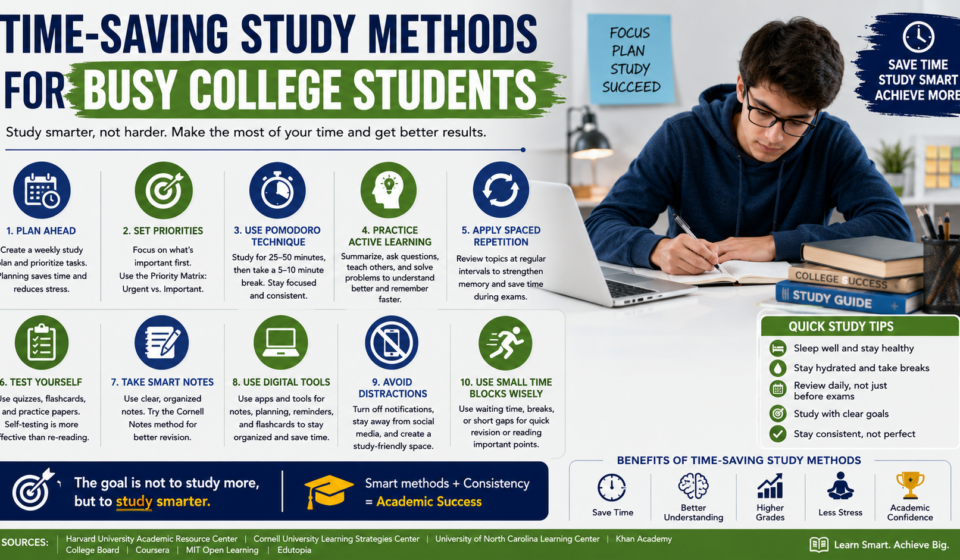
Create a Weekly Study Plan
A weekly study plan is one of the best ways to save time. Without planning, students often waste time deciding what to study. A clear plan gives structure and direction.
Start by listing your classes, assignments, exams, and deadlines. Then divide your study time across the week. Give more time to difficult subjects and less time to topics you already understand.
A good study plan should be realistic. Do not fill every hour with study tasks. Leave some free time for rest, unexpected work, and personal activities. A balanced schedule is easier to follow and helps prevent burnout.
Use the Priority Method
Busy students cannot do everything at once. That is why prioritizing is important. The priority method helps students decide which tasks need attention first.
Start by identifying urgent and important tasks. For example, an assignment due tomorrow is urgent, while exam revision for next month is important. Both need attention, but they should be planned differently.
You can divide tasks into three categories: high priority, medium priority, and low priority. Complete high-priority work first. This prevents last-minute stress and helps you use your time wisely.
Study in Short Focused Sessions
Long study sessions are not always effective. Many students sit for hours but lose focus after a short time. Short focused sessions can save time and improve learning.
Try studying for 25 to 50 minutes at a time, followed by a short break. During that session, focus only on one task. Avoid checking your phone, social media, or unrelated websites.
Focused study blocks help students complete more work in less time. Even a 30-minute session can be productive if your attention is fully on the topic.
Use the Pomodoro Technique
The Pomodoro Technique is a popular time-saving study method. It involves studying for 25 minutes and taking a 5-minute break. After four rounds, take a longer break of 15 to 30 minutes.
This method works well for busy college students because it makes studying feel manageable. Instead of waiting for several free hours, students can complete small study sessions whenever they have time.
The Pomodoro Technique is also useful for avoiding procrastination. Starting with just 25 minutes feels easier than planning a long study session.
Practice Active Learning
Active learning saves time because it helps students understand information faster. Instead of passively reading notes again and again, students should interact with the material.
Active learning includes summarizing topics in your own words, asking questions, solving problems, explaining concepts, and creating examples. This method improves understanding and memory.
For example, after reading a chapter, close the book and write a short summary. Then check your notes to see what you missed. This is faster and more effective than reading the same chapter multiple times.
Use Spaced Repetition
Spaced repetition is a smart revision method that saves time in the long run. Instead of trying to memorize everything before an exam, students review topics at regular intervals.
For example, revise a topic after one day, then after three days, then after one week, and then after two weeks. This helps information stay in your memory longer.
Spaced repetition works especially well for subjects that require memorization, such as biology, medicine, law, history, languages, and formulas. Flashcards are a useful tool for this method.
Test Yourself Instead of Re-Reading
Re-reading notes may feel useful, but it is often less effective than self-testing. Testing yourself helps your brain practice recalling information, which is important for exams.
Use practice questions, quizzes, flashcards, or previous exam papers. After studying a topic, write down everything you remember without looking at your notes. Then check your answer and correct mistakes.
This method saves time because it quickly shows what you know and what needs more revision. It also builds exam confidence.
Take Better Notes During Lectures
Good notes save a lot of time during revision. If your notes are clear and organized, you do not have to search through textbooks or online materials again and again.
During lectures, focus on key points, definitions, examples, formulas, and explanations. Do not try to write every word the professor says. Instead, listen carefully and record the most important information.
The Cornell Notes method can be helpful. It divides the page into sections for main notes, keywords, and summary. This makes reviewing easier and faster.
Use Digital Study Tools
Digital tools can help busy students stay organized and save time. Calendar apps, reminder apps, note-taking apps, flashcards, cloud storage, and task managers can make studying more efficient.
Students can use digital calendars to track deadlines, flashcard apps for revision, and note apps to organize lecture material. Cloud storage helps keep documents available from any device.
AI study tools can also help explain difficult topics, summarize notes, and create practice questions. However, technology should be used carefully. It should support learning, not become a distraction.
Avoid Multitasking
Multitasking may seem like a way to save time, but it usually reduces productivity. Studying while texting, watching videos, or switching between tasks makes learning slower.
Instead, focus on one task at a time. If you are revising, revise only. If you are writing an assignment, write only. Single-tasking helps the brain work more efficiently.
By avoiding multitasking, students can complete tasks faster and with better quality.
Use Waiting Time Wisely
Busy college students often have small gaps in their day. These may include waiting for class, commuting, standing in line, or taking short breaks between lectures.
These small time blocks can be used for quick revision. You can review flashcards, read summaries, listen to recorded notes, or plan your next task.
Using small gaps wisely does not mean studying all the time. It simply helps students complete light academic tasks without needing long study sessions later.
Prepare Before Class
Preparing before class saves time after class. Before attending a lecture, quickly review the topic, headings, or previous notes. This helps you understand the lecture faster.
Even 10 minutes of preparation can make a big difference. When you already know the basic idea, you can follow the professor more easily and take better notes.
This also reduces the time needed for revision later because the topic feels more familiar.
Review Notes the Same Day
Reviewing notes on the same day is a powerful time-saving habit. If students wait too long, they may forget important details and need more time to understand the topic again.
After class, spend 10 to 15 minutes reviewing your notes. Fill in missing points, highlight important ideas, and write a short summary.
This small habit saves hours during exam preparation and improves long-term memory.
Break Big Tasks Into Smaller Steps
Large assignments and exam preparation can feel stressful. When tasks feel too big, students often delay them. Breaking big tasks into smaller steps makes them easier to complete.
For example, instead of writing “complete research paper,” divide it into steps: choose topic, collect sources, create outline, write introduction, write main body, edit, and submit.
Small steps are easier to start and finish. This helps students avoid procrastination and save time.
Source
https://l1nq.com/2h8au5i
https://l1nq.com/q7khefx
Conclusion
Time-saving study methods are essential for busy college students who want to succeed without feeling constantly overwhelmed. Studying efficiently is not about doing everything at once. It is about planning wisely, focusing deeply, using smart revision techniques, and avoiding time-wasting habits.
A weekly study plan, priority system, Pomodoro Technique, active learning, spaced repetition, self-testing, good notes, and digital tools can help students achieve better results in less time.
With consistency and smart planning, busy college students can improve grades, reduce stress, and create a healthier balance between academic and personal life.
FAQs
1. What are the best time-saving study methods for college students?
The best methods include weekly planning, prioritizing tasks, using the Pomodoro Technique, active learning, spaced repetition, self-testing, and reviewing notes regularly.
2. How can busy college students study effectively?
Busy students can study effectively by using short focused sessions, avoiding distractions, setting clear goals, and using small gaps in the day for quick revision.
3. Is studying for short periods effective?
Yes, short focused study sessions can be very effective when done with full concentration. A 25–50 minute focused session can produce better results than hours of distracted studying.
4. How can I save time while preparing for exams?
Use summaries, flashcards, practice questions, past papers, and spaced repetition. Avoid re-reading everything from the beginning and focus on weak areas.
5. What is the Pomodoro Technique?
The Pomodoro Technique is a study method where you study for 25 minutes and then take a 5-minute break. After four rounds, you take a longer break.