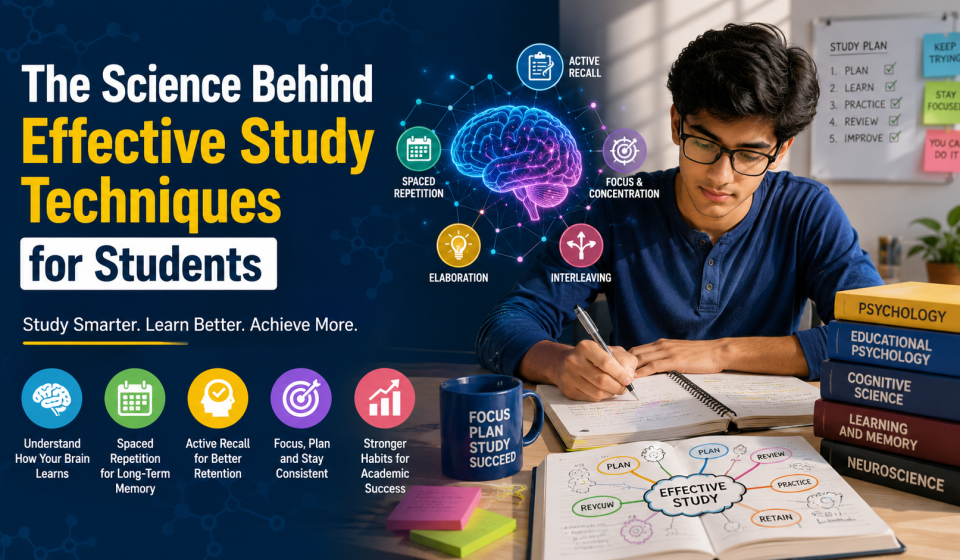

Studying is not just about sitting with books for long hours. Many students believe that more study time automatically means better results, but science shows that the quality of study matters more than the number of hours spent. Effective study techniques are based on how the brain receives, stores, and recalls information. When students understand the science behind learning, they can study smarter, remember more, and perform better in exams.
Why Understanding Study Science Matters
Every student has a different learning style, but the basic process of learning is similar for everyone. When students study, the brain creates neural connections. These connections become stronger when information is practiced repeatedly. However, if the information is only read once and never used again, the brain may forget it quickly.
Understanding the science behind effective study techniques helps students avoid weak habits such as passive reading, last-minute cramming, and copying notes without thinking. Instead, students can use proven methods that improve memory, concentration, and understanding.
Active Recall: Testing Your Brain to Learn Better
Active recall is one of the most powerful study techniques. It means trying to remember information without looking at the textbook or notes. For example, after reading a chapter, a student can close the book and explain the main points in their own words.
This method works because the brain becomes stronger when it is forced to retrieve information. Simply rereading notes may feel easy, but it does not always prove that the student understands the topic. Active recall shows what the student truly remembers and what needs more revision.
Students can use active recall by creating flashcards, answering practice questions, writing summaries from memory, or teaching the topic to someone else. This technique is especially useful for exams because exams also require students to recall information without help.
Spaced Repetition: Reviewing at the Right Time
Spaced repetition is based on the idea that students remember better when they review information over increasing time intervals. Instead of studying one topic for five hours in a single day, students should review it several times across many days.
The brain naturally forgets information over time. This is known as the forgetting curve. Spaced repetition helps fight this forgetting process by refreshing memory before the information disappears completely.
For example, a student can review a topic on day one, then again after two days, then after one week, and later after two weeks. Each review strengthens memory and makes long-term learning easier.
The Pomodoro Technique and Focused Study
The Pomodoro Technique is a popular time management method where students study for 25 minutes and then take a 5-minute break. After four sessions, they take a longer break. This method works because the brain cannot maintain deep focus for unlimited time.
Short study sessions reduce mental tiredness and make it easier to stay motivated. Breaks allow the brain to relax and recharge. Students who struggle with procrastination can also benefit from this method because 25 minutes feels manageable.
Focused study is more effective than distracted study. A student studying for one hour without phone notifications may learn more than a student studying for three hours while checking social media. Concentration is a key part of effective learning.
Interleaving: Mixing Different Topics
Many students study one type of problem again and again before moving to another topic. However, research shows that mixing related topics, known as interleaving, can improve understanding.
For example, instead of solving only algebra problems for two hours, a student can mix algebra, geometry, and word problems. This trains the brain to identify which method should be used in different situations.
Interleaving may feel harder at first, but it improves problem-solving ability. It is especially helpful for subjects like math, science, language learning, and competitive exam preparation.
Elaboration: Connecting New Ideas with Old Knowledge
Elaboration means explaining ideas in detail and connecting them with what students already know. When the brain connects new information with existing knowledge, learning becomes stronger.
For example, if a student is learning about photosynthesis, they can connect it with plants, sunlight, oxygen, and food chains. This makes the concept easier to understand and remember.
Students can use elaboration by asking questions such as “Why does this happen?”, “How is this connected to another topic?”, and “Can I explain this with an example?” These questions make learning deeper and more meaningful.
The Power of Teaching Others
Teaching is one of the best ways to learn. When students explain a topic to someone else, they must organize their thoughts clearly. This helps them identify weak areas in their understanding.
This method is sometimes called the Feynman Technique. The idea is simple: choose a topic, explain it in simple words, find gaps in your explanation, and then review those gaps.
If a student cannot explain a topic simply, it usually means they need to understand it better. Teaching others improves clarity, confidence, and memory.
Why Cramming Is Not Effective
Cramming means studying a large amount of information just before an exam. It may help students remember some facts for a short time, but it is not effective for long-term learning.
The brain needs time to process and store information. When students cram, they overload their working memory. This can increase stress and reduce understanding.
A better approach is to study small portions regularly. Daily review, practice tests, and spaced repetition are much more effective than last-minute study pressure.
Sleep and Memory: Why Rest Matters
Sleep plays a major role in learning. During sleep, the brain organizes and stores information learned during the day. Students who sleep well are more likely to remember what they studied.
Lack of sleep affects concentration, mood, memory, and problem-solving skills. Many students sacrifice sleep before exams, but this can reduce performance.
A healthy study routine should include proper sleep, short breaks, exercise, and balanced meals. The brain works best when the body is healthy.
Digital Tools for Smarter Studying
Technology can help students study more effectively when used properly. Apps for flashcards, note-taking, time management, and practice tests can improve learning.
Tools such as digital planners, online quizzes, educational videos, and AI-based learning platforms can support active recall and spaced repetition. However, students should avoid using technology as a distraction.
The best digital tools are those that help students stay organized, review regularly, and test themselves.
Creating an Effective Study Plan
A good study plan should include clear goals, daily study time, revision sessions, and practice tests. Students should not only write “study science” in their schedule. Instead, they should write specific tasks such as “review chapter 3,” “solve 20 practice questions,” or “make flashcards for key terms.”
A strong study plan includes both learning and revision. It also leaves time for breaks and rest. Consistency is more important than studying for long hours once in a while.
Students should also track their progress. This helps them understand what is working and what needs improvement.
Common Study Mistakes Students Should Avoid
Many students make mistakes that reduce their learning efficiency. One common mistake is highlighting too much text without understanding it. Another mistake is rereading notes repeatedly without testing memory.
Multitasking is another major problem. Studying while using social media, watching videos, or chatting can reduce focus. Students should create a distraction-free environment for better results.
Another mistake is ignoring difficult topics. Students often spend more time on subjects they already know because it feels comfortable. However, real improvement comes from working on weak areas.
Best Study Techniques for Exam Success
For exam preparation, students should combine several science-backed techniques. Active recall helps with memory, spaced repetition improves long-term retention, and practice tests build confidence.
Students should also review mistakes carefully. Every wrong answer shows a learning opportunity. Instead of feeling discouraged, students should ask why the mistake happened and how to avoid it next time.
Before exams, students should focus on revision, practice, and rest. A calm and prepared mind performs better than a stressed and tired one.
Source
Conclusion
The science behind effective study techniques proves that smart studying is better than long, unfocused studying. Students can improve their learning by using active recall, spaced repetition, focused study sessions, interleaving, elaboration, and regular practice. These methods help the brain understand, store, and recall information more effectively.
Success in studies does not depend only on intelligence. It depends on using the right strategies consistently. When students study with a scientific approach, they can reduce stress, improve grades, and build strong learning habits for the future.
FAQs
1. What is the most effective study technique for students?
Active recall is one of the most effective study techniques because it trains the brain to retrieve information from memory.
2. How many hours should a student study daily?
The ideal study time depends on the student’s goals, but focused study sessions of 2 to 4 hours daily can be more useful than long distracted sessions.
3. Is studying at night effective?
Studying at night can work for some students, but proper sleep is very important for memory and concentration.
4. Why is spaced repetition important?
Spaced repetition helps students remember information for a longer time by reviewing it at planned intervals.
5. How can students avoid forgetting what they study?
Students can avoid forgetting by revising regularly, using flashcards, practicing questions, and teaching the topic to others.