The Importance of Research-Oriented Colleges in Modern Education: A Complete Guide to Innovation, Academic Excellence, and Career Success

In today’s knowledge-driven world, higher education is no longer limited to classroom instruction and textbook learning. Modern industries, governments, and global organizations seek graduates who can analyze complex problems, think critically, conduct meaningful research, and develop innovative solutions.
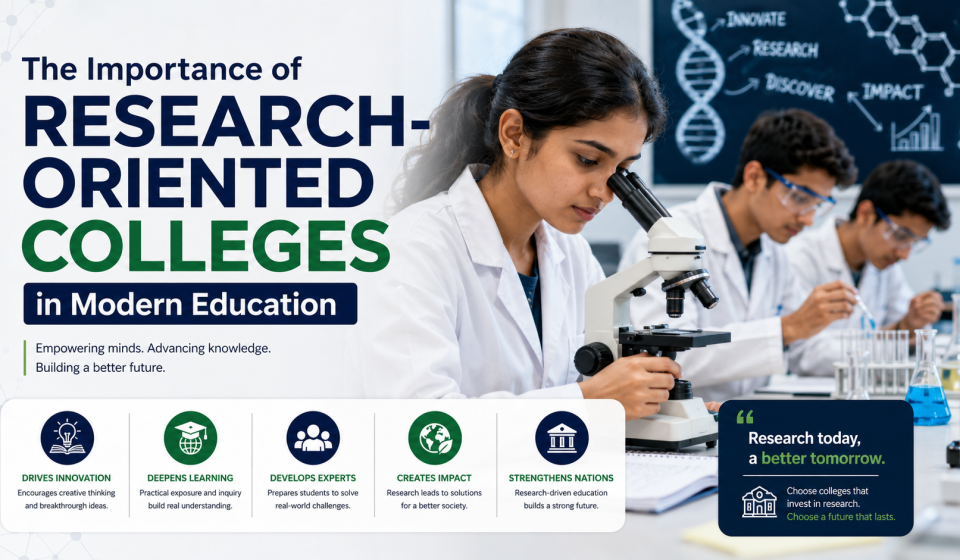
Research-oriented colleges also contribute significantly to society by generating new knowledge, improving technology, addressing social challenges, and supporting economic development. Students benefit from experienced faculty, advanced laboratories, innovation centers, industry collaborations, and opportunities to publish research papers or participate in conferences. Instead of preparing students only for their first job, these institutions prepare them to become innovators, leaders, and contributors to future advancements. This comprehensive guide explains why research-oriented colleges play a crucial role in modern education and how they help students build successful academic and professional careers.
What Is a Research-Oriented College?
A research-oriented college is an institution that integrates research into teaching and learning while encouraging students and faculty to investigate new ideas, develop innovative solutions, and contribute to academic advancement.
Such colleges emphasize:
- Scientific research
- Innovation
- Practical learning
- Critical thinking
- Problem-solving
- Industry collaboration
- Interdisciplinary studies
- Knowledge creation
Students actively participate in learning instead of simply receiving information.
Why Research Matters in Modern Education
Modern education focuses on preparing students for changing industries and global challenges.
Research helps students:
- Understand complex issues
- Develop analytical thinking
- Create innovative solutions
- Improve decision-making
- Learn independently
- Apply classroom concepts
Research transforms education into an active learning process.
Encourages Critical Thinking
Research requires students to question assumptions and evaluate evidence.
Students learn to:
- Analyze information
- Compare viewpoints
- Interpret data
- Draw logical conclusions
- Solve complex problems
Critical thinking improves both academic and professional performance.
Promotes Innovation
Innovation begins with curiosity and experimentation.
Research-oriented colleges encourage students to:
- Develop new technologies
- Design better products
- Improve existing systems
- Solve community problems
- Explore creative ideas
Innovation contributes to economic and social development.
Strengthens Practical Learning
Practical experience enhances theoretical understanding.
Students participate in:
- Laboratory experiments
- Field studies
- Research projects
- Industry case studies
- Product development
- Prototype testing
Hands-on learning builds confidence and technical expertise.
Improves Academic Excellence
Research strengthens academic quality by exposing students to current knowledge and emerging discoveries.
Benefits include:
- Updated curriculum
- Faculty-led research
- Advanced laboratories
- Evidence-based learning
- Interactive teaching
Students receive a richer educational experience.
Builds Problem-Solving Skills
Every research project begins with identifying a challenge.
Students learn how to:
- Define problems
- Collect information
- Analyze findings
- Test solutions
- Evaluate outcomes
These abilities are valuable across every profession.
Develops Independent Learning
Research encourages students to become self-directed learners.
They learn to:
- Search reliable sources
- Evaluate evidence
- Organize information
- Manage projects
- Present findings
Independent learning supports lifelong education.
Encourages Interdisciplinary Learning
Modern challenges often require knowledge from multiple fields.
Research-oriented colleges promote collaboration among disciplines such as:
- Engineering
- Healthcare
- Business
- Computer science
- Environmental science
- Social sciences
Interdisciplinary learning improves innovation.
Provides Access to Advanced Facilities
Research institutions typically invest in quality infrastructure.
Students benefit from:
- Modern laboratories
- Digital libraries
- Innovation centers
- Research databases
- High-performance computing
- Specialized equipment
Access to these resources enhances learning.
Enhances Faculty Mentorship
Faculty members guide students throughout the research process.
Mentorship includes:
- Project supervision
- Career guidance
- Publication support
- Skill development
- Academic counseling
Experienced mentors improve student outcomes.
Supports Higher Education Aspirations
Students planning postgraduate education gain valuable experience.
Research activities strengthen applications for:
- Master’s programs
- PhD admissions
- International universities
- Research fellowships
- Academic scholarships
Research experience improves academic competitiveness.
Increases Employability
Employers appreciate graduates who possess research experience.
Research develops:
- Analytical thinking
- Data interpretation
- Technical writing
- Teamwork
- Innovation
- Communication
These skills improve workplace readiness.
Encourages Entrepreneurship
Research often leads to innovative business ideas.
Many colleges support startups through:
- Incubation centers
- Innovation labs
- Startup mentoring
- Business competitions
- Patent support
Entrepreneurship grows through research-based innovation.
Develops Communication Skills
Researchers must present ideas clearly.
Students improve:
- Academic writing
- Presentation skills
- Public speaking
- Scientific communication
- Technical reporting
Strong communication supports professional success.
Promotes Global Collaboration
Research connects students with experts worldwide.
International opportunities include:
- Exchange programs
- Joint research
- Global conferences
- International publications
- Collaborative innovation
Global exposure broadens career opportunities.
Encourages Ethical Decision-Making
Responsible research requires ethical standards.
Students learn:
- Academic integrity
- Responsible data collection
- Ethical experimentation
- Respect for intellectual property
- Professional accountability
Ethics strengthen professional credibility.
Supports National Development
Research-oriented colleges contribute to national progress.
Their work benefits:
- Healthcare
- Agriculture
- Technology
- Manufacturing
- Environmental sustainability
- Public policy
Universities become centers of innovation and development.
Research Opportunities Throughout College
First-year students should develop curiosity, learn research fundamentals, and participate in introductory projects. Second-year students can work with faculty on small research assignments, laboratory activities, and innovation competitions. Third-year students should engage in interdisciplinary projects, internships, conferences, and technical paper presentations. Final-year students can undertake major research projects, publish papers, file patents where applicable, participate in startup incubation programs, and prepare for postgraduate studies or research-driven careers.
How to Identify a Research-Oriented College
Before taking admission, students should evaluate whether the college offers:
- Active research centers
- Qualified faculty researchers
- Modern laboratories
- Published research papers
- Patent filings
- Industry collaborations
- Innovation hubs
- Student research funding
- Conference participation
- National and international partnerships
These indicators reflect a strong research culture.
Common Mistakes Students Make
Some students choose colleges based only on placement advertisements while ignoring research opportunities. Others believe research is useful only for future scientists or PhD candidates. In reality, research develops analytical thinking, creativity, communication, and innovation that benefit careers in engineering, healthcare, business, technology, education, and entrepreneurship. Another mistake is avoiding research projects due to fear of difficulty. Early participation helps students gradually build confidence and valuable professional skills.
The Future of Research-Oriented Education
Artificial intelligence, biotechnology, renewable energy, data science, robotics, cybersecurity, and sustainable development are reshaping industries worldwide. Research-oriented colleges are becoming central to preparing graduates who can solve future challenges through innovation and evidence-based thinking. Governments, industries, and universities are increasing investments in research collaborations, interdisciplinary learning, startup ecosystems, and advanced technology laboratories. Students who study in research-focused institutions gain exposure to cutting-edge developments, strengthen their problem-solving abilities, and become better equipped to lead scientific, technological, and social progress in the decades ahead.
Source
https://www.ugc.gov.in
https://www.aicte-india.org
https://www.naac.gov.in
https://www.nirfindia.org
Conclusion
Research-oriented colleges play a vital role in modern education by fostering innovation, critical thinking, practical learning, and lifelong curiosity. They provide students with opportunities to work on real-world challenges, collaborate with experienced faculty, access advanced research facilities, and contribute to meaningful discoveries. Beyond improving academic performance, research prepares students for successful careers, higher education, entrepreneurship, and leadership in rapidly evolving industries. By choosing a college with a strong research culture, students invest not only in quality education but also in their ability to adapt, innovate, and make lasting contributions to society.
FAQ
1. What is a research-oriented college?
A research-oriented college integrates research into teaching by encouraging students and faculty to conduct studies, develop innovative solutions, publish findings, and participate in practical learning experiences.
2. Why are research-oriented colleges important?
They promote critical thinking, innovation, practical problem-solving, academic excellence, and career readiness while preparing students for higher education, entrepreneurship, and research-driven professions.
3. How does research benefit undergraduate students?
Research improves analytical thinking, communication, teamwork, technical knowledge, creativity, and confidence while providing practical experience that strengthens career prospects and postgraduate applications.
4. How can students identify a research-focused college?
Students should review faculty research, laboratory facilities, publications, patents, innovation centers, industry collaborations, research funding, conference participation, and accreditation details before taking admission.
5. Does research help students who do not want to pursue a PhD?
Yes. Research develops transferable skills such as problem-solving, critical thinking, communication, project management, and innovation that are valuable in almost every profession.
6. What career opportunities are available for students with research experience?
Research experience supports careers in engineering, healthcare, business, technology, education, government, consulting, product development, entrepreneurship, public policy, and advanced academic studies.