The Complete Guide to Academic Credit Transfer Between Indian Universities: Everything Students Need to Know in 2026

India’s higher education system is undergoing a historic transformation with the implementation of the National Education Policy (NEP) 2020. One of its most student-friendly reforms is the introduction of a flexible academic credit transfer system, allowing learners to move between recognized institutions without losing.
Traditionally, students who changed colleges or universities often had to restart their programs or repeat completed courses because academic credits were not easily transferable. This created unnecessary financial burdens, delayed graduation, and discouraged students from pursuing better educational opportunities. With the introduction of the Academic Bank of Credits (ABC), this challenge is gradually being addressed.
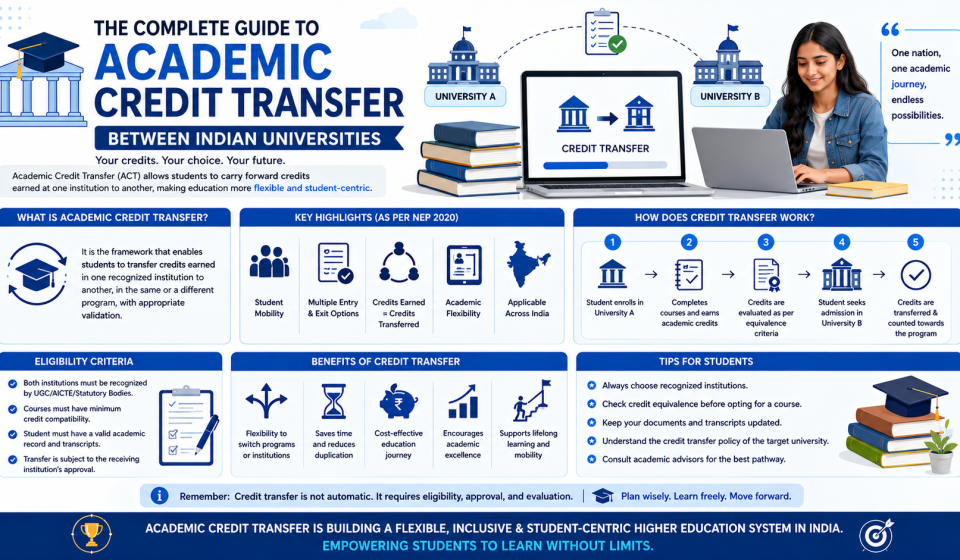
What Is Academic Credit Transfer?
Academic credit transfer allows students to move earned academic credits from one recognized institution to another.
Instead of repeating completed coursework, eligible credits may be accepted toward the completion of another academic program.
This system promotes educational flexibility and student mobility.
Understanding the Academic Bank of Credits (ABC)
The Academic Bank of Credits is a digital academic credit repository introduced under NEP 2020.
It allows students to:
- Store academic credits securely
- Access credit records digitally
- Transfer eligible credits
- Continue education after academic breaks
- Support lifelong learning
ABC simplifies academic record management.
Objectives of Credit Transfer
The system aims to:
- Increase academic flexibility
- Reduce repetition of coursework
- Support multidisciplinary education
- Encourage student mobility
- Improve access to higher education
- Promote continuous learning
These objectives align with global education practices.
Who Can Benefit?
Credit transfer is especially valuable for students who:
- Change colleges
- Relocate to another city
- Face personal or financial interruptions
- Pursue multidisciplinary education
- Return to education after a break
- Participate in exchange programs
The system supports diverse learning pathways.
How Academic Credits Work
Each successfully completed course carries a specified number of academic credits.
Credits generally reflect:
- Classroom learning
- Laboratory work
- Projects
- Practical training
- Internships
- Research activities
Accumulated credits contribute toward degree completion.
Eligibility for Credit Transfer
Eligibility depends on factors such as:
- Recognition of both institutions
- Program compatibility
- Course equivalence
- University regulations
- Academic performance
- Credit validity
Students should always review institutional policies before applying.
Role of Universities
Universities evaluate:
- Course content
- Learning outcomes
- Credit equivalence
- Program requirements
- Institutional recognition
The receiving institution determines whether credits will be accepted.
Benefits of Academic Credit Transfer
The system offers numerous advantages.
Students benefit through:
- Greater educational flexibility
- Reduced academic duplication
- Lower educational costs
- Faster degree completion
- Better career planning
- Improved learning opportunities
It also encourages lifelong education.
Support for Multidisciplinary Learning
Students can combine learning experiences across different disciplines.
Examples include:
- Technology with Management
- Economics with Data Science
- Psychology with Artificial Intelligence
- Commerce with Digital Marketing
Interdisciplinary education supports future career demands.
Multiple Entry and Exit Options
NEP 2020 also supports flexible academic progression.
Students may receive:
- Certificate after one year
- Diploma after two years
- Bachelor’s Degree after three years
- Bachelor’s Degree with Research after four years (where applicable)
Students can later resume studies using eligible academic credits.
Credit Transfer Process
A typical process includes:
- Registering with the Academic Bank of Credits
- Completing eligible coursework
- Maintaining academic records
- Applying for transfer
- University evaluation
- Credit approval
Specific procedures vary by institution.
Challenges Students Should Understand
Although beneficial, challenges may include:
- Differences in curriculum
- Credit equivalence issues
- Institutional policies
- Limited program compatibility
- Administrative processing time
Students should verify requirements before transferring.
Importance of Documentation
Students should safely maintain:
- Academic transcripts
- Credit statements
- Course syllabi
- Identity documents
- Admission records
- University correspondence
Proper documentation supports smooth transfer requests.
How Credit Transfer Improves Employability
Flexible education enables students to:
- Gain interdisciplinary knowledge
- Complete internships
- Learn specialized skills
- Pursue certifications
- Build stronger academic profiles
Employers increasingly value diverse educational experiences.
Future of Credit Transfer in India
As NEP 2020 continues to expand, credit transfer is expected to:
- Increase student mobility
- Improve global academic collaboration
- Encourage online learning
- Strengthen multidisciplinary education
- Support lifelong learning
- Modernize higher education
The future of Indian education is becoming increasingly flexible.
Tips for Students
To maximize credit transfer benefits:
- Choose recognized institutions.
- Register with the Academic Bank of Credits.
- Understand university regulations.
- Preserve academic records carefully.
- Seek academic counseling.
- Plan educational pathways strategically.
- Confirm credit eligibility before changing institutions.
Early planning helps avoid unnecessary academic delays.
Source
https://www.abc.gov.in
https://www.education.gov.in
https://www.ugc.gov.in
https://www.aicte-india.org
https://www.nad.gov.in
Conclusion
Academic credit transfer represents one of the most significant reforms introduced under India’s National Education Policy 2020. By enabling students to transfer eligible academic credits between recognized institutions through the Academic Bank of Credits, the education system has become more flexible, inclusive, and learner-centered. This initiative reduces academic disruptions, supports multidisciplinary learning, encourages lifelong education, and allows students to pursue personalized educational journeys without losing valuable academic progress. While institutional policies and program compatibility remain important considerations, students who understand the credit transfer process, maintain proper documentation, and plan their academic pathways strategically can benefit greatly from this modern approach to higher education. As implementation expands across India, academic credit transfer is expected to strengthen educational quality, improve student mobility, and prepare learners for an increasingly dynamic global workforce.
FAQ
1. What is academic credit transfer?
Academic credit transfer is a system that allows students to move eligible academic credits earned at one recognized institution to another, reducing the need to repeat completed coursework.
2. What is the Academic Bank of Credits (ABC)?
The Academic Bank of Credits is a digital platform introduced under NEP 2020 that securely stores students’ academic credits and facilitates eligible credit transfers between participating higher education institutions.
3. Can students transfer credits between all Indian universities?
Credit transfer depends on institutional recognition, course equivalence, university regulations, program compatibility, and participation in the Academic Bank of Credits framework. Not every transfer is automatically approved.
4. Who benefits the most from academic credit transfer?
Students who relocate, change colleges, pursue multidisciplinary education, take academic breaks, participate in exchange programs, or return to higher education after interruptions benefit significantly from credit transfer.
5. Does credit transfer reduce the duration of a degree?
If eligible credits are accepted by the receiving institution, students may avoid repeating completed courses, which can help reduce the time required to complete their degree.
6. What documents are needed for credit transfer?
Students typically require academic transcripts, course details, credit statements, identity documents, admission records, and other documentation requested by the receiving university.
7. Is registering with the Academic Bank of Credits necessary?
Students studying under institutions participating in the NEP 2020 framework are encouraged to register with the Academic Bank of Credits to securely maintain their academic credit records and support future credit transfers.
8. How can students maximize the benefits of academic credit transfer?
Students should choose recognized institutions, understand university regulations, maintain complete academic records, seek guidance from academic advisors, register with the Academic Bank of Credits, and verify credit eligibility before transferring institutions.