The Benefits of Choosing a College With Strong Research Opportunities: A Complete Guide to Academic Excellence, Innovation, and Career Success

Selecting the right college involves much more than comparing rankings, tuition fees, campus facilities, or placement statistics. One of the most valuable yet often overlooked factors is the availability of strong research opportunities.
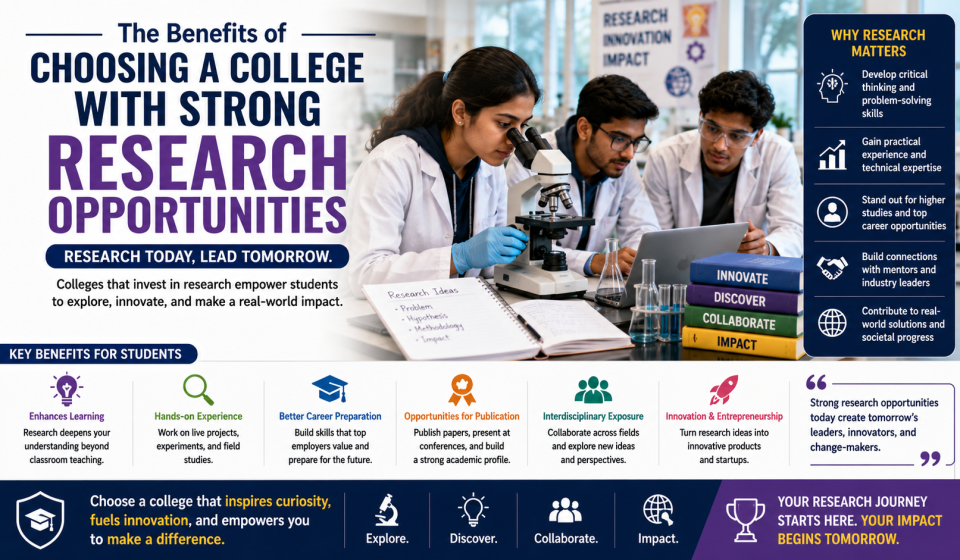
In today’s knowledge-driven economy, research experience is increasingly recognized as an important advantage by employers, graduate schools, and professional organizations. Students who participate in research develop critical thinking, data analysis, problem-solving, communication, teamwork, and project management skills that are applicable across industries. They also gain exposure to emerging technologies, academic publishing, conferences, patents, entrepreneurship, and innovation ecosystems. Beyond improving employability, research opportunities inspire lifelong learning, strengthen academic confidence, and open pathways to higher education, global collaborations, and leadership roles. This comprehensive guide explains the many benefits of choosing a college with strong research opportunities and how these experiences contribute to long-term academic and career success.
What Are College Research Opportunities?
Research opportunities are structured programs that allow students to investigate questions, develop solutions, analyze information, and contribute to new knowledge under faculty or industry guidance.
Common research opportunities include:
- Faculty-led research projects
- Undergraduate research programs
- Innovation laboratories
- Research internships
- Industry-sponsored projects
- Academic conferences
- Scientific publications
- Case study research
- Product development
- Startup incubation
These experiences encourage practical learning and innovation.
Why Research Opportunities Matter
Research transforms students from passive learners into active contributors.
Research participation helps students:
- Develop analytical thinking
- Improve academic performance
- Build confidence
- Strengthen technical skills
- Prepare for advanced education
- Enhance career readiness
Research supports holistic student development.
Developing Critical Thinking Skills
Research requires students to examine problems carefully and evaluate evidence.
Students learn to:
- Ask meaningful questions
- Analyze information objectively
- Interpret results
- Evaluate multiple perspectives
- Make informed decisions
Critical thinking benefits every profession.
Strengthening Problem-Solving Abilities
Every research project involves identifying challenges and exploring solutions.
Students improve their ability to:
- Investigate complex issues
- Design effective methodologies
- Test hypotheses
- Evaluate outcomes
- Recommend practical solutions
These skills are highly valued by employers.
Gaining Hands-On Learning Experience
Research complements classroom education by providing practical experience.
Students apply concepts learned in:
- Science
- Engineering
- Business
- Healthcare
- Social sciences
- Technology
- Arts and humanities
Practical application improves knowledge retention.
Working With Experienced Faculty
Research programs provide opportunities to collaborate closely with faculty mentors.
Faculty guidance helps students:
- Improve technical knowledge
- Build research methodology
- Develop academic writing
- Receive career advice
- Expand professional networks
Mentorship enhances educational growth.
Building a Strong Academic Profile
Research experience strengthens applications for:
- Graduate programs
- Scholarships
- Fellowships
- International universities
- Competitive internships
Academic achievements demonstrate commitment to learning.
Improving Communication Skills
Research requires effective communication throughout the project.
Students develop:
- Academic writing
- Technical reporting
- Presentation skills
- Public speaking
- Scientific communication
Strong communication supports professional success.
Exposure to Emerging Technologies
Research-oriented colleges often provide access to advanced technologies.
Students may work with:
- Artificial Intelligence
- Machine Learning
- Robotics
- Biotechnology
- Data Analytics
- Renewable Energy
- Cloud Computing
Technology exposure prepares students for future careers.
Encouraging Innovation and Entrepreneurship
Research often leads to innovative ideas and startup opportunities.
Students may participate in:
- Innovation competitions
- Patent development
- Business incubation
- Prototype creation
- Product commercialization
Innovation supports entrepreneurship.
Expanding Professional Networks
Research programs connect students with:
- Faculty researchers
- Industry experts
- Alumni
- Government organizations
- International collaborators
Networking creates future academic and career opportunities.
Career Advantages of Research Experience
Employers recognize research experience as evidence of initiative, curiosity, persistence, teamwork, analytical ability, and independent thinking. Students who have participated in research projects are often better prepared for technical roles, consulting, innovation, product development, healthcare, education, and management careers.
Global Learning Opportunities
Many research-focused colleges collaborate with international universities and organizations. Students may participate in exchange programs, global conferences, collaborative publications, and multinational research projects that broaden their academic and cultural perspectives.
Common Challenges
Research can be demanding and requires patience, discipline, and continuous learning. Students may face challenges such as time management, complex methodologies, limited funding, or data collection difficulties. Colleges with strong mentoring systems, research training workshops, and faculty support help students overcome these challenges successfully.
The Future of Research in Higher Education
Artificial intelligence, big data, sustainability research, interdisciplinary innovation, digital laboratories, virtual collaboration, open-access publishing, and global research partnerships are transforming higher education. Colleges that invest in research infrastructure will continue preparing students to solve future challenges through innovation and scientific discovery.
Source
https://www.unesco.org
https://www.oecd.org
https://www.nsf.gov
https://www.weforum.org
Conclusion
Choosing a college with strong research opportunities is one of the best decisions students can make for their academic and professional future. Research participation develops critical thinking, problem-solving, communication, leadership, and technical skills while providing valuable hands-on experience beyond traditional classroom education. Students gain exposure to innovation, advanced technologies, faculty mentorship, global collaborations, and professional networking that significantly enhance career readiness and opportunities for higher education. As industries increasingly seek graduates who can think creatively, analyze complex problems, and adapt to changing environments, research-focused colleges provide an ideal foundation for lifelong learning, innovation, and career success.
FAQ
1. Why are research opportunities important in college?
Research opportunities help students develop critical thinking, practical skills, problem-solving abilities, communication, innovation, and academic confidence while preparing them for advanced education and successful careers.
2. Can undergraduate students participate in research?
Yes. Many colleges offer undergraduate research programs where students work with faculty members, research centers, laboratories, or industry partners on academic and practical projects.
3. How does research improve career readiness?
Research strengthens analytical thinking, teamwork, project management, technical expertise, communication, and independent learning—qualities highly valued by employers across industries.
4. What types of research opportunities do colleges offer?
Colleges may provide faculty-led projects, innovation labs, industry collaborations, internships, academic conferences, scientific publications, startup incubation, and interdisciplinary research initiatives.
5. Does research experience help with higher education?
Yes. Research experience improves applications for postgraduate studies, scholarships, fellowships, international universities, and competitive academic programs by demonstrating strong academic engagement.
6. How can students choose a college with strong research opportunities?
Students should evaluate research laboratories, faculty expertise, undergraduate research programs, funding opportunities, industry partnerships, innovation centers, publication records, and student participation in conferences and projects before making an admission decision.