
Choosing where to pursue higher education is one of the most important decisions a student will make. With increasing globalization, technological advancement, and access to world-class education, students today have more options than ever before.
Both options offer unique advantages, opportunities, and challenges. Studying in India provides affordability, cultural familiarity, and access to rapidly growing educational institutions. On the other hand, studying abroad offers international exposure, global networking opportunities, diverse learning environments, and potential career advantages.
Why This Decision Matters
Higher education plays a significant role in shaping a student’s future.
The choice of study destination can influence:
- Academic experience.
- Career opportunities.
- Professional network.
- Cultural exposure.
- Personal development.
- Financial investment.
Because education is a long-term investment, selecting the right option requires careful planning and research.
Students should focus on what will best support their personal and professional goals rather than simply following popular trends.
The Growing Popularity of International Education
Over the past decade, thousands of Indian students have chosen to study abroad.
Popular destinations include:
- United States.
- Canada.
- United Kingdom.
- Australia.
- Germany.
- Singapore.
- Ireland.
Students are attracted by:
- Global university rankings.
- Research opportunities.
- International exposure.
- Career prospects.
- Advanced infrastructure.
At the same time, Indian universities are also making significant improvements in quality, innovation, and industry collaboration.
Benefits of Studying in India
India remains one of the largest higher education systems in the world.
Students who choose to study in India enjoy several advantages.
Affordable Education
One of the biggest benefits of studying in India is affordability.
Compared to international education, Indian institutions generally offer:
- Lower tuition fees.
- Reduced living expenses.
- Lower travel costs.
Students can often complete quality degree programs at a fraction of the cost of studying abroad.
This reduces financial stress and minimizes educational debt.
Cultural Familiarity
Studying in India allows students to remain within a familiar cultural environment.
Benefits include:
- Language comfort.
- Family support.
- Familiar food and lifestyle.
- Established social networks.
For many students, this familiarity contributes to a smoother educational experience.
Growing Academic Excellence
India is home to several highly respected institutions.
Many universities now offer:
- Modern infrastructure.
- Industry partnerships.
- Research opportunities.
- International collaborations.
Fields such as engineering, medicine, management, technology, and law continue to attract talented students from across the country.
Strong Domestic Career Opportunities
India’s rapidly expanding economy offers significant employment opportunities.
Graduates can pursue careers in:
- Information Technology.
- Healthcare.
- Finance.
- Manufacturing.
- Startups.
- Consulting.
Many global organizations actively recruit from Indian universities.
Challenges of Studying in India
While India offers numerous advantages, students should also consider potential limitations.
Challenges may include:
- Intense competition.
- Limited international exposure.
- Variations in institutional quality.
- Capacity constraints in top institutions.
Understanding these factors helps students make realistic educational decisions.
Benefits of Studying Abroad
Studying abroad offers unique experiences that extend beyond academics.
Students gain exposure to different cultures, educational systems, and professional environments.
Global Exposure
One of the most significant advantages of studying abroad is international exposure.
Students experience:
- Diverse cultures.
- Global perspectives.
- Multicultural environments.
- International networking opportunities.
This exposure often contributes to personal growth and broader worldviews.
Access to Specialized Programs
Many international universities offer specialized programs that may not be widely available elsewhere.
Students can access emerging fields such as:
- Artificial Intelligence.
- Sustainability Studies.
- Biotechnology.
- Data Science.
- Aerospace Engineering.
These specialized programs can provide a competitive advantage in future careers.
Advanced Research Opportunities
Leading international universities often invest heavily in research and innovation.
Students may benefit from:
- Modern laboratories.
- Research funding.
- Industry-sponsored projects.
- Access to renowned faculty.
Research-focused students often find significant opportunities in global academic environments.
Enhanced Global Employability
Employers increasingly value international experience.
Studying abroad can help students develop:
- Cross-cultural communication skills.
- Adaptability.
- Global awareness.
- Independent thinking.
These qualities are highly valued in multinational organizations.
Challenges of Studying Abroad
While studying abroad offers numerous benefits, it also comes with challenges.
Students should carefully consider:
Higher Costs
International education can be expensive.
Expenses often include:
- Tuition fees.
- Accommodation.
- Travel.
- Health insurance.
- Daily living costs.
Students may need scholarships, education loans, or financial support to manage these expenses.
Cultural Adjustment
Adapting to a new country can be challenging.
Students may experience:
- Homesickness.
- Cultural differences.
- Language barriers.
- Social adjustment challenges.
Successful adaptation requires flexibility and resilience.
Distance from Family
Living far from family and support systems can be emotionally difficult.
Students must learn to:
- Manage responsibilities independently.
- Handle personal challenges.
- Build new support networks.
While challenging, this often contributes to personal development.
Comparing Academic Quality
Academic quality varies significantly among institutions both in India and abroad.
Students should evaluate:
- Accreditation.
- Faculty expertise.
- Curriculum relevance.
- Research opportunities.
- Industry connections.
Rather than focusing solely on location, students should assess the quality of individual institutions and programs.
Career Opportunities: India vs Abroad
Career outcomes depend on multiple factors beyond study location.
Important considerations include:
- Industry demand.
- Skills acquired.
- Internship experience.
- Professional networking.
- Academic performance.
Both Indian and international graduates can achieve successful careers when they develop relevant skills and practical experience.
The Importance of Return on Investment
Education should be viewed as an investment.
Students should consider:
- Total educational costs.
- Expected salary outcomes.
- Employment opportunities.
- Career growth potential.
A higher-cost education is not always the best option if the return on investment is unclear.
Evaluating long-term value is essential.
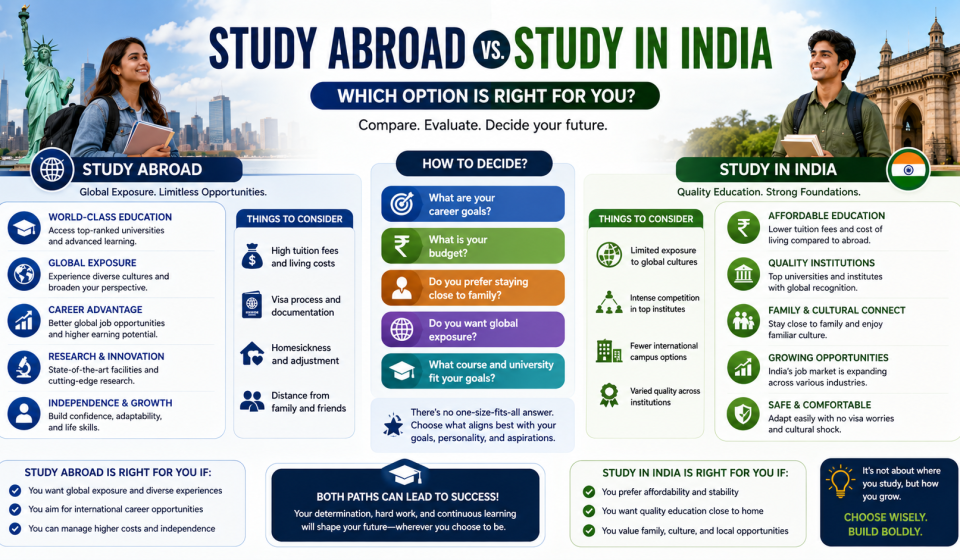
Factors to Consider Before Making a Decision
Students should ask themselves several important questions:
- What are my career goals?
- What is my budget?
- Which educational environment suits me best?
- Do I value international exposure?
- Am I prepared for cultural adaptation?
- What opportunities exist in my chosen field?
Honest self-assessment can lead to more informed decisions.
Who Should Consider Studying in India?
Studying in India may be ideal for students who:
- Prefer affordability.
- Want to remain close to family.
- Plan to build careers within India.
- Have access to strong domestic institutions.
- Prefer cultural familiarity.
Many students achieve exceptional academic and professional success through Indian universities.
Who Should Consider Studying Abroad?
Studying abroad may be suitable for students who:
- Seek international exposure.
- Want access to specialized programs.
- Are comfortable with cultural adaptation.
- Have financial resources or scholarships.
- Aspire to global career opportunities.
International education can provide valuable experiences that support long-term professional growth.
The Future of Global Education
Technology is transforming education worldwide.
Hybrid learning, international collaborations, virtual internships, and global partnerships are making education more interconnected.
As a result, students increasingly have access to world-class learning opportunities regardless of location.
Success will depend less on where students study and more on how effectively they utilize educational opportunities.
Source
https://www.studyinindia.gov.in
https://www.education.gov.in
https://www.timeshighereducation.com
https://www.topuniversities.com
https://www.oecd.org/education
Conclusion
The decision between studying abroad and studying in India is highly personal and depends on individual goals, financial circumstances, career aspirations, and learning preferences. Studying in India offers affordability, cultural familiarity, and access to a growing educational ecosystem, while studying abroad provides international exposure, specialized programs, and global networking opportunities. Neither option is universally better than the other. The best choice is the one that aligns most closely with a student’s academic interests, professional ambitions, and personal circumstances. By carefully evaluating all factors and focusing on long-term outcomes, students can make informed decisions that set the foundation for future success.
FAQ
Is studying abroad better than studying in India?
Not necessarily. Both options offer unique advantages. The best choice depends on your goals, budget, career plans, and personal preferences.
What are the advantages of studying in India?
Advantages include affordability, family support, cultural familiarity, lower living expenses, and strong domestic career opportunities.
What are the benefits of studying abroad?
Studying abroad offers international exposure, diverse learning environments, global networking opportunities, and access to specialized programs.
Is studying abroad expensive?
Yes, international education often involves higher tuition fees and living costs, although scholarships and financial aid may help reduce expenses.
Do employers prefer graduates who studied abroad?
Some employers value international experience, but skills, practical experience, and academic performance are often more important than study location alone.
How can I decide whether to study abroad or in India?
Consider factors such as career goals, budget, preferred learning environment, family circumstances, and long-term professional aspirations.
Can I get a good job after studying in India?
Absolutely. Many Indian universities produce highly successful graduates who secure excellent opportunities in India and internationally.
What should students prioritize when choosing a university?
Students should focus on academic quality, faculty expertise, industry connections, curriculum relevance, research opportunities, and career outcomes rather than location alone.