
Student exchange programs in India are becoming an important part of modern education. Today, students do not want only classroom learning. They want global exposure, practical knowledge, cultural understanding, better communication skills, and career-ready experience.
A student exchange program allows students to study at another institution for a short period, one semester, one academic year, or a specific training program. These programs can be national or international. In India, many universities and institutions now offer exchange opportunities through academic collaborations, foreign university partnerships, government schemes, cultural exchange programs, and institutional MoUs.
What Are Student Exchange Programs?
Student exchange programs are academic opportunities where students study at another college, university, or educational institution for a limited period. The student usually remains enrolled in the home institution but completes part of the academic learning at a host institution.
These programs may include semester exchange, summer school, research exchange, cultural exchange, internship-based exchange, short-term study tours, language programs, and international credit transfer programs. Some exchange programs are fully funded, some are partially funded, and some require students to pay tuition, travel, accommodation, and living expenses.
The main goal of a student exchange program is to help students experience different teaching methods, academic systems, cultures, and professional environments. It also supports international collaboration between institutions.
Why Student Exchange Programs Are Important in India
India’s higher education system is becoming more global and flexible. With the growth of international collaborations, digital learning, multidisciplinary education, and the National Education Policy 2020, students are getting more opportunities to learn beyond their own campus.
Student exchange programs support academic mobility. They allow students to move across institutions and gain exposure to different learning systems. This is useful because students today need global awareness, adaptability, communication skills, and practical experience.
For Indian institutions, exchange programs improve global partnerships and academic reputation. For students, they create opportunities for personal growth, professional networking, and career development.
Types of Student Exchange Programs in India
There are different types of student exchange programs available for Indian and international students. The first type is semester exchange, where students study at a partner university for one semester and earn academic credits.
The second type is short-term exchange, which may last from a few weeks to a few months. These programs often include workshops, summer schools, cultural learning, language training, or skill-based modules.
The third type is research exchange, where students work on research projects under faculty guidance at another institution. This is useful for postgraduate and doctoral students.
The fourth type is cultural exchange, where students learn about another country’s culture, language, traditions, lifestyle, and education system.
The fifth type is internship-based exchange, where students gain professional work experience in another institution, company, laboratory, or organization.
Benefits of Student Exchange Programs
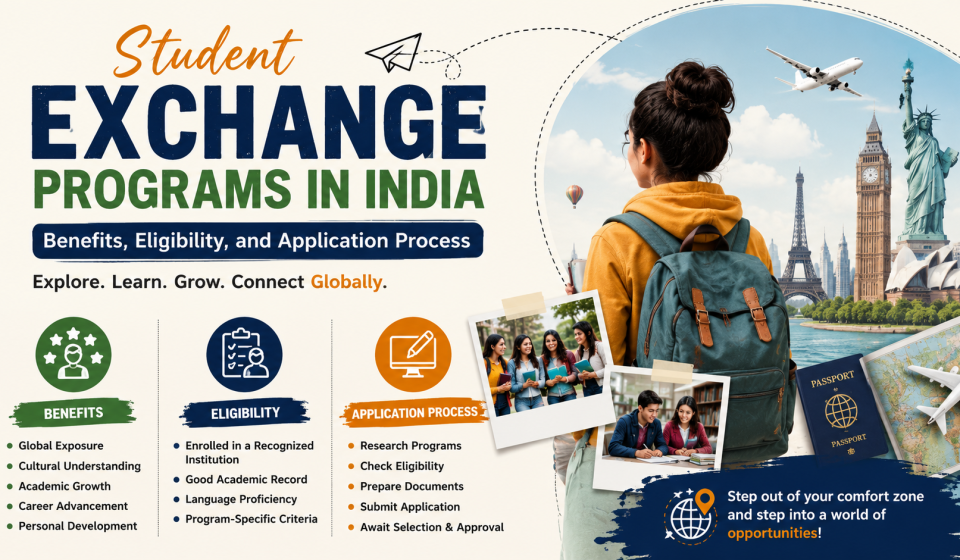
Student exchange programs offer many benefits. The biggest benefit is exposure. Students get a chance to study in a new environment and understand how education works in another institution or country.
Another major benefit is confidence building. Living and studying in a new place helps students become independent, responsible, adaptable, and mature. They learn how to manage time, communicate with new people, solve problems, and adjust to different situations.
Exchange programs also improve communication skills. Students interact with people from different backgrounds, which helps them become more open-minded and culturally aware.
Academically, exchange programs help students learn new subjects, attend different teaching styles, access new resources, and work with experienced faculty. Professionally, they improve resumes and make students stand out during internships, placements, and higher education applications.
Career Advantages of Exchange Programs
A student exchange program can add strong value to a resume. Employers often appreciate students who have international or inter-institutional exposure because it shows adaptability, confidence, communication ability, and willingness to learn.
Students who complete exchange programs may develop better problem-solving skills, teamwork skills, leadership ability, and cross-cultural understanding. These qualities are highly useful in multinational companies, startups, research organizations, NGOs, academic institutions, and global career paths.
Exchange experience can also help students during interviews. They can speak about real learning experiences, challenges faced, projects completed, and skills developed during the program. This makes their profile more attractive and practical.
Academic Benefits for Students
Exchange programs allow students to explore subjects that may not be available in their home institution. They may get access to better labs, research facilities, libraries, digital tools, industry-linked courses, or expert faculty.
Students can also experience new teaching methods. Some institutions focus more on discussions, case studies, projects, presentations, lab work, field visits, or research assignments. This can improve learning quality and academic confidence.
In many exchange programs, credits earned at the host institution may be transferred to the student’s home institution, depending on the agreement between universities. This helps students continue their degree without academic loss.
Cultural and Personal Growth
One of the most valuable parts of a student exchange program is cultural learning. Students get to experience new traditions, food, languages, festivals, lifestyles, and social values. This helps them become more respectful, flexible, and globally aware.
Students also learn independence. They may need to manage accommodation, travel, food, budget, documents, classes, and daily responsibilities on their own. These experiences build maturity and life skills.
Cultural exposure also helps students reduce fear and hesitation. They learn to interact with people from different regions and countries, which improves confidence and social understanding.
Eligibility for Student Exchange Programs in India
Eligibility criteria may vary from one institution to another, but there are some common requirements. Students usually need to be enrolled in a recognized school, college, or university. For higher education exchange programs, students are generally required to have good academic performance.
Many universities ask for a minimum CGPA or percentage. Students may also need approval from their department or international relations office. For international exchange, English language proficiency may be required, especially if the host institution teaches in English.
Students must also have a valid passport for international programs. Some programs may require a statement of purpose, recommendation letters, resume, academic transcripts, and proof of financial support.
For some cultural exchange or scholarship-based programs, leadership skills, extracurricular achievements, community service, and interview performance may also matter.
Documents Required for Application
Students should prepare documents carefully before applying. Common documents include academic transcripts, student ID proof, passport, resume, statement of purpose, recommendation letters, passport-size photographs, language proficiency certificate, financial documents, and application form.
For international programs, students may also need a visa, health insurance, vaccination certificate, travel insurance, invitation letter, acceptance letter, and accommodation details.
It is important to check the official requirement list of the specific exchange program because missing documents can delay or reject the application.
Step-by-Step Application Process
The first step is to find exchange opportunities. Students should check their college website, international relations office, notice boards, university emails, government portals, scholarship websites, and partner university announcements.
The second step is to check eligibility. Students must read the academic, language, financial, age, course, and document requirements carefully.
The third step is to speak with the department or faculty coordinator. Academic approval is important because students need to ensure that the exchange program fits their course structure and credit requirements.
The fourth step is to prepare documents such as transcripts, resume, statement of purpose, recommendation letters, passport, and financial proof.
The fifth step is to submit the application before the deadline. Students should avoid last-minute applications because exchange programs often require multiple approvals.
The sixth step is selection. Selection may be based on academic performance, statement of purpose, interview, language skills, extracurricular record, and availability of seats.
The seventh step is confirmation and travel preparation. Once selected, students may need to complete visa formalities, accommodation booking, insurance, ticket booking, fee payment, and pre-departure orientation.
How to Write a Strong Statement of Purpose
A statement of purpose is an important part of many exchange applications. It should clearly explain why you want to join the program, how it fits your academic goals, what skills you hope to gain, and how you will use the experience in the future.
Students should avoid writing general statements. Instead, they should mention specific courses, faculty, research areas, cultural learning goals, or career benefits related to the host institution.
A good statement of purpose should be honest, focused, and personal. It should show motivation, maturity, clarity, and seriousness.
Cost of Student Exchange Programs
The cost of a student exchange program depends on the destination, duration, institution, scholarship availability, and type of program. Common expenses include tuition fees, travel, visa, accommodation, food, insurance, local transport, books, and personal expenses.
Some exchange programs are fully funded and cover tuition, travel, living expenses, and insurance. Some are partially funded and cover only tuition or accommodation. Some programs are self-funded.
Students should calculate the full cost before applying. They should also check scholarships, grants, fee waivers, university funding, government support, and education loans if needed.
Popular Exchange Opportunities for Indian Students
Indian students can explore exchange opportunities through their own universities, international partner institutions, government-backed programs, cultural exchange organizations, and global scholarship schemes.
Many Indian institutions have partnerships with universities in countries like the United States, United Kingdom, Germany, France, Japan, Australia, Canada, Singapore, and South Korea. Students should check their institution’s official international relations office for current opportunities.
Programs such as Global UGRAD, Erasmus-related opportunities, ICCR cultural initiatives, and university-level exchange programs can also be useful depending on eligibility and availability.
Student Exchange Programs for International Students in India
India is also becoming a popular destination for international students. The country offers diverse academic programs, affordable education, cultural richness, and globally recognized institutions.
International students can explore programs through Study in India, ICCR scholarships, university partnerships, and direct institutional exchange agreements. India offers courses in engineering, management, medicine, humanities, social sciences, yoga, Ayurveda, Indian culture, technology, and research.
Studying in India gives international students the chance to experience a unique combination of modern education and cultural diversity.
Challenges Students May Face
Student exchange programs are exciting, but students may face challenges. Common challenges include homesickness, language barriers, culture shock, academic pressure, food adjustment, financial planning, travel stress, and documentation issues.
Students may also find different teaching styles difficult at first. Some institutions may expect more independent study, presentations, group work, or research-based assignments.
The best way to handle these challenges is preparation. Students should research the host institution, understand the academic system, prepare documents early, manage budget properly, and stay connected with mentors and coordinators.
Tips to Make the Most of an Exchange Program
Students should participate actively in classes, events, cultural activities, workshops, and networking sessions. They should build relationships with faculty, classmates, alumni, and international students.
It is also important to maintain academic discipline. Students should attend classes regularly, complete assignments on time, and follow host institution rules.
Students should document their experience through notes, projects, certificates, photos, and reflections. These can later help in resumes, interviews, blogs, portfolios, and higher education applications.
Source
https://www.studyinindia.gov.in
https://iccr.gov.in
https://exchanges.state.gov/non-us/tag/india
https://www.aicte-india.org
Conclusion
Student exchange programs in India are powerful opportunities for academic, personal, cultural, and career growth. They help students learn beyond textbooks, experience different education systems, build confidence, improve communication skills, and develop a global mindset. For Indian students, exchange programs can open doors to international learning and professional exposure. For international students, India offers quality education, cultural diversity, and affordable academic opportunities.
Before applying, students should carefully check eligibility, documents, costs, deadlines, credit transfer rules, and scholarship options. A successful exchange experience requires planning, preparation, and an open mind. When used wisely, student exchange programs can become a life-changing part of a student’s educational journey and future career success.
FAQ
1. What is a student exchange program?
A student exchange program allows students to study at another institution for a short period, semester, or academic year while remaining connected to their home institution.
2. Who can apply for student exchange programs in India?
Students enrolled in recognized schools, colleges, or universities can apply, depending on the program’s eligibility criteria, academic requirements, and institutional rules.
3. Are student exchange programs only for international study?
No, exchange programs can be national or international. Students may study at another institution within India or in another country.
4. What documents are required for exchange programs?
Common documents include academic transcripts, resume, statement of purpose, recommendation letters, passport, ID proof, application form, financial proof, and language proficiency certificate.
5. Are exchange programs fully funded?
Some exchange programs are fully funded, some are partially funded, and some are self-funded. Students should check scholarship and funding details before applying.
6. Can exchange program credits be transferred?
Yes, credits may be transferred if the home and host institutions have proper agreements and academic approval. Students should confirm credit transfer rules before applying.
7. Do exchange programs improve career opportunities?
Yes, exchange programs can improve resumes, communication skills, global exposure, adaptability, confidence, and professional networking, which can help in career growth.
8. How can Indian students find exchange programs?
Indian students can check their university’s international relations office, official college website, government portals, scholarship platforms, and partner university announcements.
9. Is English proficiency required for exchange programs?
Many international exchange programs require English proficiency, especially if the host institution teaches in English. Requirements depend on the program and university.
10. What should students check before applying?
Students should check eligibility, cost, documents, deadline, credit transfer, visa rules, accommodation, insurance, scholarship options, and academic approval.