
Education has undergone significant changes over the past few decades, driven by technological advancements, evolving workforce demands, and a deeper understanding of how students learn. Traditional education systems often follow a one-size-fits-all approach, where every student receives the same instruction regardless of their learning style, pace, strengths, or interests. While this model has served generations of learners, it often fails to address individual learning needs effectively.
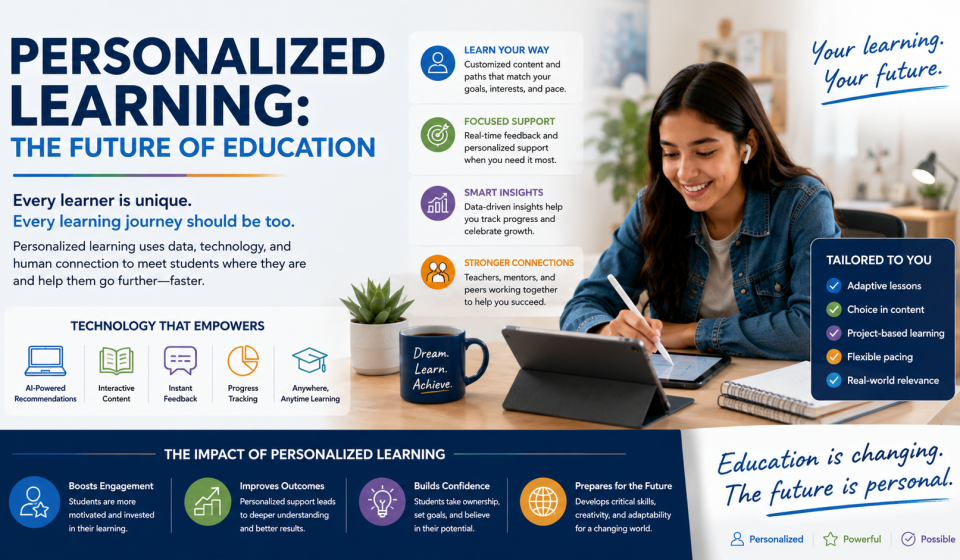
Personalized learning is emerging as a powerful solution to this challenge. By tailoring educational experiences to the unique needs, abilities, and goals of each student, personalized learning is transforming how knowledge is delivered and acquired. With the support of educational technology, artificial intelligence, data analytics, and adaptive learning platforms, students can now enjoy customized learning experiences that improve engagement, understanding, and academic outcomes.
As educational institutions continue to embrace innovation, personalized learning is increasingly recognized as the future of education. This approach empowers students to take ownership of their learning journey while helping educators provide more effective and meaningful instruction.
What Is Personalized Learning?
Personalized learning is an educational approach that adapts teaching methods, learning content, pace, and assessment strategies to meet the individual needs of each student.
Unlike traditional classrooms where all students follow the same curriculum at the same pace, personalized learning allows learners to:
- Progress according to their abilities
- Focus on areas requiring improvement
- Explore subjects of interest
- Learn through preferred methods
- Receive targeted support
The goal is to create a student-centered learning experience that maximizes educational success.
Why Traditional Learning Models Face Challenges
Traditional education systems often struggle to accommodate the diverse needs of students.
Common challenges include:
- Different learning speeds
- Varied learning styles
- Diverse academic backgrounds
- Limited individual attention
- Standardized teaching methods
As a result, some students may become disengaged, overwhelmed, or under-challenged.
Personalized learning addresses these issues by recognizing that every learner is unique.
The Evolution of Personalized Learning
The concept of individualized instruction is not new. Teachers have always attempted to adapt lessons to student needs whenever possible.
However, modern technology has made large-scale personalization more practical and effective.
Advancements such as:
- Artificial Intelligence
- Learning Management Systems
- Educational Apps
- Adaptive Learning Software
- Learning Analytics
have enabled institutions to provide customized learning experiences for larger groups of students.
Key Principles of Personalized Learning
Student-Centered Learning
Personalized learning places students at the center of the educational process.
Students actively participate in:
- Goal setting
- Learning decisions
- Progress tracking
- Skill development
This approach increases engagement and ownership.
Flexible Learning Paths
Students can follow different pathways to achieve learning objectives.
Flexibility may involve:
- Customized assignments
- Alternative learning resources
- Individual pacing
- Specialized projects
Flexible pathways accommodate diverse learning needs and interests.
Competency-Based Progression
Rather than advancing based solely on time spent in class, students progress after demonstrating mastery of specific skills or concepts.
This ensures deeper understanding and stronger learning outcomes.
Continuous Assessment
Personalized learning relies on ongoing evaluation rather than infrequent standardized testing.
Regular assessments help educators:
- Monitor progress
- Identify challenges
- Adjust instruction
- Provide targeted support
Benefits of Personalized Learning
Improved Student Engagement
When students learn content relevant to their interests and abilities, engagement increases significantly.
Engaged learners are more likely to:
- Participate actively
- Retain information
- Complete assignments
- Achieve academic success
Better Academic Performance
Customized instruction helps students focus on areas requiring improvement while building upon existing strengths.
Research consistently shows that personalized learning can improve academic achievement and knowledge retention.
Increased Motivation
Students often feel more motivated when they have control over aspects of their learning experience.
Personalized learning encourages:
- Goal setting
- Self-reflection
- Independent learning
- Continuous improvement
Motivated learners are more likely to persist through challenges.
Supports Diverse Learning Styles
Every student learns differently.
Some learners prefer:
- Visual materials
- Audio resources
- Hands-on activities
- Reading-based instruction
Personalized learning accommodates multiple learning styles and preferences.
Builds Confidence
Students progress at their own pace without constant comparison to peers.
This reduces frustration and helps learners develop confidence in their abilities.
The Role of Technology in Personalized Learning
Educational technology plays a critical role in delivering personalized experiences.
Artificial Intelligence
AI-powered systems can:
- Analyze learning patterns
- Recommend resources
- Identify knowledge gaps
- Customize lessons
These capabilities help create individualized learning journeys.
Adaptive Learning Platforms
Adaptive learning systems automatically adjust content difficulty based on student performance.
Benefits include:
- Immediate feedback
- Personalized challenges
- Improved retention
- Enhanced engagement
Learning Analytics
Data collected from student interactions helps educators understand:
- Learning behaviors
- Progress trends
- Areas of difficulty
- Performance patterns
Data-driven insights support more effective teaching strategies.
Online Learning Platforms
Digital platforms provide access to diverse educational resources, allowing students to learn according to their preferences and schedules.
Personalized Learning in Higher Education
Colleges and universities increasingly incorporate personalized learning approaches.
Benefits for higher education students include:
- Flexible course options
- Customized degree pathways
- Personalized academic support
- Career-focused learning experiences
These innovations help students achieve both academic and professional goals.
Personalized Learning and Career Readiness
Modern employers seek individuals who can learn independently and adapt to changing environments.
Personalized learning helps students develop:
- Critical thinking
- Problem-solving skills
- Self-management
- Digital literacy
- Lifelong learning habits
These competencies are essential for long-term career success.
Challenges of Personalized Learning
Despite its advantages, personalized learning presents certain challenges.
Technology Access
Not all students have equal access to devices and internet connectivity.
Addressing digital inequality remains an important priority.
Implementation Costs
Developing and maintaining personalized learning systems may require significant investments in technology and training.
Teacher Training
Educators need professional development to effectively implement personalized learning strategies.
Data Privacy
Protecting student information and ensuring ethical use of educational data are critical concerns.
Future Trends in Personalized Learning
Artificial Intelligence Expansion
AI will continue improving adaptive learning systems and educational recommendations.
Virtual Reality and Augmented Reality
Immersive technologies will create highly engaging and personalized educational experiences.
Microlearning
Short, focused lessons will allow learners to acquire knowledge efficiently and flexibly.
Predictive Analytics
Advanced data analysis will help identify learning challenges before they become significant obstacles.
Lifelong Personalized Learning
Personalized education will extend beyond formal schooling, supporting continuous professional and personal development.
How Students Can Benefit from Personalized Learning
Students can maximize personalized learning opportunities by:
- Setting clear goals
- Monitoring progress
- Seeking feedback
- Using digital learning tools
- Exploring different learning methods
Active participation enhances the effectiveness of personalized education.
Why Personalized Learning Represents the Future
The future of education requires approaches that recognize individual differences and prepare students for a rapidly changing world.
Personalized learning offers:
- Greater flexibility
- Enhanced engagement
- Improved outcomes
- Better career preparation
- Lifelong learning support
As technology continues to evolve, personalized learning will likely become a standard component of educational systems worldwide.
Source Links
https://www.unesco.org
https://www.edx.org
https://www.coursera.org
https://www.khanacademy.org
https://www.weforum.org
https://www.education.com
Conclusion
Personalized learning is transforming education by placing students at the center of the learning experience. Through customized instruction, adaptive technologies, flexible learning pathways, and data-driven insights, personalized learning addresses the diverse needs of modern learners more effectively than traditional educational models. As educational technology continues to advance, personalized learning will play an increasingly important role in improving academic achievement, enhancing engagement, and preparing students for future careers. By embracing personalized learning, educational institutions can create more inclusive, effective, and future-ready learning environments that empower every student to reach their full potential.
FAQ
1. What is personalized learning?
Personalized learning is an educational approach that tailors instruction, content, pace, and learning experiences to meet the unique needs of each student.
2. How does personalized learning differ from traditional education?
Traditional education often uses a one-size-fits-all model, while personalized learning adapts to individual student needs and preferences.
3. What role does technology play in personalized learning?
Technology supports personalized learning through adaptive platforms, artificial intelligence, learning analytics, and digital educational resources.
4. What are the benefits of personalized learning?
Benefits include improved engagement, higher academic achievement, increased motivation, stronger confidence, and better learning outcomes.
5. Can personalized learning improve career readiness?
Yes, personalized learning helps students develop critical thinking, problem-solving, self-management, and lifelong learning skills valued by employers.
6. What challenges does personalized learning face?
Challenges include technology access, implementation costs, teacher training requirements, and data privacy concerns.
7. Is personalized learning suitable for higher education?
Yes, many colleges and universities use personalized learning strategies to support diverse student needs and career goals.
8. Why is personalized learning considered the future of education?
It provides flexible, student-centered, technology-driven learning experiences that better prepare learners for modern academic and professional environments.