
Higher education has evolved far beyond traditional lectures, textbooks, and examinations. In today’s competitive and technology-driven world, employers seek graduates who can apply theoretical knowledge to solve real-world challenges.
As industries continue to embrace innovation, digital transformation, and global collaboration, higher education institutions are increasingly integrating experiential learning into their academic programmes. Students who participate in real-world learning experiences not only improve their academic understanding but also develop communication, leadership, teamwork, and problem-solving skills that employers highly value. By combining classroom instruction with practical application, experiential learning prepares students for successful careers while fostering lifelong learning, adaptability, and personal growth.
What Is Experiential Learning?
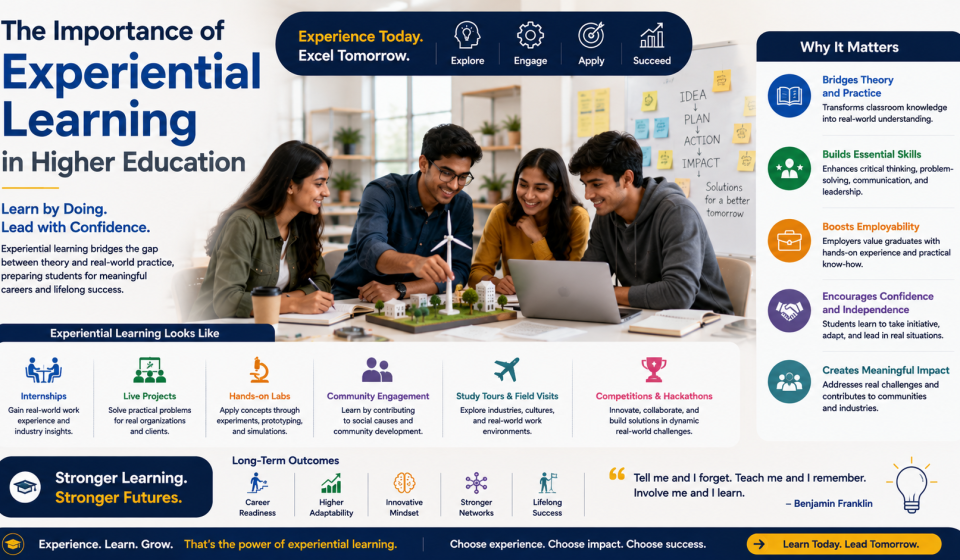
Experiential learning is an educational approach where students learn by actively participating in practical experiences rather than relying solely on theoretical instruction. The concept is based on the idea that meaningful learning occurs when individuals apply knowledge, reflect on their experiences, and continuously improve their understanding.
Experiential learning may include:
- Internships
- Industrial training
- Live business projects
- Laboratory experiments
- Research projects
- Community service
- Field visits
- Study tours
- Simulations
- Case studies
- Entrepreneurship programmes
- Capstone projects
Students become active participants in their education instead of passive learners.
Why Experiential Learning Matters in Higher Education
Higher education should prepare students for professional success, not just academic achievement.
Experiential learning helps students:
- Apply classroom concepts
- Develop practical skills
- Understand workplace expectations
- Build professional confidence
- Improve decision-making
- Enhance employability
- Develop lifelong learning habits
It bridges the gap between education and employment.
Connects Theory with Real-World Practice
Traditional lectures explain concepts, but experiential learning demonstrates how those concepts work in real situations.
For example:
- Engineering students build prototypes.
- Business students analyse real companies.
- Computer science students develop software.
- Healthcare students participate in clinical training.
- Marketing students create live campaigns.
Applying knowledge improves understanding and retention.
Improves Knowledge Retention
Students generally remember information better when they actively use it.
Practical learning encourages:
- Observation
- Experimentation
- Reflection
- Problem-solving
- Active participation
These experiences strengthen long-term memory and understanding.
Develops Critical Thinking Skills
Modern workplaces require analytical thinking.
Experiential learning challenges students to:
- Analyse situations
- Evaluate information
- Make informed decisions
- Solve practical problems
- Think creatively
Critical thinking enables graduates to adapt to complex workplace situations.
Enhances Problem-Solving Abilities
Real-world projects rarely have perfect solutions.
Students learn how to:
- Identify challenges
- Evaluate alternatives
- Test solutions
- Learn from mistakes
- Improve outcomes
These experiences prepare students for professional responsibilities.
Strengthens Communication Skills
Practical learning often involves teamwork and presentations.
Students improve:
- Public speaking
- Business communication
- Professional writing
- Active listening
- Presentation skills
Effective communication supports career advancement across every industry.
Builds Teamwork and Collaboration
Most professional environments require collaboration.
Experiential learning teaches students how to:
- Share responsibilities
- Resolve conflicts
- Respect different perspectives
- Achieve common goals
- Support team members
Strong collaboration skills improve workplace performance.
Increases Student Engagement
Students become more motivated when learning feels meaningful.
Hands-on experiences:
- Make lessons interesting
- Encourage participation
- Increase curiosity
- Improve classroom interaction
- Reduce passive learning
Higher engagement often leads to better academic outcomes.
Prepares Students for Employment
Employers increasingly seek graduates with practical experience.
Experiential learning provides exposure to:
- Workplace culture
- Professional ethics
- Industry expectations
- Business operations
- Customer interactions
- Project management
Students graduate with valuable real-world experience.
Supports Career Exploration
Experiential learning helps students understand different career paths before graduation.
Through internships and projects, students can:
- Explore industries
- Identify interests
- Discover strengths
- Build career confidence
- Make informed career decisions
Early exposure reduces career uncertainty.
Encourages Innovation and Creativity
Hands-on learning encourages students to think differently.
Activities such as:
- Design thinking
- Innovation competitions
- Startup incubators
- Research projects
- Product development
help students create original solutions to real challenges.
Promotes Independent Learning
Experiential learning encourages students to take responsibility for their education.
Students develop:
- Self-motivation
- Initiative
- Accountability
- Time management
- Research skills
Independent learners continue growing throughout their careers.
Builds Professional Confidence
Real-world experiences reduce anxiety about entering the workforce.
Students become more confident by:
- Completing internships
- Presenting projects
- Working with professionals
- Solving business problems
- Receiving constructive feedback
Confidence improves interview performance and workplace success.
Strengthens Leadership Skills
Experiential learning provides opportunities to lead teams and manage projects.
Leadership experiences teach students:
- Decision-making
- Delegation
- Responsibility
- Motivation
- Strategic thinking
These qualities support long-term career growth.
Encourages Reflection and Continuous Improvement
Reflection is a core component of experiential learning.
Students regularly evaluate:
- What they learned
- What challenges they faced
- How they solved problems
- What they can improve
Reflection transforms experience into meaningful knowledge.
Types of Experiential Learning in Higher Education
Common experiential learning methods include:
Internships
Provide workplace experience under professional supervision.
Industrial Training
Introduces students to industry operations and technologies.
Laboratory Work
Allows scientific experimentation and technical skill development.
Field Visits
Expose students to real business environments and operational processes.
Research Projects
Develop analytical thinking and innovation.
Community Service
Encourages civic responsibility and social awareness.
Simulations
Create realistic environments for decision-making and skill practice.
Capstone Projects
Allow students to apply everything learned during their academic programme.
Benefits Across Different Academic Disciplines
Engineering
Students gain experience designing, testing, and improving systems.
Business
Learners solve marketing, finance, and management challenges.
Healthcare
Clinical placements improve patient care skills.
Computer Science
Students build software, websites, mobile applications, and AI solutions.
Education
Teaching practice prepares future educators for classroom management.
Environmental Science
Field research strengthens scientific understanding.
Every discipline benefits from practical learning.
The Role of Technology in Experiential Learning
Technology has expanded experiential education through:
- Virtual laboratories
- AI-powered simulations
- Augmented Reality (AR)
- Virtual Reality (VR)
- Remote internships
- Cloud collaboration platforms
- Digital project management tools
Technology makes practical learning more accessible and engaging.
Challenges of Experiential Learning
Although highly beneficial, experiential learning may involve challenges such as:
- Limited internship availability
- Resource constraints
- Scheduling conflicts
- Unequal access to opportunities
- Financial limitations
- Industry partnership gaps
Educational institutions should work closely with employers to address these challenges.
Tips for Students to Maximise Experiential Learning
Students can gain the greatest value by:
- Participating actively
- Asking questions
- Seeking feedback
- Reflecting on experiences
- Building professional relationships
- Maintaining portfolios
- Developing soft skills
- Applying classroom concepts
A proactive attitude leads to greater personal and professional growth.
Long-Term Benefits of Experiential Learning
Students who engage in experiential learning often experience:
- Better academic performance
- Higher employability
- Stronger technical skills
- Improved communication
- Increased confidence
- Better problem-solving abilities
- Stronger professional networks
- Greater career clarity
- Leadership development
- Lifelong learning habits
These long-term advantages prepare graduates for success in a rapidly changing global economy.
Source
https://www.unesco.org
https://www.weforum.org
https://www.naceweb.org
https://www.oecd.org
https://www.aacu.org
https://www.coursera.org
https://www.edx.org
Conclusion
Experiential learning has become an essential part of higher education because it bridges the gap between theoretical knowledge and practical application. Through internships, live projects, research, field experiences, simulations, and community engagement, students gain valuable real-world exposure that strengthens both academic understanding and professional readiness. These experiences help learners develop technical expertise, communication skills, leadership qualities, critical thinking, and adaptability—competencies that are highly valued in today’s competitive job market.
As higher education continues to evolve alongside technological innovation and changing industry demands, experiential learning will remain a cornerstone of student success. Institutions that integrate practical learning into their curriculum prepare graduates who are not only academically capable but also confident, innovative, and ready to contribute effectively in the workplace. For students, actively participating in experiential learning opportunities is one of the most effective ways to build meaningful careers, expand professional networks, and develop lifelong skills that extend far beyond the classroom.
FAQ
1. What is experiential learning?
Experiential learning is a teaching approach where students gain knowledge and skills through practical experiences such as internships, research, projects, simulations, laboratory work, and community engagement.
2. Why is experiential learning important in higher education?
It helps students apply theoretical knowledge, develop practical skills, improve problem-solving abilities, strengthen communication, and become better prepared for professional careers.
3. What are examples of experiential learning?
Examples include internships, industrial training, live business projects, laboratory experiments, field visits, research assignments, simulations, service-learning, entrepreneurship programmes, and capstone projects.
4. How does experiential learning improve employability?
Students gain workplace experience, technical competence, professional confidence, teamwork, leadership, and communication skills that employers value during recruitment.
5. Can experiential learning improve academic performance?
Yes. Active participation, practical application, and reflective learning improve understanding, knowledge retention, classroom engagement, and overall academic outcomes.
6. What skills do students develop through experiential learning?
Students develop critical thinking, communication, teamwork, leadership, adaptability, time management, creativity, technical expertise, and decision-making skills.
7. What challenges are associated with experiential learning?
Some challenges include limited internship opportunities, resource constraints, scheduling difficulties, financial barriers, and varying access to industry partnerships.
8. What is the biggest benefit of experiential learning in higher education?
The greatest benefit is preparing students to confidently transition from academic study to professional careers by combining classroom learning with real-world experience.