How to Evaluate Campus Learning Resources Like an Expert: The Complete Guide to Choosing a College That Supports Academic Success

Selecting the right college involves much more than comparing rankings, tuition fees, or placement statistics. One of the most important yet often overlooked factors is the quality of campus learning resources. These resources directly influence how effectively.
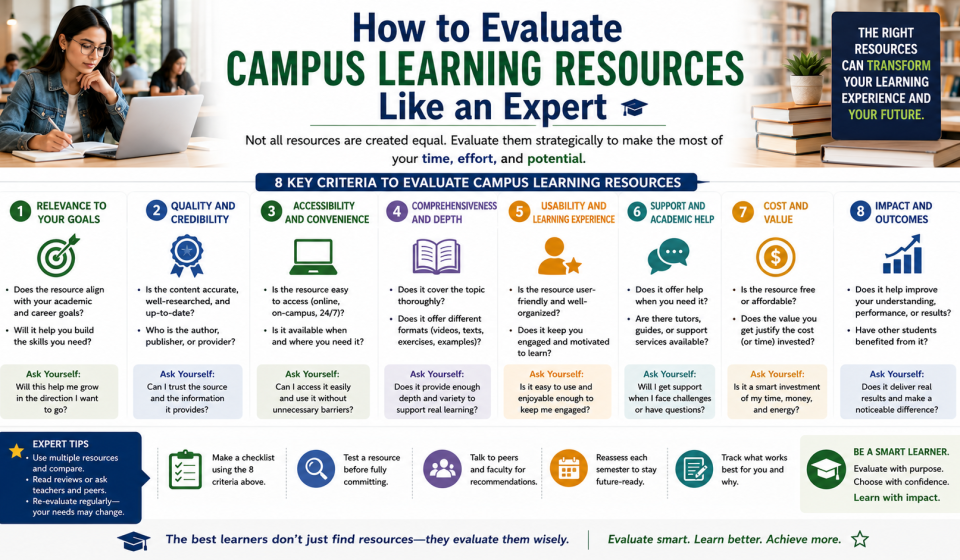
In today’s rapidly evolving educational landscape, colleges are investing heavily in technology-enabled learning, interdisciplinary education, experiential learning, research facilities, and student-centered support systems. However, simply having impressive infrastructure is not enough. Students should assess how frequently these resources are used, whether they are easily accessible, how well they align with academic programs, and how effectively they contribute to student learning outcomes. A campus with well-maintained, inclusive, and innovative learning resources helps students develop critical thinking, creativity, technical expertise, and lifelong learning habits. This comprehensive guide explains how to evaluate campus learning resources like an expert and identify institutions that truly support academic excellence and career readiness.
Why Campus Learning Resources Matter
Learning resources extend education beyond classroom lectures.
They help students:
- Understand complex concepts
- Practice practical skills
- Conduct research
- Collaborate with peers
- Develop creativity
- Prepare for careers
High-quality resources improve both academic performance and overall student experience.
What Are Campus Learning Resources?
Campus learning resources include all facilities, services, technologies, and support systems that enhance learning.
Examples include:
- Libraries
- Laboratories
- Computer centers
- Digital learning platforms
- Innovation hubs
- Study spaces
- Academic support centers
- Career services
- Research facilities
- Faculty mentoring
Each resource contributes to student development in different ways.
Evaluate the Library
A modern academic library should provide more than printed books.
Look for:
- Updated book collections
- Academic journals
- Digital libraries
- Research databases
- Quiet study areas
- Group discussion rooms
- Librarian assistance
A strong library supports independent learning and research.
Check Digital Learning Resources
Digital education has become an essential part of higher education.
Evaluate whether the college offers:
- Learning Management Systems (LMS)
- Recorded lectures
- E-books
- Online journals
- Virtual classrooms
- Digital assessments
Accessible digital resources improve flexible learning.
Assess Laboratory Facilities
Laboratories should support practical learning.
Consider:
- Modern equipment
- Safety standards
- Regular maintenance
- Industry-standard software
- Student accessibility
- Faculty supervision
Well-equipped labs strengthen technical education.
Visit Computer Centers
Computer facilities should include:
- High-performance systems
- Licensed software
- Internet connectivity
- Technical support
- Printing services
- Specialized applications
Technology access supports both coursework and research.
Examine Research Opportunities
Research resources indicate academic strength.
Ask about:
- Research centers
- Faculty-led projects
- Undergraduate research
- Research funding
- Publications
- Conferences
Research participation develops analytical skills.
Explore Innovation and Entrepreneurship Centers
Innovation hubs encourage creativity and practical problem-solving.
Facilities may include:
- Startup incubators
- Makerspaces
- AI laboratories
- Robotics labs
- Prototype workshops
These centers prepare students for emerging careers.
Evaluate Academic Support Services
Academic support improves student success.
Important services include:
- Tutoring
- Writing centers
- Mathematics support
- Language assistance
- Peer mentoring
- Study skills workshops
These resources help students overcome academic challenges.
Assess Faculty Accessibility
Learning resources include people as well as facilities.
Students should evaluate whether faculty members:
- Hold regular office hours
- Mentor students
- Support research
- Encourage discussion
- Provide academic guidance
Accessible faculty improve learning outcomes.
Review Career Development Resources
Career services prepare students for employment.
Look for:
- Resume workshops
- Career counseling
- Internship support
- Mock interviews
- Placement assistance
- Employer networking events
Strong career services enhance employability.
Observe Study Spaces
A productive learning environment includes:
- Quiet reading rooms
- Collaborative workspaces
- Discussion areas
- Comfortable seating
- Reliable Wi-Fi
- Charging stations
Well-designed study spaces encourage focused learning.
Check Internet and Technology Infrastructure
Reliable technology supports modern education.
Evaluate:
- Campus-wide Wi-Fi
- High-speed internet
- Smart classrooms
- Audio-visual equipment
- Online collaboration tools
Technology infrastructure enables digital learning.
Evaluate Accessibility
Learning resources should be accessible to all students.
Consider:
- Wheelchair access
- Assistive technologies
- Accessible study materials
- Inclusive classrooms
- Learning accommodations
Inclusive education benefits the entire campus community.
Student Clubs and Learning Communities
Learning continues outside formal classrooms.
Educational clubs may include:
- Coding clubs
- Debate societies
- Research groups
- Entrepreneurship clubs
- Literary societies
- Professional associations
Participation strengthens leadership and teamwork.
Industry Collaboration Resources
Industry partnerships improve practical learning.
Examples include:
- Live industry projects
- Guest lectures
- Internship programs
- Corporate laboratories
- Industrial visits
These experiences connect classroom knowledge with professional practice.
Evaluate Maintenance and Resource Availability
Resources should be:
- Well maintained
- Regularly updated
- Easy to access
- Available during convenient hours
- Supported by trained staff
Outdated facilities reduce educational effectiveness.
Review Student Feedback
Current students often provide valuable insights.
Ask about:
- Resource availability
- Faculty support
- Technology reliability
- Library usefulness
- Laboratory access
- Overall satisfaction
First-hand experiences help verify official information.
Visit the Campus Personally
Whenever possible, visit the campus before admission.
Observe:
- Classroom conditions
- Library activity
- Laboratory usage
- Student engagement
- Campus atmosphere
- Technology integration
A campus visit provides a realistic understanding of available resources.
Evaluate Learning Outcomes
The quality of learning resources should be reflected in student outcomes.
Indicators include:
- Graduation rates
- Research publications
- Internship participation
- Placement statistics
- Student competitions
- Alumni achievements
Effective resources contribute to measurable academic success.
Future Trends in Campus Learning Resources
Higher education is rapidly adopting artificial intelligence, virtual reality, cloud computing, digital libraries, adaptive learning platforms, smart classrooms, simulation laboratories, and personalized learning technologies. Future-ready campuses invest continuously in modern educational tools that prepare students for evolving industries while supporting lifelong learning and innovation.
Questions Students Should Ask Before Admission
When evaluating a college, students should ask practical questions such as:
- Are laboratories regularly upgraded?
- Which research databases are available?
- How accessible are faculty members?
- What internship opportunities exist?
- Does the library provide digital resources?
- Are innovation centers open to undergraduate students?
- What academic support services are available?
- How successful are graduates in employment and higher education?
These questions help students make informed admission decisions.
Source
https://www.education.gov.in
https://www.ugc.gov.in
https://www.naac.gov.in
https://www.aicte-india.org
Conclusion
Evaluating campus learning resources is one of the smartest steps students can take before choosing a college. High-quality libraries, laboratories, digital learning platforms, research facilities, innovation centers, academic support services, career development programs, and accessible faculty all contribute to a rich educational experience that extends far beyond classroom instruction. Rather than focusing only on rankings or infrastructure photographs, students should carefully assess how these resources are maintained, utilized, and integrated into everyday learning. A college with strong learning resources not only improves academic performance but also prepares students with the practical knowledge, professional skills, and confidence needed to succeed in higher education, future careers, and lifelong learning.
FAQ
1. What are campus learning resources?
Campus learning resources include libraries, laboratories, digital learning platforms, computer centers, research facilities, innovation hubs, academic support services, study spaces, and career development centers that enhance student learning.
2. Why should students evaluate learning resources before admission?
Evaluating learning resources helps students choose a college that provides quality education, practical experience, research opportunities, and the support needed for academic and career success.
3. What should I look for in a college library?
Look for updated books, academic journals, digital databases, quiet study spaces, group discussion rooms, research assistance, and easy access to online learning materials.
4. How important are laboratories in higher education?
Modern laboratories provide hands-on learning, practical skill development, research opportunities, and exposure to industry-standard equipment, making them essential for many academic disciplines.
5. Do learning resources affect employability?
Yes. Strong learning resources improve technical knowledge, practical skills, research experience, communication abilities, and career readiness, all of which enhance employability.
6. How can I verify the quality of campus learning resources?
Visit the campus, speak with current students and faculty, review accreditation reports, explore official college websites, examine available facilities, and evaluate student outcomes such as placements, research, and academic achievements.