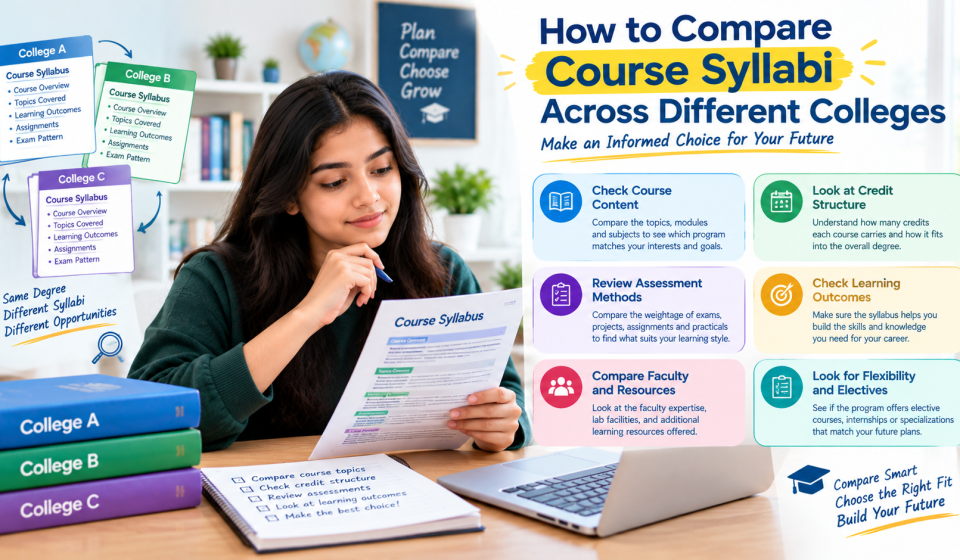

Learn how to compare course syllabi across different colleges by evaluating subjects, credits, learning outcomes, practical training, electives, internships, projects, and career relevance.
Choosing between colleges can be difficult when several institutions offer the same or similar degree programs. Students often compare colleges based on fees, rankings, placements, campus facilities, location, and reputation. However, one of the most important factors to compare is the course syllabus. Two colleges may offer the same degree name but provide very different learning experiences because their subjects, electives, practical training, projects, assessment methods, and specialization options may differ.
A syllabus comparison helps students understand what they will actually study during their degree. It also helps them determine whether a course matches their career interests and future plans. The University Grants Commission’s Learning Outcomes-Based Curriculum Framework explains that higher education curricula should focus on what students are expected to know, understand, and be able to do after completing their studies. It also allows higher education institutions flexibility in designing and developing their syllabi within broader academic frameworks. Therefore, students should compare more than subject names when evaluating different colleges.
What Is a Course Syllabus?
A course syllabus is a structured outline of what students are expected to learn during a particular academic program or course.
It may include:
- Subjects
- Modules or units
- Credit values
- Practical sessions
- Laboratory work
- Projects
- Internships
- Electives
- Skill-based courses
- Assessment methods
- Learning outcomes
- Recommended learning resources
- Specialization options
The exact format can differ between colleges and universities.
A good syllabus comparison should therefore look at the complete academic structure rather than simply counting the number of subjects.
Why Comparing Syllabi Is Important
Students may assume that two colleges offering the same degree provide almost identical education. This is not always true.
For example, two colleges may offer a Bachelor of Computer Applications, but one may emphasize programming and artificial intelligence while another focuses more heavily on business applications and database management.
Similarly, two management programs may have the same degree title but offer different specializations, industry projects, electives, and internship opportunities.
Comparing syllabi allows students to identify these differences before making an admission decision.
1. Start With the Official Syllabus
The first step is to collect the official syllabus documents from each college or university.
Look for:
- Official university website
- Academic department page
- Examination section
- Curriculum section
- Admission prospectus
- Academic regulations
- Department notifications
Avoid comparing information from random education websites because older versions of syllabi may still be available online.
Try to obtain the latest syllabus applicable to the academic year in which you plan to enroll.
2. Compare the Degree Structure
Before comparing individual subjects, understand the overall structure of each program.
Check:
- Total course duration
- Number of semesters
- Total credits
- Major requirements
- Minor requirements
- Elective requirements
- Skill-based courses
- Project requirements
- Internship requirements
UGC’s Curriculum and Credit Framework for Undergraduate Programmes provides a flexible, multidisciplinary credit-based structure and supports multiple academic pathways.
This makes it important to understand not only what students study but also how the curriculum is organized.
3. Compare the Total Number of Credits
Credits are an important part of syllabus comparison.
A course with more subjects does not necessarily provide more academic value if those subjects carry very few credits.
Compare:
- Total credits
- Credits per semester
- Major credits
- Minor credits
- Elective credits
- Practical credits
- Project credits
- Internship credits
UGC’s curriculum framework allows higher education institutions to decide credit distribution across categories while meeting applicable minimum requirements.
Therefore, students should examine the credit structure carefully rather than simply counting subjects.
4. Compare Core Subjects
Core subjects represent the central knowledge areas of a degree.
For example, a computer-related program may include:
- Programming
- Data Structures
- Database Management
- Computer Networks
- Operating Systems
- Software Engineering
When comparing colleges, identify which core subjects are included and when students study them.
Ask:
- Does the syllabus cover fundamental concepts?
- Are advanced subjects included?
- Are important industry topics missing?
- Are subjects introduced in a logical sequence?
A strong syllabus should generally build knowledge progressively from foundational concepts toward more advanced applications.
5. Compare Elective Subjects
Electives allow students to explore areas beyond the mandatory curriculum.
Different colleges may offer different elective choices.
For example, students in technology programs might find electives such as:
- Artificial Intelligence
- Machine Learning
- Cloud Computing
- Cybersecurity
- Data Science
- UI/UX Design
- Blockchain
Students should compare not only the number of electives but also their relevance to their career interests.
A college offering fewer electives may still be a strong choice if those electives closely match the student’s goals.
6. Compare Specialization Options
Some degree programs provide opportunities for specialization.
Students should check whether the college offers:
- Major specialization
- Minor specialization
- Concentrations
- Special tracks
- Advanced electives
- Interdisciplinary combinations
UGC’s undergraduate framework supports multidisciplinary education and allows students greater flexibility in choosing subjects and academic pathways.
This can be particularly useful for students who already have a specific career direction.
7. Compare Learning Outcomes
One of the most important but often ignored areas is learning outcomes.
Learning outcomes explain what students should be able to know, understand, or perform after completing a course.
UGC’s Learning Outcomes-Based Curriculum Framework explains that learning outcomes describe what graduates are expected to know, understand, and be able to do at the end of their studies.
When comparing two syllabi, ask:
- What skills will students develop?
- Does the course encourage problem-solving?
- Does it develop analytical abilities?
- Does it include practical application?
- Does it support further education?
- Does it develop transferable skills?
A syllabus with clearly defined and relevant learning outcomes can provide better insight into the expected educational experience.
8. Compare Practical Learning
Students should not focus only on theory.
Check whether each syllabus includes:
- Laboratory sessions
- Practical assignments
- Fieldwork
- Workshops
- Simulations
- Case studies
- Industry projects
- Hands-on activities
UGC’s curriculum framework highlights practical skills and the connection between theory and practice as important elements of the teaching-learning process. It also identifies projects, field-based learning, internships, industrial visits, and research facilities as possible learning experiences.
For career-oriented degrees, practical exposure can be particularly valuable.
9. Compare Project Requirements
Projects can help students apply classroom knowledge to real-world problems.
When comparing syllabi, check:
- Number of projects
- Semester projects
- Final-year project
- Individual or group projects
- Industry-sponsored projects
- Research projects
- Project evaluation method
A syllabus that includes meaningful project work can provide students with opportunities to build portfolios and demonstrate practical skills.
For example, a design student may graduate with multiple design projects, while a computer science student may develop software applications or research prototypes.
10. Compare Internship Opportunities
Internships can connect academic learning with professional experience.
Check whether internships are:
- Mandatory
- Optional
- Credit-based
- Summer internships
- Semester-long internships
- Industry-linked
- Research internships
UGC currently lists dedicated guidelines for internships and research internships for undergraduate students.
Students should also check whether the college merely recommends internships or formally integrates them into the curriculum.
11. Compare Skill-Based Courses
Modern degree programs often include courses designed to develop practical or transferable skills.
These may include:
- Communication
- Professional writing
- Presentation skills
- Entrepreneurship
- Digital skills
- Research skills
- Data analysis
- Critical thinking
- Problem-solving
- Professional ethics
UGC’s learning-outcomes framework emphasizes both subject-specific knowledge and transferable skills that can support employment and further study.
Therefore, skill-based courses should be included in your comparison.
12. Compare Industry Relevance
A syllabus should be evaluated according to how relevant it is to the student’s intended career.
Students should ask:
- Does the curriculum include current technologies?
- Are industry-relevant tools covered?
- Are practical applications included?
- Does the course encourage real-world problem-solving?
- Are there opportunities for industry interaction?
UGC’s curriculum framework states that curriculum planning should consider academic standards, learning outcomes, skills, and relevance to employment and further study.
However, students should avoid choosing a syllabus only because it contains trendy keywords. The fundamentals of a subject remain important.
13. Compare Assessment Methods
The syllabus may also show how students are evaluated.
Compare whether the program uses:
- Written examinations
- Internal tests
- Assignments
- Presentations
- Projects
- Practical examinations
- Viva examinations
- Continuous assessment
- Research work
Assessment methods can influence the learning experience.
A course that combines examinations with projects and practical work may evaluate a broader range of skills than a course relying mainly on written exams.
14. Compare the Balance Between Theory and Practice
A strong curriculum generally needs an appropriate balance between theoretical knowledge and practical application.
Theory provides the foundation required to understand concepts deeply.
Practical work helps students apply those concepts.
When comparing syllabi, look at the proportion of:
Theory + Practical + Projects + Internships + Skill Development
The ideal balance depends on the subject.
For example, a pure research-oriented program may contain more theoretical and research-focused learning, while a professional degree may require greater practical exposure.
15. Compare Course Sequencing
The order in which subjects are taught matters.
A good curriculum should generally build knowledge progressively.
For example:
Basic Programming → Data Structures → Algorithms → Advanced Development
This structure allows students to build on previously learned concepts.
If an advanced subject appears before students receive the necessary foundational knowledge, they may struggle.
Therefore, compare the semester-by-semester sequence of subjects.
16. Check Whether the Syllabus Is Updated
Technology and industries change quickly.
Students should check the year of the syllabus and whether it has been recently revised.
Look for:
- Revision year
- New subjects
- Updated tools
- Emerging technologies
- New electives
- Revised practical components
- Updated learning outcomes
UGC maintains current curriculum and guideline initiatives, including its Curriculum and Credit Framework for Undergraduate Programmes and newer initiatives related to industry linkage and apprenticeship-embedded degrees.
This makes checking the latest official curriculum particularly important.
17. Compare Interdisciplinary Opportunities
Students increasingly benefit from learning across disciplines.
For example, a computer science student may combine technology with:
- Business
- Design
- Psychology
- Economics
- Mathematics
- Communication
UGC’s current undergraduate framework incorporates a multidisciplinary approach and choice-based credit system.
When comparing colleges, check whether students can select subjects outside their primary discipline.
18. Compare Career Alignment
Finally, compare each syllabus with your intended career.
Create three columns:
| Career Goal | College A Syllabus | College B Syllabus |
|---|---|---|
| Required technical skills | Check coverage | Check coverage |
| Practical experience | Compare | Compare |
| Internship | Compare | Compare |
| Electives | Compare | Compare |
| Projects | Compare | Compare |
| Industry relevance | Compare | Compare |
| Advanced subjects | Compare | Compare |
This makes the decision more objective.
A Simple Syllabus Comparison Method
Students can score each syllabus from 1 to 5 on important factors.
Core Subjects: 1–5
Electives: 1–5
Practical Learning: 1–5
Projects: 1–5
Internships: 1–5
Skill Development: 1–5
Industry Relevance: 1–5
Learning Outcomes: 1–5
Flexibility: 1–5
Career Alignment: 1–5
The score should not be the only deciding factor, but it can make comparisons easier.
Common Mistakes When Comparing Syllabi
Students often make these mistakes:
- Comparing only subject names
- Ignoring credits
- Choosing the syllabus with the largest number of subjects
- Ignoring practical learning
- Ignoring internships
- Not checking learning outcomes
- Using an outdated syllabus
- Focusing only on trendy technologies
- Ignoring elective options
- Not considering career goals
A syllabus should be evaluated as a complete academic structure.
Questions to Ask the College Before Admission
Before finalizing admission, students can ask:
- Is this the latest syllabus?
- How many total credits are required?
- Which subjects are compulsory?
- Which electives are available?
- Are internships mandatory?
- Is there a final-year project?
- Are industry projects available?
- How are students assessed?
- Can students choose minors or interdisciplinary courses?
- How frequently is the syllabus updated?
- Which skills should students have after completing the program?
- Does the curriculum support the career path I am interested in?
These questions can help students understand the program beyond the admission brochure.
Source
UGC – Curriculum and Credit
UGC – Learning Outcomes
UGC – Learning Outcomes-Based
Conclusion
Comparing course syllabi across different colleges is one of the most useful steps students can take before choosing a degree program. The name of a degree may look identical across institutions, but the actual academic experience can vary significantly based on core subjects, credits, electives, practical learning, projects, internships, assessment methods, learning outcomes, and specialization options.
Students should therefore avoid choosing a college simply because it has a popular degree title or a large number of subjects. Instead, they should examine the complete curriculum and ask whether it provides the knowledge and skills required for their future goals. UGC’s learning-outcomes approach emphasizes what students should know, understand, and be able to do after completing their studies, while its undergraduate curriculum framework supports flexibility, multidisciplinary learning, and choice-based credits. A careful syllabus comparison can help students select a program that is academically relevant, practically useful, and better aligned with their career plans.
FAQ
1. Why should students compare course syllabi before admission?
Students should compare syllabi because the same degree can have different subjects, electives, practical components, internships, projects, and learning outcomes at different colleges.
2. What should I compare first in a syllabus?
Start with the overall course structure, duration, total credits, core subjects, electives, practical learning, projects, internships, and learning outcomes.
3. Is a syllabus with more subjects always better?
No. The number of subjects does not automatically indicate quality. Students should also examine credit value, depth, learning outcomes, practical exposure, and relevance to their career goals.
4. Why are credits important when comparing syllabi?
Credits indicate the academic weight assigned to courses and help students understand how the overall curriculum is structured.
5. Should I compare electives between colleges?
Yes. Electives can allow students to specialize in areas that match their interests and career plans.
6. Why are learning outcomes important?
Learning outcomes explain what students should know, understand, and be able to do after completing a course or program. UGC’s learning-outcomes framework places significant emphasis on these expected outcomes.
7. Should practical training be considered when comparing courses?
Yes. Practical sessions, projects, fieldwork, internships, and industry exposure can help students apply theoretical knowledge to real-world situations.
8. How can I check whether a syllabus is current?
Download the syllabus from the official college or university website and check the academic year, revision date, notification, and department information.
9. Should I choose a syllabus based only on current industry trends?
No. Industry relevance is important, but strong fundamentals are equally important. A good curriculum should combine foundational knowledge with relevant contemporary skills.
10. What is the best way to compare two college syllabi?
Create a comparison table covering credits, core subjects, electives, practical learning, projects, internships, assessment, learning outcomes, flexibility, and career relevance. Then select the program that best matches your academic and career goals.