How to Choose the Right College After 12th in 2026: The Ultimate Step-by-Step Career Guide for Students

Choosing the right college after completing Class 12 is one of the most important decisions in a student’s life. The college you select will not only shape your academic journey but also influence your career opportunities.
The higher education landscape in India continues to evolve with new universities, industry-focused courses, multidisciplinary education, digital learning, and global collaborations. Students now have access to government universities, private universities, autonomous colleges, institutes of national importance, and international degree programmes. This comprehensive guide explains how to choose the right college after 12th in 2026 through a practical step-by-step approach. It covers career planning, course selection, college evaluation, entrance exams, fee comparison, placement analysis, scholarships, common mistakes, and expert tips to help students make confident and informed decisions.
Why Choosing the Right College Matters
Your college is much more than a place where you attend classes. It becomes the foundation of your future career by helping you build knowledge, technical skills, communication abilities, professional networks, and practical experience.
Choosing the right college can help you:
- Receive quality education
- Gain practical industry exposure
- Access better internships
- Improve placement opportunities
- Build professional skills
- Participate in research and innovation
- Develop leadership qualities
- Expand networking opportunities
- Increase career growth potential
Selecting the wrong college may lead to limited career opportunities, poor academic experience, and unnecessary financial burden.
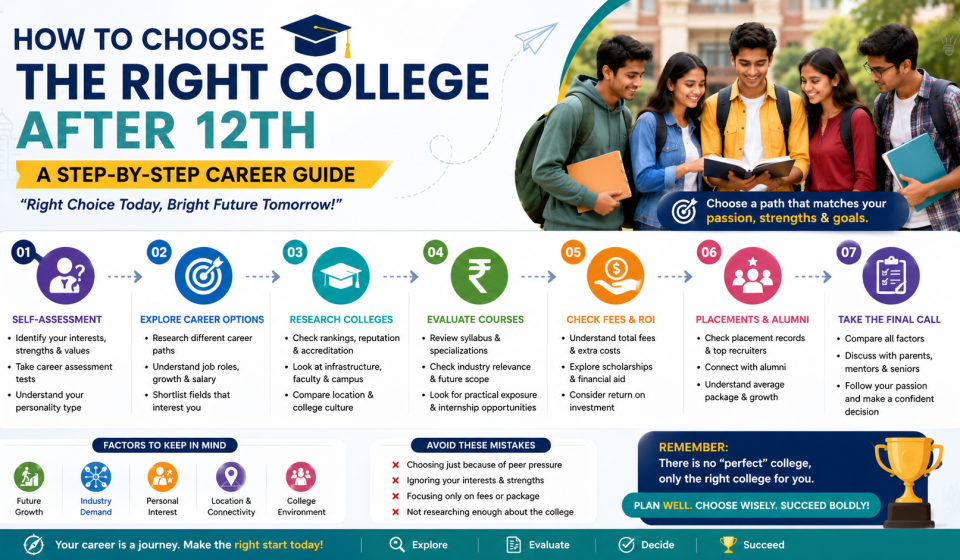
Step 1: Identify Your Interests and Career Goals
Before searching for colleges, students should first understand their own interests, strengths, and career aspirations.
Ask yourself questions such as:
- Which subjects do I enjoy studying?
- What type of work interests me?
- Do I prefer technical or creative careers?
- Would I like to work in the government or private sector?
- Am I interested in entrepreneurship?
- Do I plan to study abroad later?
Choosing a course based on personal interests often leads to better academic performance and long-term career satisfaction.
Step 2: Select the Right Course
The college is important, but the course you choose is equally critical.
Popular undergraduate options include:
Engineering
Ideal for students interested in technology, innovation, and problem-solving.
Medical Sciences
Suitable for students passionate about healthcare and patient care.
Commerce
Offers opportunities in accounting, finance, taxation, banking, and business.
Management
Perfect for students aspiring to leadership and business careers.
Law
Provides opportunities in legal practice, judiciary, corporate law, and public policy.
Arts and Humanities
Excellent for careers in media, education, psychology, social sciences, literature, and public administration.
Science
Includes fields such as Physics, Chemistry, Biology, Mathematics, Biotechnology, Environmental Science, and Data Science.
Students should choose a course that aligns with their abilities and future aspirations rather than following current trends alone.
Step 3: Shortlist Colleges
Prepare a list of colleges based on your preferred course.
While shortlisting, compare:
- Accreditation
- Rankings
- Course curriculum
- Faculty
- Placements
- Fees
- Infrastructure
- Hostel facilities
- Scholarships
- Campus environment
A comparison table can help simplify the selection process.
Step 4: Check Accreditation and Recognition
Always verify whether the institution is approved by the relevant regulatory authorities.
Important recognitions include:
- University Grants Commission (UGC)
- All India Council for Technical Education (AICTE)
- National Medical Commission (NMC)
- Bar Council of India (BCI)
- National Council for Teacher Education (NCTE)
- National Assessment and Accreditation Council (NAAC)
Accreditation ensures that the institution maintains recognised academic standards.
Step 5: Compare College Rankings
Rankings provide useful insights into academic quality and institutional performance.
Students should compare rankings along with:
- Faculty qualifications
- Research output
- Infrastructure
- Graduation outcomes
- Placement records
- Student satisfaction
Rankings alone should not determine your final choice.
Step 6: Analyse Placement Records
Placement statistics provide valuable information about career opportunities after graduation.
Compare:
- Placement percentage
- Average salary package
- Median salary
- Top recruiters
- Internship opportunities
- Alumni success
Avoid making decisions based solely on the highest salary package advertised by the institution.
Step 7: Understand the Fee Structure
Higher education involves several expenses beyond tuition fees.
Consider:
- Tuition fees
- Hostel charges
- Examination fees
- Library fees
- Laboratory charges
- Transportation
- Books and study materials
- Personal expenses
Compare the total cost of education before making a decision.
Step 8: Evaluate Return on Investment (ROI)
A college with moderate fees and strong placements may offer better value than an expensive institution with average career outcomes.
ROI should include:
- Total educational cost
- Average graduate salary
- Placement rate
- Career growth opportunities
Step 9: Research Faculty and Curriculum
Qualified faculty and an updated curriculum significantly improve the learning experience.
Look for:
- Experienced professors
- Industry experts
- Practical projects
- Laboratory work
- Research opportunities
- Internship support
- Industry collaborations
An industry-relevant curriculum prepares students for future employment.
Step 10: Examine Campus Infrastructure
Modern infrastructure contributes to a better academic environment.
Important facilities include:
- Smart classrooms
- Laboratories
- Libraries
- Sports facilities
- Hostels
- Wi-Fi connectivity
- Medical facilities
- Cafeterias
- Student activity centres
If possible, visit the campus before finalising admission.
Step 11: Check Internship Opportunities
Internships provide practical industry experience and improve employability.
Good colleges actively support students through:
- Summer internships
- Industrial training
- Live projects
- Industry visits
- Corporate mentoring
- Placement preparation
Practical exposure is increasingly valued by employers.
Step 12: Explore Scholarships
Scholarships reduce educational expenses and make quality education more accessible.
Popular scholarship sources include:
- Central Government
- State Governments
- Universities
- Corporate foundations
- Private organisations
- Educational trusts
Apply early and carefully review eligibility criteria.
Step 13: Consider College Location
Location affects both educational experience and living costs.
Consider factors such as:
- Safety
- Transportation
- Climate
- Internship opportunities
- Industry presence
- Cost of living
- Accessibility
Students studying away from home should also evaluate hostel facilities.
Step 14: Review Student Life
College life extends beyond academics.
Look for opportunities involving:
- Student clubs
- Cultural festivals
- Sports
- Entrepreneurship cells
- Innovation centres
- Technical competitions
- Volunteer programmes
Active participation develops leadership and communication skills.
Step 15: Compare Admission Process
Different colleges have different admission procedures.
Admissions may be based on:
- Entrance examinations
- Merit
- Counselling
- Personal interviews
- Portfolio assessment (for specialised courses)
Read official admission notifications carefully.
Common Mistakes Students Should Avoid
Many students make avoidable errors while selecting colleges.
Common mistakes include:
- Choosing a college based only on popularity
- Following friends without independent research
- Ignoring accreditation
- Comparing only tuition fees
- Overlooking placement statistics
- Ignoring scholarship opportunities
- Missing application deadlines
- Not visiting the campus when possible
- Focusing only on rankings
- Selecting a course without considering personal interests
Avoiding these mistakes improves the chances of making the right decision.
Tips for Parents
Parents play an important role in the college selection process.
They should:
- Encourage open discussions
- Understand the student’s interests
- Compare colleges objectively
- Consider financial planning
- Avoid forcing career choices
- Attend counselling sessions
- Support long-term career goals
Collaborative decision-making often leads to better outcomes.
Future Trends in Higher Education
Higher education is rapidly changing with the introduction of multidisciplinary learning, digital education, Artificial Intelligence, Data Science, entrepreneurship programmes, global collaborations, and skill-based curricula. Colleges are increasingly partnering with industries to provide internships, certifications, startup incubation, and research opportunities.
Students choosing colleges in 2026 should evaluate institutions based not only on academic reputation but also on innovation, employability, industry partnerships, practical learning, and adaptability to future career demands. Selecting a college that embraces modern education practices can provide a strong advantage in an increasingly competitive job market.
Source
https://www.nirfindia.org
https://www.ugc.gov.in
https://www.aicte-india.org
https://www.naac.gov.in
Conclusion
Choosing the right college after Class 12 is one of the most significant investments in your future. Instead of making decisions based on advertisements, peer influence, or rankings alone, students should carefully evaluate their interests, career goals, course options, accreditation, faculty, infrastructure, placement records, fee structure, scholarships, and return on investment. Thorough research, timely preparation, and informed decision-making can help students secure admission to a college that supports both academic excellence and long-term career growth. By focusing on quality education and personal aspirations, students can build a strong foundation for a successful and fulfilling professional journey.
FAQ
1. How do I choose the right college after Class 12?
Start by identifying your career goals, selecting the right course, comparing accredited colleges, reviewing placements, evaluating fees, and researching faculty, infrastructure, and scholarships before making a final decision.
2. Are college rankings the most important factor?
No. Rankings are helpful, but students should also compare accreditation, placements, faculty, curriculum, internships, campus facilities, and return on investment.
3. Should I choose a course based on job opportunities?
Career opportunities are important, but you should also consider your interests, strengths, aptitude, and long-term career goals.
4. How important are placements when selecting a college?
Placements are a major consideration, especially for professional courses. Compare average salaries, placement rates, recruiters, and internship opportunities rather than focusing only on the highest package.
5. Can scholarships reduce college expenses?
Yes. Government bodies, universities, and private organisations offer scholarships based on merit, financial need, category, sports achievements, and other criteria.
6. Is it better to study near home or in another city?
The answer depends on your preferred course, college quality, budget, family circumstances, and career opportunities available in different locations.
7. Should I visit the college campus before taking admission?
If possible, yes. Visiting the campus helps you evaluate infrastructure, faculty interaction, student environment, hostel facilities, and overall learning atmosphere.
8. What is the biggest mistake students make while choosing a college?
One of the most common mistakes is selecting a college based only on popularity or peer influence without researching accreditation, placements, curriculum, and career outcomes.