
Technology has become one of the most powerful forces shaping modern education. Over the past decade, educational institutions around the world have embraced digital transformation to improve learning experiences, increase accessibility, and prepare.
Higher education is no longer limited to traditional classrooms, textbooks, and face-to-face lectures. Today’s students have access to a vast range of digital resources that enable learning anytime and anywhere. Universities and colleges are increasingly leveraging innovative technologies to create engaging, flexible, and student-centered educational experiences. These advancements are helping bridge learning gaps, improve academic outcomes, and provide students with opportunities to develop skills that align with modern industry demands.
The Digital Transformation of Higher Education
The education sector has undergone a significant transformation due to advances in technology. Universities are increasingly integrating digital tools into teaching, administration, assessment, and student support services.
Digital transformation in higher education includes:
- Online learning platforms.
- Virtual classrooms.
- Cloud-based collaboration tools.
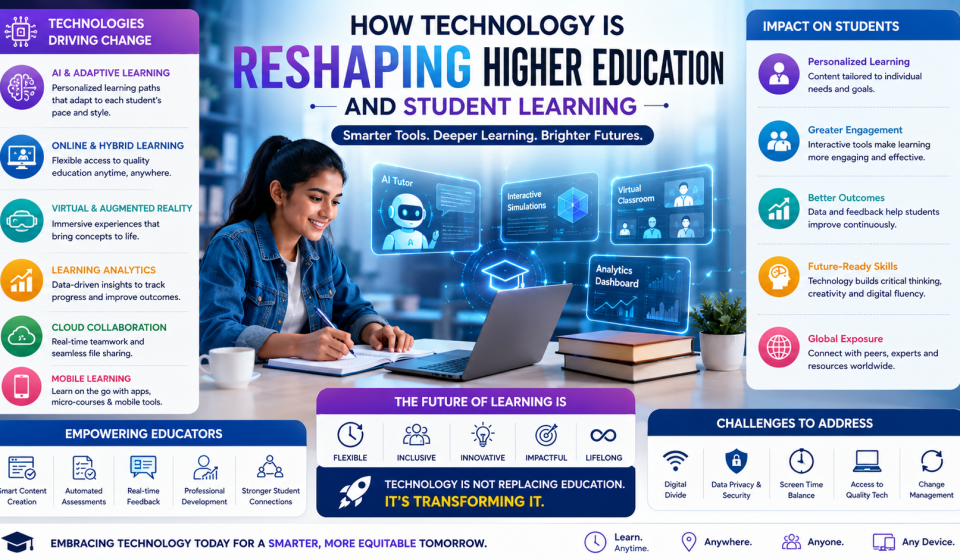
- Artificial Intelligence applications.
- Digital libraries.
- Learning management systems.
These technologies enable institutions to deliver education more efficiently while enhancing the overall student experience.
The Rise of Online Learning
One of the most visible impacts of technology has been the growth of online learning.
Students today can:
- Attend virtual classes.
- Access recorded lectures.
- Participate in online discussions.
- Complete assignments digitally.
- Collaborate remotely with peers.
Online learning offers flexibility and convenience, allowing students to balance education with work, internships, and personal commitments.
It has also made quality education more accessible to learners regardless of geographical location.
Personalized Learning Through Artificial Intelligence
Artificial Intelligence (AI) is transforming education by enabling personalized learning experiences.
AI-powered learning systems can:
- Analyze student performance.
- Identify learning gaps.
- Recommend study materials.
- Customize learning pathways.
- Provide instant feedback.
This individualized approach helps students learn at their own pace and improves academic outcomes.
Personalized learning is particularly beneficial because it recognizes that students have different strengths, weaknesses, and learning styles.
Smart Learning Management Systems
Learning Management Systems (LMS) have become essential tools in modern education.
Popular LMS platforms allow students to:
- Access course materials.
- Submit assignments.
- Track academic progress.
- Participate in discussions.
- Communicate with instructors.
These systems centralize educational resources and streamline academic management for both students and educators.
They also provide valuable data that helps institutions improve teaching effectiveness.
Virtual Classrooms and Interactive Learning
Traditional lectures are increasingly being supplemented by interactive virtual learning environments.
Modern virtual classrooms offer features such as:
- Live video lectures.
- Real-time discussions.
- Interactive quizzes.
- Screen sharing.
- Collaborative whiteboards.
These tools encourage student participation and make online learning more engaging and effective.
Technology helps recreate many aspects of face-to-face learning while adding new opportunities for interaction.
Access to Global Educational Resources
Technology has removed many barriers to information access.
Students can now utilize:
- Digital libraries.
- Academic databases.
- Research journals.
- Online courses.
- Educational videos.
Access to global educational resources enables students to expand their knowledge beyond traditional classroom materials.
This promotes independent learning and academic exploration.
Enhanced Collaboration and Communication
Modern technology facilitates seamless communication among students, faculty, and institutions.
Collaboration tools allow students to:
- Work on group projects.
- Share files.
- Communicate instantly.
- Coordinate tasks.
- Participate in virtual meetings.
These skills are highly relevant in today’s professional environments, where remote collaboration has become increasingly common.
Gamification in Education
Gamification incorporates game-like elements into learning experiences.
Examples include:
- Achievement badges.
- Progress tracking.
- Leaderboards.
- Interactive challenges.
- Rewards systems.
Gamification can increase student engagement, motivation, and participation by making learning more interactive and enjoyable.
Educational institutions are increasingly adopting gamified approaches to enhance learning outcomes.
Virtual Reality and Augmented Reality in Education
Virtual Reality (VR) and Augmented Reality (AR) are creating immersive educational experiences.
Students can:
- Explore historical sites virtually.
- Conduct simulated laboratory experiments.
- Visualize complex scientific concepts.
- Practice real-world scenarios.
These technologies make learning more engaging and help students better understand abstract concepts.
Fields such as medicine, engineering, architecture, and science particularly benefit from immersive learning environments.
Data Analytics for Academic Success
Educational institutions increasingly use data analytics to improve student outcomes.
Analytics can help identify:
- Academic performance trends.
- Attendance patterns.
- Learning challenges.
- Student engagement levels.
By analyzing this information, institutions can provide targeted support and interventions that improve retention and success rates.
Data-driven decision-making helps create more effective learning environments.
Digital Assessments and Evaluation
Technology has transformed how students are assessed.
Digital assessment tools enable:
- Online examinations.
- Automated grading.
- Instant feedback.
- Performance tracking.
- Adaptive testing.
These innovations improve efficiency and provide students with timely insights into their academic progress.
They also reduce administrative workload for educators.
Expanding Access to Higher Education
Technology has significantly increased educational accessibility.
Students who previously faced barriers due to:
- Geographic location.
- Financial limitations.
- Physical disabilities.
- Time constraints.
Can now access educational opportunities through online and hybrid learning models.
This democratization of education supports greater inclusivity and social mobility.
Supporting Lifelong Learning
The modern economy requires continuous skill development.
Technology supports lifelong learning through:
- Online certification programs.
- Professional development courses.
- Micro-credentials.
- Virtual workshops.
Students and professionals can continuously update their skills to remain competitive in evolving industries.
Lifelong learning has become a critical component of career success.
Preparing Students for the Digital Workforce
Employers increasingly seek graduates with strong digital competencies.
Technology-enhanced education helps students develop skills such as:
- Digital literacy.
- Data analysis.
- Virtual collaboration.
- Technology proficiency.
- Online communication.
These capabilities are essential for success in modern workplaces.
Educational institutions play a key role in preparing students for technology-driven careers.
Challenges of Technology in Higher Education
While technology offers numerous benefits, it also presents challenges.
Common concerns include:
- Digital distractions.
- Screen fatigue.
- Cybersecurity risks.
- Unequal technology access.
- Privacy concerns.
Institutions must address these issues to ensure that technology enhances rather than hinders learning experiences.
Balanced implementation is essential for maximizing educational value.
The Role of Educators in a Technology-Driven Environment
Technology does not replace educators.
Instead, it enhances their ability to:
- Facilitate learning.
- Provide mentorship.
- Offer personalized support.
- Foster critical thinking.
Educators remain central to student success, while technology serves as a powerful tool that supports effective teaching and learning.
The most successful educational models combine technological innovation with human guidance.
Emerging Trends in Educational Technology
Several technologies are expected to further transform higher education in the coming years.
Emerging trends include:
- Artificial Intelligence tutors.
- Adaptive learning systems.
- Blockchain credentials.
- Advanced learning analytics.
- Immersive virtual campuses.
These innovations will continue shaping how students access, experience, and benefit from education.
Institutions that embrace innovation will be better positioned to meet future learning needs.
The Future of Student Learning
The future of higher education is increasingly flexible, personalized, and technology-driven.
Students will benefit from:
- Customized learning experiences.
- Global educational access.
- Enhanced collaboration.
- Continuous skill development.
- Career-focused learning pathways.
Technology will continue expanding opportunities for students while supporting more effective and engaging educational experiences.
Success in the future will depend not only on knowledge acquisition but also on the ability to adapt, learn continuously, and leverage digital tools effectively.
Source
https://www.unesco.org
https://www.educause.edu
https://www.weforum.org
https://www.coursera.org
https://www.oecd.org/education
Conclusion
Technology is reshaping higher education in profound ways, creating more accessible, flexible, and personalized learning experiences for students worldwide. From Artificial Intelligence and virtual classrooms to digital assessments and immersive learning technologies, innovation is transforming every aspect of education. These advancements not only improve academic outcomes but also help students develop the skills required for success in a digital economy. While challenges remain, the thoughtful integration of technology can enhance teaching, expand educational opportunities, and prepare learners for the future. As higher education continues evolving, students who embrace technology and lifelong learning will be best positioned to thrive in an increasingly connected world.
FAQ
How is technology changing higher education?
Technology is improving accessibility, personalization, collaboration, assessment, and learning flexibility through digital tools and online platforms.
What role does Artificial Intelligence play in education?
AI helps personalize learning experiences, identify learning gaps, provide recommendations, and support student success through data-driven insights.
Are online learning platforms effective?
Yes. Online learning platforms offer flexibility, accessibility, and a wide range of educational resources that support student learning.
What are Learning Management Systems?
Learning Management Systems are digital platforms that help manage courses, assignments, communication, assessments, and academic resources.
How do virtual classrooms benefit students?
Virtual classrooms enable real-time interaction, collaboration, flexibility, and access to education regardless of location.
What skills do students gain through technology-enhanced learning?
Students develop digital literacy, communication, collaboration, problem-solving, adaptability, and technology-related skills.
Can technology replace teachers?
No. Technology supports educators by enhancing teaching methods, but human guidance, mentorship, and instruction remain essential.
What is the future of higher education technology?
Future trends include AI-powered learning, adaptive education systems, immersive virtual environments, advanced analytics, and personalized learning experiences.