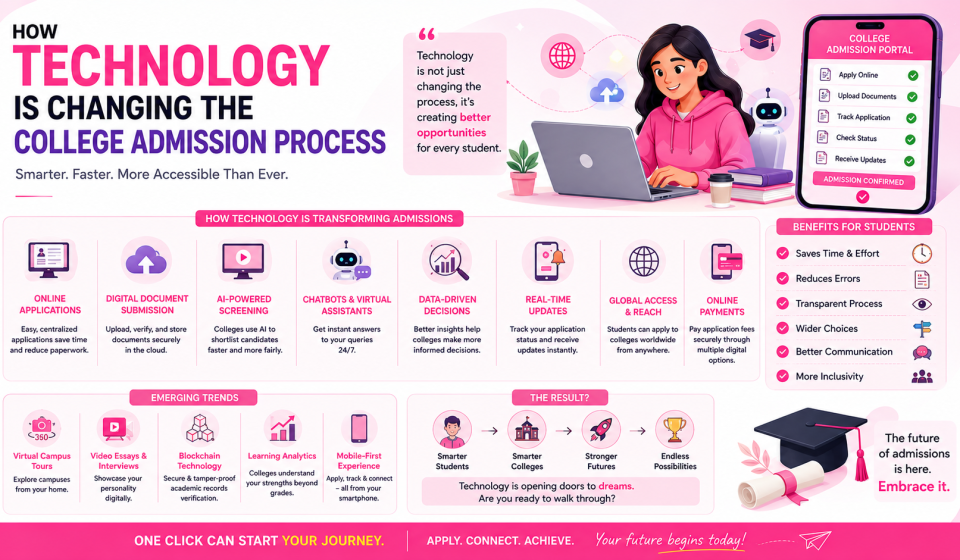
How Technology Is Changing the College Admission Process: The Complete Guide for Students and Parents in 2026

The college admission process has undergone a remarkable transformation over the past decade, driven by rapid advancements in technology. Gone are the days when students had to fill out lengthy paper applications, mail physical documents, and wait weeks or even months for updates.
Technology has simplified nearly every stage of the admission journey—from researching colleges and submitting applications to uploading documents, tracking admission status, attending virtual campus tours, participating in online interviews, and accepting admission offers. Students can now compare institutions, explore scholarship opportunities, interact with admission counselors, and receive instant notifications through websites and mobile applications.
The Evolution of College Admissions
Traditional admission systems relied heavily on paper-based processes.
Today, technology enables:
- Online applications
- Digital document submission
- Automated verification
- Virtual counseling
- Online fee payments
- Real-time application tracking
These improvements save time and increase convenience.
Online Application Portals
Most colleges now offer dedicated admission portals.
Students can:
- Create accounts
- Complete applications
- Upload certificates
- Submit entrance exam scores
- Track application status
- Receive notifications
Digital applications reduce paperwork and processing delays.
Artificial Intelligence in Admissions
AI is improving administrative efficiency.
Educational institutions use AI to:
- Organize applications
- Verify documents
- Answer common questions through chatbots
- Schedule interviews
- Analyze application data
AI supports faster processing while allowing admission teams to focus on more complex evaluations.
Virtual Campus Tours
Students can explore campuses without traveling.
Virtual tours allow applicants to view:
- Classrooms
- Laboratories
- Libraries
- Hostels
- Sports facilities
- Student activity centers
This helps families compare colleges from anywhere.
Online Counseling Sessions
Technology enables direct interaction with admission teams.
Students can attend:
- Webinars
- Live question-and-answer sessions
- Career counseling
- Admission guidance workshops
- Parent information sessions
These events improve access to accurate information.
Digital Document Verification
Electronic verification speeds up admissions.
Students can securely upload:
- Academic transcripts
- Identity documents
- Entrance examination results
- Certificates
- Recommendation letters
Digital verification reduces administrative errors.
Data-Driven Decision Making
Admission offices increasingly use analytics to:
- Monitor application trends
- Improve student services
- Predict enrollment numbers
- Allocate scholarships
- Enhance recruitment strategies
Data supports more informed institutional planning.
Online Entrance Examinations
Many institutions now conduct computer-based assessments.
Advantages include:
- Faster results
- Flexible scheduling
- Automated evaluation
- Improved accessibility
- Reduced paperwork
Technology has modernized testing experiences.
Scholarship Search Platforms
Students can easily discover financial aid opportunities.
Digital platforms help applicants:
- Search scholarships
- Compare eligibility
- Submit applications
- Track deadlines
- Receive updates
Technology increases awareness of funding opportunities.
Personalized College Recommendations
Many educational platforms provide personalized suggestions based on:
- Academic performance
- Career interests
- Entrance scores
- Preferred location
- Budget
- Course preferences
This helps students make informed decisions.
Improved Communication
Admission departments now communicate through:
- Mobile applications
- SMS notifications
- Online dashboards
- Video conferencing
- Social media updates
Students receive timely information throughout the admission process.
Cloud-Based Record Management
Cloud technology allows colleges to:
- Store student records securely
- Access information quickly
- Improve collaboration
- Reduce paperwork
- Enhance data security
Digital records simplify administration.
Technology and Transparency
Digital systems increase transparency by allowing students to:
- Track applications
- Verify submitted documents
- Receive status updates
- Monitor admission timelines
- Access official announcements
Transparency builds trust between institutions and applicants.
Challenges of Digital Admissions
Despite many benefits, challenges remain.
Students should be aware of:
- Internet connectivity issues
- Cybersecurity risks
- Digital literacy requirements
- Technical errors
- Increased online competition
Proper preparation helps overcome these challenges.
Tips for Students
To succeed in technology-driven admissions:
- Keep digital copies of important documents.
- Monitor admission deadlines.
- Use professional email addresses.
- Verify information through official college websites.
- Prepare for online interviews.
- Maintain a stable internet connection during virtual assessments.
Organization improves the admission experience.
The Future of College Admissions
Emerging technologies are expected to further transform admissions through:
- AI-powered student support
- Blockchain credential verification
- Predictive analytics
- Virtual reality campus experiences
- Personalized learning recommendations
- Enhanced cybersecurity systems
Technology will continue making admissions more efficient and student-friendly.
Source
https://www.unesco.org
https://www.weforum.org
https://www.indeed.com/career-advice
https://www.coursera.org
https://www.forbes.com
Conclusion
Technology has fundamentally transformed the college admission process by making it faster, more transparent, and more accessible for students, parents, and educational institutions. From online applications and virtual campus tours to AI-powered support systems, digital document verification, and real-time communication, technology has simplified every stage of the admission journey. While challenges such as digital literacy and cybersecurity remain important considerations, the overall benefits significantly outweigh the limitations. Students who understand modern admission technologies, prepare their documents carefully, stay informed through official channels, and embrace digital tools will be better positioned to navigate the competitive college admission landscape successfully. As innovation continues to reshape higher education, technology will remain a driving force behind smarter, more efficient, and student-centered admission systems.
FAQ
1. How has technology improved the college admission process?
Technology has simplified admissions through online applications, digital document submission, AI-powered support, virtual counseling, online payments, application tracking, and faster communication between students and institutions.
2. What role does artificial intelligence play in college admissions?
AI helps colleges organize applications, verify documents, answer applicant questions through chatbots, schedule interviews, analyze data, and improve administrative efficiency while supporting admission teams.
3. Are virtual campus tours useful?
Yes. Virtual tours allow students and parents to explore classrooms, laboratories, libraries, hostels, sports facilities, and campus environments remotely before making admission decisions.
4. What are the advantages of online admission portals?
Online portals enable students to submit applications, upload documents, pay fees, monitor application status, receive notifications, and communicate with admission offices from a single platform.
5. Are digital admissions secure?
Most institutions use secure technologies to protect applicant information. However, students should use official websites, strong passwords, and verify communications to reduce cybersecurity risks.
6. How can students prepare for technology-based admissions?
Students should organize digital documents, maintain a professional email address, monitor deadlines, practice for virtual interviews, ensure reliable internet access, and regularly check official admission portals.
7. Can technology help students find scholarships?
Yes. Many online platforms allow students to search for scholarships, compare eligibility criteria, submit applications, and receive deadline reminders efficiently.
8. What is the future of college admissions?
Future admission systems are expected to incorporate advanced AI, blockchain-based credential verification, predictive analytics, virtual reality campus tours, enhanced cybersecurity, and more personalized admission experiences.