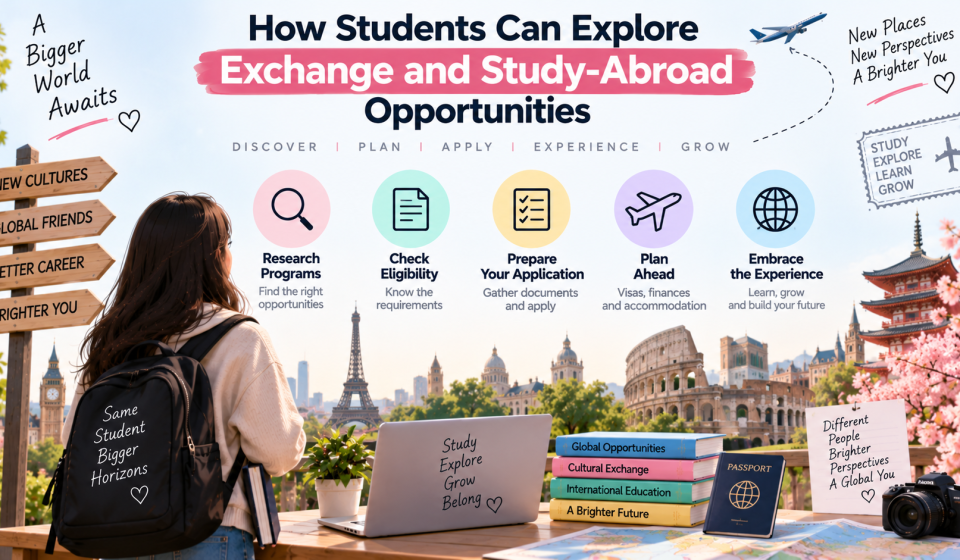

Discover how students can explore exchange and study-abroad opportunities, find university partnerships, compare programs, apply for scholarships, transfer credits, and prepare for international study.
Studying abroad can be an exciting opportunity for college students who want to experience a different education system, explore another culture, develop international skills, and expand their academic perspective. Students may participate in a semester exchange, short-term study programme, international summer school, research opportunity, internship, or a longer study-abroad programme. However, finding the right opportunity requires careful research because eligibility, costs, application procedures, academic requirements, and credit-transfer rules can vary significantly between programmes.
Students do not always need to wait until graduation to explore international education. Many universities and colleges have international offices, exchange partnerships, mobility programmes, and agreements with institutions in other countries. Programmes such as Erasmus+ also support study periods and traineeships abroad, while resources such as EducationUSA and DAAD provide information for students exploring specific destinations. The key is to start early, understand your options, and choose an opportunity that fits your academic goals and financial situation.
What Is a Student Exchange Programme?
A student exchange programme allows students to study at another educational institution, often in another country, for a specific period while remaining connected to their home institution.
The student normally continues their degree at their home university while completing approved academic work at the host institution.
Depending on the programme, an exchange may last for:
- A few weeks
- A summer
- One semester
- Two semesters
- Another approved period
The exact duration depends on the programme and participating institutions.
Erasmus+, for example, supports physical and blended student mobility and allows eligible students to study at partner higher education institutions abroad. Its current framework includes opportunities for short-cycle, bachelor’s, master’s, and doctoral students.
What Is Study Abroad?
Study abroad is a broader term that describes studying in another country as part of a student’s academic experience.
It can include:
- University exchange programmes
- Semester-abroad programmes
- Summer schools
- Short-term programmes
- International research projects
- Joint-degree programmes
- International internships
- Study tours
- Language programmes
- Visiting-student opportunities
Not every study-abroad programme works as a traditional exchange.
Some programmes may be organized directly by a student’s university, while others may require students to apply independently to a host institution or external programme provider.
Why Should Students Consider Studying Abroad?
International study can provide academic, personal, and professional experiences that may be difficult to gain by studying in only one environment.
Students may develop:
- Cross-cultural communication skills
- Independence
- Adaptability
- Language skills
- International awareness
- Confidence
- Problem-solving skills
- Networking abilities
- New academic perspectives
Erasmus+ identifies communication, language, intercultural and other soft skills as benefits of studying abroad. Its student mobility opportunities can also be combined with traineeships in some circumstances.
Start With Your Own College or University
The first place students should look for exchange opportunities is their own college or university.
Many institutions have an:
- International Relations Office
- International Education Office
- Study Abroad Office
- Student Exchange Office
- Global Engagement Office
These departments may maintain information about partner universities, eligibility requirements, exchange seats, application deadlines, scholarships, and credit-transfer procedures.
Erasmus+ specifically advises students interested in studying abroad to contact their own higher education institution because many opportunities are accessed through the student’s university.
Students should therefore avoid searching randomly on the internet before checking whether their own institution already has international partnerships.
Check Your University’s Partner Universities
Exchange programmes often depend on institutional partnerships.
A university may have agreements with institutions in countries such as:
- Germany
- France
- Italy
- Spain
- United Kingdom
- United States
- Canada
- Australia
- Japan
- South Korea
- Singapore
- Other countries
The available destinations depend entirely on the student’s university and programme.
Students should ask their international office for the current list of partner institutions.
They should also check whether a particular partner is available for their department or degree.
Research the Academic Fit
Choosing a destination simply because the country looks attractive may not be the best approach.
Students should first determine whether the host institution offers courses relevant to their degree.
For example, a computer engineering student may want courses related to:
- Artificial intelligence
- Machine learning
- Software engineering
- Data science
- Cybersecurity
- Computer networks
- Human-computer interaction
- Cloud computing
A design student might search for:
- UI/UX design
- Graphic design
- Interaction design
- Visual communication
- Product design
- Digital media
The academic content should be relevant enough to support the student’s degree and learning objectives.
Check Credit Transfer Before Applying
Credit transfer is one of the most important issues students should investigate before going abroad.
Students should not assume that every course completed abroad will automatically count toward their degree.
Before accepting an exchange opportunity, students should ask:
- Which courses will be approved?
- How many credits will transfer?
- Who approves the courses?
- Will grades be transferred?
- Will the study period count toward graduation?
- Is a learning agreement required?
Erasmus+ uses a learning agreement to establish how study activities abroad will be recognized, and after completion the host institution provides a transcript of records.
EducationUSA similarly advises students to check with their home institution because some universities require prior approval for study-abroad credits.
Understand Eligibility Requirements
Every programme can have different eligibility requirements.
Students may need to meet conditions related to:
- Current year of study
- Minimum academic performance
- Course completion
- Language proficiency
- Academic standing
- Age
- Programme requirements
- Passport or travel documents
Some exchange programmes may be limited to students in particular departments or academic levels.
Students should carefully read the official eligibility requirements before preparing an application.
Check Language Requirements
Language is another important consideration.
Some universities offer courses in English, while others may require students to understand the local language.
Even when classes are taught in English, learning basic local phrases can make daily life easier.
Students should check:
- Language of instruction
- Required language test
- Minimum language score
- Accepted certificates
- Availability of language courses
Erasmus+ also provides language-learning support for participating students through its Online Language Support system.
Explore Scholarships and Financial Support
Studying abroad can involve several expenses.
Students may need to budget for:
- Tuition or programme fees
- Accommodation
- Food
- Flights
- Local transportation
- Insurance
- Visa expenses
- Study materials
- Personal expenses
- Emergency funds
However, financial support may be available through scholarships, grants, university funding, government programmes, or mobility schemes.
Erasmus+ provides financial support for eligible mobility participants, with grant amounts depending on factors such as destination and programme conditions.
Students should also check scholarship opportunities offered by their home institution and the destination country.
Explore Country-Specific Resources
Students can use official education resources when researching destinations.
For students interested in the United States, EducationUSA is a U.S. Department of State network that provides information about U.S. higher education and advising services for international students.
Students exploring Germany can use DAAD resources for information about studying, research, scholarships, and academic opportunities related to Germany.
Using official sources can help students avoid outdated or misleading information.
Consider Short-Term Study Abroad Opportunities
Not every international experience needs to last a full semester or academic year.
Students can explore:
- Summer schools
- Short courses
- Workshops
- International competitions
- Study tours
- Short research programmes
- Short-term exchanges
- Blended mobility programmes
Short-term opportunities can be useful for students who cannot commit to a long stay abroad.
EducationUSA, for example, describes short-term U.S. programmes that can include university exchanges, professional exchange programmes, internships, visiting opportunities, and other formats.
Look for International Internships
International experience is not limited to classroom study.
Students can also explore internships or traineeships abroad.
An international internship can allow students to gain practical experience while experiencing a different professional environment.
Erasmus+ supports traineeships abroad for eligible higher education students and recent graduates under its programme rules.
Students should check whether the internship can count toward their academic requirements before accepting it.
Explore Research Opportunities
Students interested in research can look for international research opportunities.
These may include:
- Research internships
- Laboratory placements
- Faculty-led projects
- Summer research programmes
- International conferences
- Research exchanges
- Graduate research opportunities
Research experience abroad can expose students to different academic approaches, technologies, research environments, and international collaborations.
Students should search university department websites and contact faculty members when appropriate.
Compare Destinations Carefully
Choosing a country should involve more than looking at popular destinations.
Students should compare:
- Academic quality
- Course availability
- Cost of living
- Tuition fees
- Accommodation
- Transportation
- Climate
- Language
- Safety information
- Visa requirements
- Scholarship availability
- Cultural environment
- Career opportunities
A destination that is affordable and academically suitable may be a better choice than a more expensive destination with fewer relevant courses.
Check the Application Timeline
Students should start researching well before the planned departure.
EducationUSA recommends beginning the search for short-term study opportunities well in advance, noting that students should ideally start around a year before participation.
Students should create a timeline covering:
- Programme research
- Eligibility check
- Language test
- Scholarship research
- Document preparation
- Application submission
- University nomination if required
- Host university application
- Visa preparation
- Accommodation
- Travel planning
- Pre-departure preparation
Starting early gives students more time to correct mistakes and find alternatives.
Prepare a Strong Application
A study-abroad application may require several documents.
These can include:
- Academic transcripts
- Passport
- Resume or CV
- Statement of purpose
- Motivation letter
- Recommendation letters
- Language test scores
- Portfolio
- Proof of financial resources
- Application forms
Requirements vary by programme.
Students should carefully follow the official application checklist.
Write a Strong Statement of Purpose
Some international programmes ask students to explain why they want to participate.
A strong statement should clearly explain:
- Academic goals
- Why the programme is relevant
- Why the destination is suitable
- What the student hopes to learn
- How the experience supports future plans
- What the student can contribute
Students should avoid writing only about wanting to travel.
The focus should remain on education, personal development, and academic or professional goals.
Prepare Financially
Even when a student receives a scholarship or grant, some expenses may remain.
Students should prepare a realistic budget before departure.
A basic budget can include:
Before departure: passport, visa, application fees, insurance, flights and documentation.
During the stay: accommodation, food, transport, study materials, communication and personal expenses.
Emergency budget: unexpected medical, travel, accommodation, or other expenses.
Students should understand exactly what their scholarship covers before relying on it.
Understand Visa and Travel Requirements
Visa requirements depend on the destination country, nationality, programme type, and duration of stay.
Students should use official government or embassy sources for visa information.
They should also check passport validity, insurance requirements, immigration conditions, and entry requirements.
Students should avoid relying solely on social-media posts or unofficial agents for immigration information.
Prepare for Cultural Differences
Studying abroad involves more than attending classes in another country.
Students may experience differences in:
- Teaching styles
- Classroom communication
- Food
- Transportation
- Social customs
- Academic expectations
- Assessment methods
- Communication styles
Being open-minded can help students adjust more comfortably.
Students should also respect local laws, customs, and university policies.
Build an International Network
An exchange programme can provide opportunities to meet students from different countries.
Students can build connections through:
- Student clubs
- Academic projects
- Workshops
- Cultural activities
- University events
- Research projects
- International student organizations
These relationships can become valuable personal and professional connections.
Make the Most of the Experience
Students should balance academics with cultural exploration.
They can:
- Attend university events
- Join student organizations
- Visit academic facilities
- Participate in cultural activities
- Practice the local language
- Meet local students
- Explore professional events
- Document their academic experience
The goal should not simply be to visit another country but to learn from the experience.
Common Mistakes to Avoid
Students should avoid:
- Applying without checking eligibility
- Ignoring credit-transfer rules
- Choosing a destination only for tourism
- Underestimating costs
- Waiting until the last minute
- Ignoring visa requirements
- Using unreliable information
- Forgetting insurance
- Not checking accommodation
- Ignoring language requirements
- Failing to maintain academic responsibilities
Careful preparation can prevent many avoidable problems.
How Study Abroad Can Support Career Development
International experience can help students develop skills that are useful in professional environments.
Students may improve:
- Communication
- Adaptability
- Independence
- Teamwork
- Cross-cultural collaboration
- Problem-solving
- Confidence
- Language skills
Erasmus+ specifically highlights communication, language, intercultural skills and employability-related soft skills among the potential benefits of international mobility.
Students should record their achievements and experiences so they can later describe them accurately on their resume or during interviews.
How Students Can Start Today
Students who are interested in studying abroad do not need to have everything decided immediately.
They can begin with five simple steps:
Step 1: Visit the college or university international office.
Step 2: Find out which partner universities are available.
Step 3: Identify programmes relevant to your degree.
Step 4: Check eligibility, costs, scholarships, and credit transfer.
Step 5: Create an application timeline.
These simple steps can turn a general interest in studying abroad into a realistic academic plan.
Source
Erasmus+ – Studying Abroad
EducationUSA – Official Source on U.S. Higher Education
Your Europe – Study Abroad and Scholarship Opportunities
Conclusion
Exploring exchange and study-abroad opportunities can help students expand their academic knowledge, experience different education systems, develop international skills, and build greater independence. Opportunities may include semester exchanges, short-term programmes, international internships, research experiences, summer schools, and other forms of academic mobility.
The best place to start is usually the student’s own college or university international office. Students should carefully research partner institutions, course compatibility, credit transfer, eligibility, language requirements, costs, scholarships, visa rules, and application deadlines before making a decision.
Studying abroad should be approached as an academic and professional opportunity rather than simply a chance to travel. With early planning, reliable information, financial preparation, and clear academic goals, students can find international opportunities that genuinely support their education and future career.
FAQ
1. What is a student exchange programme?
A student exchange programme allows students to study at another institution, often in another country, for an approved period while remaining connected to their home university.
2. How can students find study-abroad opportunities?
Students should begin by contacting their college or university’s international office, study-abroad office, or international relations department. They can also explore official programme websites and government education resources.
3. Can undergraduate students study abroad?
Yes. Many international mobility programmes are available to undergraduate students, although eligibility depends on the specific programme and participating institutions.
4. How long can a student study abroad?
The duration can range from a few days or weeks to a semester, academic year, or longer programme. The exact duration depends on the opportunity.
5. Do study-abroad courses count toward a student’s degree?
They may, but students should confirm credit recognition with their home university before going abroad. Prior approval may be required.
6. Are scholarships available for studying abroad?
Yes. Scholarships, grants, university funding, government support, and mobility grants may be available depending on the destination and programme.
7. Is studying abroad expensive?
Costs vary significantly by country, university, programme, accommodation, travel, and lifestyle. Students should create a complete budget before applying.
8. Do students need a language test?
Some programmes require proof of language proficiency, while others may not. Requirements depend on the host university and language of instruction.
9. Can students do internships abroad?
Yes. Some international mobility programmes provide opportunities for students to complete internships or traineeships abroad. Eligibility and funding depend on the programme.
10. When should students start planning to study abroad?
Students should ideally begin researching well in advance, often six months to a year or more before the intended study period, because applications, scholarships, visas, accommodation, and academic approvals can take time.
11. What documents are usually required?
Depending on the programme, students may need academic transcripts, passport details, language-test results, recommendation letters, a resume, statement of purpose, financial documents, portfolio, and other application materials.
12. Is studying abroad useful for career development?
International study can help students develop communication, adaptability, intercultural awareness, independence, teamwork, and other transferable skills that may be useful in academic and professional settings.