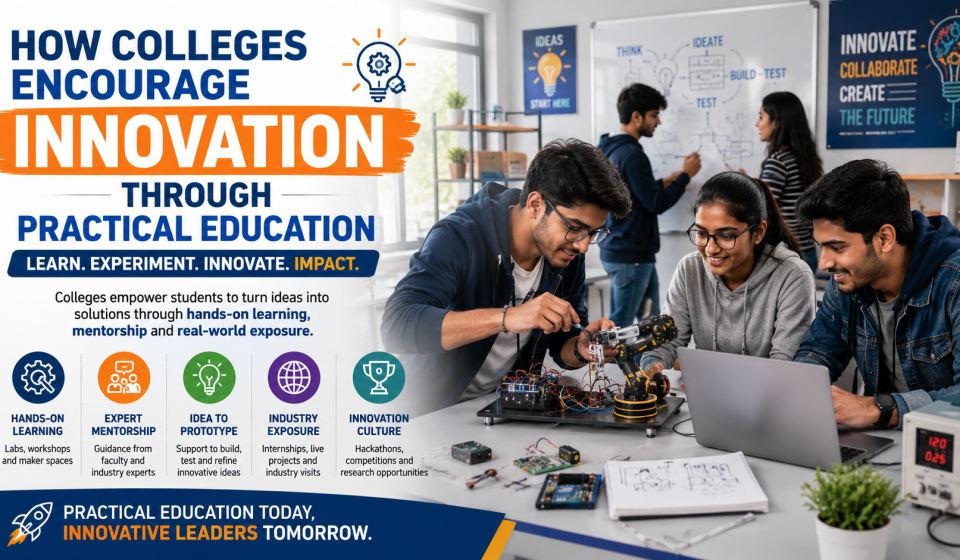

Higher education has evolved far beyond traditional classroom lectures and textbook-based learning. Today’s colleges focus on practical education that equips students with real-world skills, encourages creative thinking.
Innovation is no longer limited to research laboratories or technology companies. Every profession requires individuals who can think critically, identify opportunities, solve problems creatively, and continuously improve existing processes. Colleges play a crucial role in nurturing these abilities by providing experiential learning opportunities such as internships, live projects, startup incubators, industry collaborations, laboratory work, hackathons, and entrepreneurship programs. Through these experiences, students develop the confidence and expertise needed to become future-ready professionals.
Understanding Practical Education
Practical education refers to a learning approach that emphasizes applying theoretical concepts in real-world situations. Instead of memorizing information solely for examinations, students actively participate in projects, experiments, fieldwork, internships, simulations, and collaborative assignments that reinforce classroom knowledge.
This method bridges the gap between education and employment by enabling students to understand how concepts function in professional environments. Practical education also improves confidence, critical thinking, communication, and decision-making abilities that employers value across industries.
Why Innovation Matters in Modern Education
The global economy is changing rapidly due to technological advancements, digital transformation, automation, and evolving business models. Organizations now seek graduates who can innovate rather than simply perform routine tasks.
Innovation helps students:
- Solve complex problems creatively
- Improve existing products and services
- Develop entrepreneurial ideas
- Adapt to changing technologies
- Increase workplace productivity
- Contribute to organizational growth
Colleges that prioritize innovation prepare graduates who are capable of leading future industries instead of merely participating in them.
Learning by Doing
One of the strongest aspects of practical education is experiential learning. Students understand concepts more effectively when they apply them rather than simply reading about them.
Examples include:
- Laboratory experiments
- Engineering workshops
- Software development projects
- Business case studies
- Clinical training
- Teaching practice
- Architecture studios
- Design projects
Hands-on experiences reinforce theoretical learning while improving technical competence.
Project-Based Learning Encourages Creativity
Many colleges integrate project-based learning into their curriculum. Students work individually or in teams to solve practical challenges.
Projects help students:
- Analyze real problems
- Conduct research
- Design innovative solutions
- Present findings professionally
- Manage timelines
- Collaborate effectively
These experiences closely resemble workplace responsibilities, making graduates more employment-ready.
Industry Collaboration Enhances Learning
Modern colleges increasingly collaborate with industries to provide practical exposure.
Industry partnerships may include:
- Guest lectures
- Live projects
- Corporate internships
- Sponsored research
- Industrial visits
- Skill development workshops
Students gain firsthand knowledge of workplace expectations and emerging technologies.
Internship Programs Build Professional Experience
Internships remain one of the most valuable components of practical education.
Benefits include:
- Exposure to professional work culture
- Technical skill development
- Networking opportunities
- Resume enhancement
- Career exploration
- Increased employability
Many students receive full-time job offers after successfully completing internships.
Innovation Labs and Research Centers
Innovation flourishes when students have access to modern laboratories and research facilities.
Innovation labs allow students to:
- Build prototypes
- Conduct experiments
- Test new ideas
- Develop software applications
- Design engineering models
- Explore emerging technologies
These facilities encourage students to transform ideas into practical solutions.
Startup Incubators Promote Entrepreneurship
Many colleges now establish startup incubation centers where aspiring entrepreneurs receive guidance and resources.
Startup incubators provide:
- Business mentoring
- Workspace
- Funding opportunities
- Investor connections
- Product validation
- Legal guidance
Students learn how to convert innovative ideas into sustainable businesses.
Hackathons Inspire Innovative Thinking
Hackathons are intensive competitions where students solve practical challenges within limited timeframes.
Participants develop:
- Teamwork
- Coding skills
- Creativity
- Problem-solving
- Leadership
- Time management
Hackathons also expose students to industry mentors and recruiters.
Design Thinking in Education
Design thinking encourages students to create solutions by understanding users’ needs.
The process typically includes:
- Empathy
- Problem definition
- Idea generation
- Prototype development
- Testing
- Continuous improvement
This methodology promotes innovation across engineering, healthcare, business, education, and social sciences.
Laboratory-Based Learning
Laboratories provide opportunities for experimentation and observation.
Students learn to:
- Apply scientific principles
- Analyze results
- Improve accuracy
- Follow safety standards
- Develop research skills
Practical laboratory sessions strengthen conceptual understanding.
Role of Artificial Intelligence in Practical Education
Artificial Intelligence has transformed modern education by providing personalized learning experiences and advanced analytical tools.
Students now gain experience with:
- Machine learning
- Data analytics
- Robotics
- Computer vision
- Natural language processing
- AI-assisted research
These skills increase career opportunities across multiple industries.
Digital Learning Platforms
Colleges increasingly integrate digital technologies into practical education.
Popular learning tools include:
- Virtual laboratories
- Learning management systems
- Online simulations
- Interactive assessments
- Digital collaboration platforms
- Cloud-based software
Technology enables flexible, engaging, and practical learning experiences.
Multidisciplinary Learning Encourages Innovation
Real-world challenges often require expertise from multiple disciplines.
Colleges encourage collaboration among students from:
- Engineering
- Business
- Healthcare
- Design
- Computer Science
- Environmental Studies
Interdisciplinary projects generate more innovative and comprehensive solutions.
Faculty Mentorship Supports Innovation
Experienced faculty members guide students throughout their innovation journey.
Mentors help students:
- Refine ideas
- Conduct research
- Develop projects
- Publish papers
- Apply for grants
- Build professional confidence
Mentorship significantly enhances learning outcomes.
Community-Based Learning
Practical education extends beyond campus boundaries.
Students participate in:
- Rural development programs
- Community health initiatives
- Environmental campaigns
- Social entrepreneurship projects
- Public awareness activities
These experiences develop empathy, responsibility, and civic leadership.
Critical Thinking Through Case Studies
Case studies expose students to realistic business and technical scenarios.
Students learn to:
- Analyze situations
- Evaluate evidence
- Compare alternatives
- Recommend solutions
- Defend decisions
Case-based learning strengthens analytical reasoning.
Communication Skills Through Practical Activities
Innovation succeeds only when ideas are communicated effectively.
Practical education improves:
- Presentation skills
- Report writing
- Professional communication
- Negotiation
- Team discussions
- Public speaking
These abilities are essential in modern workplaces.
Teamwork and Collaboration
Innovation rarely occurs in isolation.
College projects require students to:
- Work with diverse teams
- Share responsibilities
- Resolve conflicts
- Respect different viewpoints
- Achieve common goals
Collaborative experiences prepare students for organizational environments.
Developing Leadership Skills
Practical education often involves leadership opportunities.
Students lead:
- Technical teams
- Student organizations
- Research groups
- Startup initiatives
- Community projects
Leadership experiences improve confidence and decision-making.
Exposure to Emerging Technologies
Colleges introduce students to modern technologies including:
- Artificial Intelligence
- Internet of Things (IoT)
- Blockchain
- Cybersecurity
- Cloud Computing
- Data Science
- Robotics
- Virtual Reality
Understanding these technologies prepares students for future careers.
Assessment Beyond Examinations
Practical education evaluates students through multiple methods.
Assessment includes:
- Project submissions
- Prototype development
- Internship performance
- Research reports
- Viva examinations
- Presentations
- Portfolio creation
This approach measures actual competence rather than memorization.
Benefits for Employers
Graduates with practical education bring significant advantages to employers.
They often demonstrate:
- Faster learning ability
- Better problem-solving
- Workplace confidence
- Technical competence
- Adaptability
- Creativity
- Professional ethics
These qualities reduce training time and improve organizational productivity.
Challenges in Practical Education
Although highly beneficial, practical education faces several challenges.
Common issues include:
- Limited infrastructure
- Funding constraints
- Industry partnership gaps
- Faculty training requirements
- Rapid technological change
Continuous investment and collaboration can address these challenges.
The Future of Practical Education
Higher education continues evolving with innovation-driven learning models.
Future trends include:
- AI-powered personalized learning
- Virtual reality classrooms
- Industry-integrated curriculum
- Global collaborative projects
- Smart laboratories
- Digital credentialing
- Micro-certifications
- Skill-based education
These developments will further strengthen students’ ability to innovate and succeed in competitive careers.
Source
https://www.unesco.org
https://www.oecd.org/education
https://www.weforum.org
https://www.naceweb.org
Conclusion
Practical education has become the foundation of innovation in modern higher education. By combining classroom knowledge with hands-on experiences, internships, research, entrepreneurship programs, industry collaborations, and emerging technologies, colleges prepare students to think creatively and solve real-world problems. These experiences build technical expertise, leadership, teamwork, communication, and critical thinking skills that employers highly value. As industries continue to evolve, colleges that prioritize practical education will continue producing graduates who are not only job-ready but also capable of driving innovation, creating businesses, and making meaningful contributions to society.
FAQ
Q1. What is practical education in colleges?
Practical education focuses on applying classroom knowledge through projects, internships, laboratories, fieldwork, research, and industry experiences.
Q2. How does practical education encourage innovation?
It allows students to solve real-world problems, develop creative solutions, experiment with new ideas, and gain hands-on experience.
Q3. Why are internships important for students?
Internships provide workplace exposure, improve professional skills, build industry connections, and increase employability.
Q4. What role do innovation labs play in colleges?
Innovation labs provide resources for experimentation, prototyping, research, and developing practical solutions to real-world challenges.
Q5. How do startup incubators benefit students?
Startup incubators offer mentorship, funding guidance, networking opportunities, and business development support for aspiring entrepreneurs.
Q6. Why is project-based learning effective?
Project-based learning improves teamwork, critical thinking, creativity, communication, and practical problem-solving abilities.
Q7. How do colleges prepare students for future careers?
Colleges combine academic knowledge with practical experiences, digital skills, internships, leadership opportunities, and industry collaborations to make students career-ready.
Q8. Why is innovation important in higher education?
Innovation helps students adapt to changing industries, improve productivity, create new solutions, and remain competitive in the global job market.