How Modern Colleges Support Innovation Through Practical Learning: A Complete Guide to Future-Ready Education and Career Success

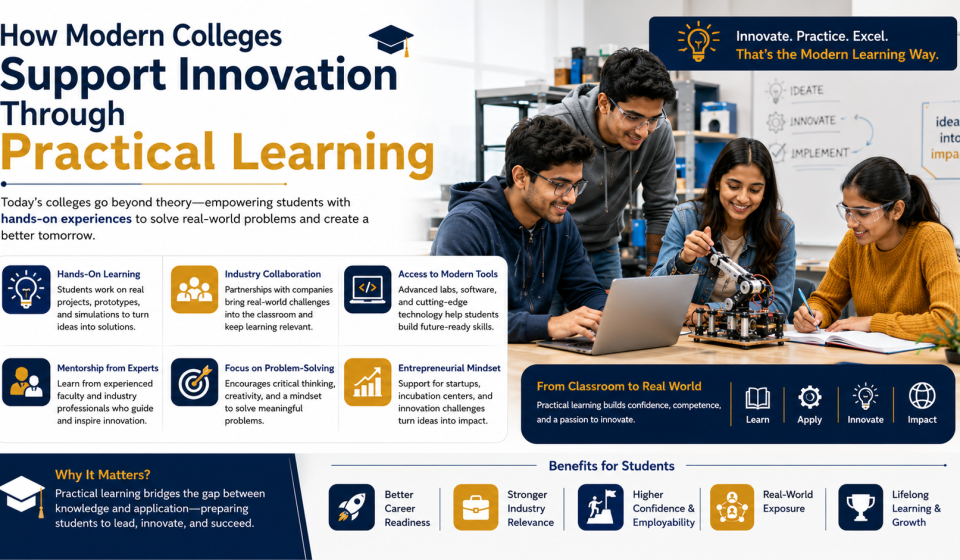
Innovation has become one of the defining characteristics of modern higher education. Today’s colleges are no longer limited to traditional classroom teaching and textbook-based learning. Instead, they focus on creating dynamic learning environments.
Employers today seek graduates who are capable of adapting to changing technologies, collaborating with diverse teams, communicating effectively, and applying their knowledge in practical situations. Modern colleges recognize these expectations and integrate innovation-focused learning into their academic programs. Students participate in live industry projects, hackathons, design thinking workshops, entrepreneurship initiatives, research collaborations, and community-based learning experiences that enhance both technical and professional skills. Choosing a college that emphasizes practical learning ensures students graduate with the confidence, experience, and problem-solving abilities needed to succeed in future careers. This comprehensive guide explains how modern colleges support innovation through practical learning and why these opportunities play a crucial role in student success.
What Is Practical Learning?
Practical learning is an educational approach that combines classroom knowledge with real-world experiences.
Examples include:
- Laboratory experiments
- Live industry projects
- Internships
- Research activities
- Case studies
- Field visits
- Simulations
- Entrepreneurship projects
- Community engagement
- Capstone projects
Practical learning helps students apply theoretical concepts effectively.
Why Innovation Matters in Higher Education
Innovation encourages students to think creatively and develop solutions for modern challenges.
Innovative education helps students:
- Solve real-world problems
- Improve critical thinking
- Enhance creativity
- Build adaptability
- Strengthen collaboration
- Prepare for future careers
Innovation drives lifelong learning.
Project-Based Learning
Project-based learning allows students to gain practical experience while working on meaningful assignments.
Benefits include:
- Team collaboration
- Research skills
- Problem-solving
- Time management
- Communication
- Practical application of knowledge
Projects improve academic understanding.
Industry Collaboration Supports Innovation
Partnerships with businesses expose students to current industry practices.
Industry collaboration may include:
- Corporate internships
- Guest lectures
- Industrial visits
- Sponsored projects
- Professional mentoring
- Industry certifications
Real-world exposure improves employability.
Innovation Labs and Makerspaces
Many colleges establish innovation centers where students can experiment with new ideas.
Innovation facilities often include:
- Robotics laboratories
- AI and data science labs
- Engineering workshops
- Prototype development centers
- Digital fabrication labs
These spaces encourage creativity and experimentation.
Research Opportunities
Research helps students explore new ideas while contributing to academic advancement.
Research experiences include:
- Faculty-guided projects
- Undergraduate research
- Scientific publications
- Innovation competitions
- Conference presentations
Research strengthens analytical thinking.
Entrepreneurship Development
Modern colleges encourage students to become job creators rather than only job seekers.
Entrepreneurship support may include:
- Startup incubation centers
- Business mentoring
- Innovation challenges
- Pitch competitions
- Funding guidance
Entrepreneurial education promotes innovation.
Experiential Learning Beyond the Classroom
Learning extends beyond lectures through practical experiences.
Examples include:
- Community service
- Study tours
- Industrial training
- International exchange programs
- Professional workshops
Experiential learning broadens perspectives.
Technology Enhances Practical Learning
Modern technology supports interactive education.
Digital learning resources include:
- Virtual laboratories
- Learning management systems
- Simulation software
- Artificial intelligence tools
- Digital collaboration platforms
Technology improves accessibility and engagement.
Faculty as Innovation Mentors
Experienced faculty members guide students throughout their learning journey.
Faculty contribute by:
- Supervising research
- Providing mentorship
- Encouraging innovation
- Connecting students with industry
- Supporting interdisciplinary learning
Faculty mentorship enhances student development.
Competitions Encourage Creative Thinking
Academic competitions challenge students to develop innovative solutions.
Examples include:
- Hackathons
- Business plan competitions
- Robotics contests
- Design challenges
- Research symposiums
Competitions strengthen practical skills.
Career Benefits of Practical Learning
Students with practical experience often enjoy stronger career outcomes.
Advantages include:
- Higher employability
- Better communication skills
- Workplace readiness
- Leadership development
- Professional confidence
Employers value practical experience alongside academic achievement.
Questions to Ask Before Admission
Before choosing a college, students should ask:
- Does the college provide internship opportunities?
- Are innovation labs available?
- How many students participate in research?
- Are startup incubation facilities available?
- What industry partnerships exist?
- Does the curriculum include project-based learning?
These questions help evaluate innovation-focused education.
Common Mistakes Students Make
Many students focus only on rankings or campus infrastructure without evaluating practical learning opportunities. Ignoring research programs, internships, innovation centers, entrepreneurship support, and industry collaborations may limit future career growth. A college that actively promotes experiential learning often provides better preparation for professional success.
The Future of Practical Learning
Artificial intelligence, virtual reality, augmented reality, interdisciplinary education, digital simulations, remote internships, smart laboratories, global industry partnerships, startup ecosystems, and personalized learning platforms will continue transforming practical education while preparing students for the evolving workforce.
Source
https://www.ugc.gov.in
https://www.aicte-india.org
https://www.education.gov.in
https://www.naac.gov.in
Conclusion
Modern colleges play a vital role in fostering innovation by integrating practical learning into every stage of higher education. Through internships, live projects, research opportunities, innovation labs, entrepreneurship programs, industry collaborations, and technology-enabled learning, students gain valuable experiences that prepare them for future careers. These opportunities help develop creativity, problem-solving abilities, leadership, teamwork, and adaptability—qualities that employers increasingly value. Before selecting a college, students should carefully evaluate the institution’s commitment to practical learning and innovation, ensuring they choose an environment that supports both academic excellence and long-term professional success.
FAQ
1. What is practical learning in higher education?
Practical learning combines classroom education with hands-on experiences such as internships, live projects, laboratory work, research, case studies, field visits, and industry collaborations.
2. Why is innovation important in modern colleges?
Innovation encourages creativity, critical thinking, problem-solving, adaptability, and entrepreneurship, preparing students for evolving career opportunities and real-world challenges.
3. How do colleges promote innovation?
Colleges support innovation through research centers, innovation labs, startup incubation, project-based learning, hackathons, industry partnerships, mentorship programs, and experiential learning activities.
4. Does practical learning improve employability?
Yes. Practical learning develops technical knowledge, communication skills, teamwork, leadership, and workplace experience that employers highly value.
5. What facilities should students look for before admission?
Students should evaluate innovation labs, research centers, internship programs, startup incubation facilities, industry collaborations, digital learning resources, and career development services.
6. Why should students choose colleges with strong practical learning opportunities?
Such colleges provide better preparation for future careers by helping students apply theoretical knowledge, develop professional skills, gain industry exposure, and build confidence through real-world experiences.