How Colleges Prepare Students for Industry 5.0: The Ultimate 2026 Guide to Future-Ready Skills, Human-Centered Innovation, and Career Success

The world of work is evolving rapidly, and higher education is evolving with it. After the widespread adoption of automation, artificial intelligence, robotics, and digital technologies during Industry 4.0, the global economy is now entering the era of Industry 5.0. Unlike previous industrial.
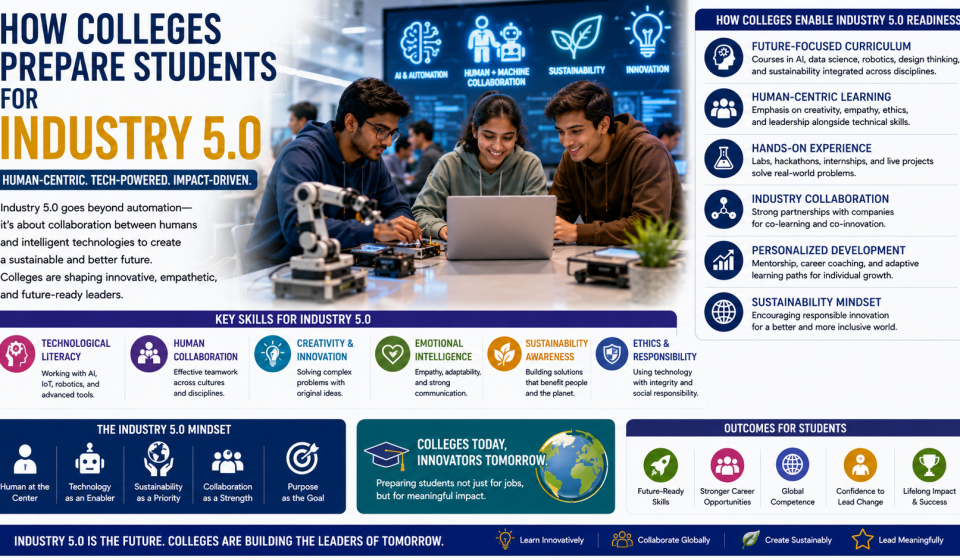
In 2026, modern colleges are redesigning academic programs to align with Industry 5.0 requirements. They are integrating emerging technologies with practical learning experiences while encouraging innovation, critical thinking, ethical decision-making, sustainability, and lifelong learning. Employers are increasingly looking for graduates who not only understand advanced technologies but can also work effectively alongside them, combining human creativity with machine intelligence.
Understanding Industry 5.0
Industry 5.0 represents the next phase of industrial development where humans and advanced technologies work together.
Its major focus areas include:
- Human-centered innovation
- Artificial intelligence
- Automation
- Sustainability
- Collaboration
- Personalized solutions
Technology supports people rather than replacing them.
Industry-Aligned Curriculum
Modern colleges regularly update curricula to include:
- Artificial intelligence
- Data analytics
- Cloud computing
- Internet of Things (IoT)
- Cybersecurity
- Smart manufacturing
- Digital business practices
Industry-relevant education improves graduate readiness.
Project-Based Learning
Students gain practical experience through:
- Real-world projects
- Case studies
- Innovation challenges
- Product development
- Collaborative assignments
Hands-on learning improves knowledge application.
Interdisciplinary Education
Industry 5.0 encourages collaboration across disciplines.
Students often combine knowledge from:
- Engineering
- Computer science
- Business
- Healthcare
- Design
- Environmental studies
Interdisciplinary learning supports innovation.
Artificial Intelligence and Digital Skills
Many institutions now offer exposure to:
- AI applications
- Machine learning fundamentals
- Data visualization
- Digital collaboration tools
- Automation technologies
Digital literacy has become an essential career skill.
Research and Innovation Centers
Colleges support innovation through:
- Research laboratories
- Innovation hubs
- Startup incubators
- Maker spaces
- Prototype development facilities
Students gain opportunities to solve real-world challenges.
Industry Partnerships
Collaboration with industry provides:
- Internships
- Live industry projects
- Guest lectures
- Technical workshops
- Professional networking
Practical exposure strengthens employability.
Entrepreneurship Development
Modern campuses encourage entrepreneurship through:
- Startup mentoring
- Business plan competitions
- Incubation programs
- Innovation funding
- Leadership workshops
Entrepreneurial thinking prepares students for changing career opportunities.
Sustainability Education
Industry 5.0 emphasizes responsible innovation.
Students learn about:
- Environmental sustainability
- Ethical technology
- Resource efficiency
- Social responsibility
- Sustainable business practices
Responsible innovation creates long-term value.
Soft Skills Remain Essential
Employers increasingly value:
- Communication
- Leadership
- Teamwork
- Emotional intelligence
- Adaptability
- Critical thinking
- Creativity
Human skills complement advanced technologies.
Lifelong Learning Mindset
Industry 5.0 requires professionals to continuously update their knowledge.
Colleges encourage:
- Independent learning
- Professional certifications
- Research participation
- Digital learning
- Skill development
Continuous learning supports career growth.
Choosing a Future-Focused College
Before selecting a college, evaluate:
- Updated curriculum
- Industry collaborations
- Internship opportunities
- Research facilities
- Innovation ecosystem
- Career support services
These factors improve long-term educational outcomes.
Career Opportunities in Industry 5.0
Graduates prepared for Industry 5.0 may pursue careers in:
- Artificial intelligence
- Data science
- Smart manufacturing
- Digital transformation
- Sustainable engineering
- Product innovation
- Technology consulting
- Entrepreneurship
Future-ready skills increase career flexibility.
Source
https://www.ugc.gov.in
https://www.aicte-india.org
https://www.education.gov.in
https://www.nirfindia.org
https://www.worldeconomicforum.org
Conclusion
Industry 5.0 represents a new era where advanced technologies and human creativity work together to build smarter, more sustainable, and people-centered industries. Modern colleges play a crucial role in preparing students for this future by combining industry-aligned curricula, practical learning experiences, research opportunities, entrepreneurship programs, digital technologies, sustainability education, and soft skill development. Rather than focusing only on technical expertise, higher education institutions are nurturing adaptable, innovative, and lifelong learners who can successfully collaborate with emerging technologies. Choosing a college that embraces Industry 5.0 principles provides students with stronger career opportunities, greater professional confidence, and the ability to thrive in an increasingly dynamic global workforce.
FAQ
1. What is Industry 5.0?
Industry 5.0 is the next phase of industrial development that emphasizes collaboration between humans and advanced technologies while focusing on innovation, sustainability, and human-centered workplaces.
2. How are colleges preparing students for Industry 5.0?
Colleges are updating curricula, integrating emerging technologies, promoting project-based learning, encouraging research, supporting entrepreneurship, and strengthening industry partnerships.
3. Which technical skills are important for Industry 5.0?
Important skills include artificial intelligence, data analytics, cloud computing, cybersecurity, automation, Internet of Things (IoT), digital collaboration, and smart manufacturing concepts.
4. Why are soft skills important in Industry 5.0?
Communication, leadership, teamwork, emotional intelligence, creativity, adaptability, and critical thinking help professionals work effectively alongside advanced technologies.
5. How do internships support Industry 5.0 readiness?
Internships provide practical experience, industry exposure, professional networking, and opportunities to apply classroom knowledge in real workplace environments.
6. Why is sustainability included in Industry 5.0 education?
Industry 5.0 encourages organizations to combine technological innovation with environmental responsibility and socially responsible business practices.
7. Should students choose colleges with innovation and research facilities?
Yes. Innovation centers, research labs, startup incubators, and maker spaces provide valuable practical experience and strengthen career readiness.
8. What careers are available in Industry 5.0?
Graduates may work in artificial intelligence, digital transformation, smart manufacturing, data science, sustainable engineering, product innovation, technology consulting, research, and entrepreneurship.