How Colleges Foster Innovation Through Research Opportunities: A Complete Guide to Academic Discovery, Student Growth, and Career Success

Innovation has become one of the defining characteristics of modern higher education. Colleges and universities are no longer focused solely on classroom instruction—they are also centers of research, creativity, technological advancement, and problem-solving.
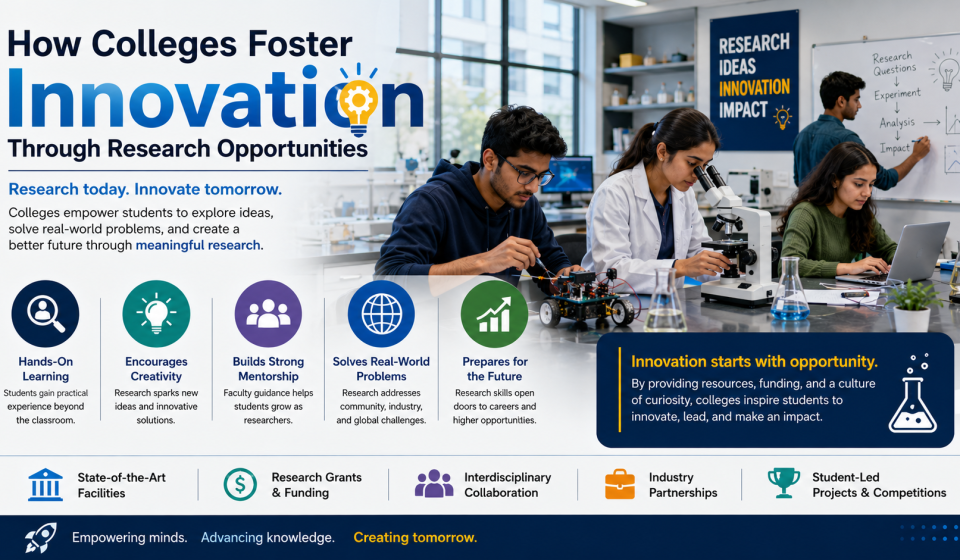
In today’s knowledge-driven economy, employers increasingly seek graduates who can think critically, solve complex problems, collaborate effectively, and adapt to rapidly changing technologies. Colleges that invest in strong research ecosystems provide students with access to experienced faculty mentors, advanced laboratories, innovation centers, research funding, interdisciplinary collaborations, and industry partnerships. These resources encourage students to move beyond textbook learning and participate in discovery-based education that strengthens both academic achievement and career readiness. Research opportunities also inspire curiosity, lifelong learning, and entrepreneurial thinking while helping students build professional networks and competitive academic profiles. This comprehensive guide explores how colleges foster innovation through research opportunities and why research has become an essential component of higher education.
What Are Research Opportunities in College?
Research opportunities allow students to investigate real-world questions, generate new knowledge, analyze information, and contribute to academic or industry-based innovation.
Common research opportunities include:
- Faculty-led research projects
- Laboratory research
- Engineering design projects
- Healthcare studies
- Social science research
- Business research
- Innovation competitions
- Entrepreneurship programs
- Undergraduate research fellowships
- Industry-sponsored research
Research combines learning with practical application.
Why Research Matters in Higher Education
Research transforms students from passive learners into active problem-solvers.
Major benefits include:
- Critical thinking
- Innovation
- Practical experience
- Career readiness
- Academic excellence
- Lifelong learning
Research strengthens both knowledge and professional skills.
Encouraging Critical Thinking
Research teaches students to analyze information carefully.
Students learn how to:
- Ask meaningful questions
- Evaluate evidence
- Test hypotheses
- Interpret results
- Make informed conclusions
Critical thinking improves academic performance.
Promoting Innovation
Innovation begins with curiosity and experimentation.
Research encourages students to:
- Develop original ideas
- Improve existing technologies
- Solve practical problems
- Create new solutions
- Explore emerging fields
Innovation contributes to scientific and technological advancement.
Building Problem-Solving Skills
Research projects present real challenges.
Students strengthen their ability to:
- Identify problems
- Analyze complex situations
- Evaluate alternatives
- Develop practical solutions
- Improve decision-making
Problem-solving skills are highly valued by employers.
Developing Technical Expertise
Research provides practical experience using professional tools and technologies.
Students gain exposure to:
- Laboratory equipment
- Data analysis software
- Artificial intelligence tools
- Statistical methods
- Research databases
- Technical documentation
Technical competence increases employability.
Strengthening Communication Skills
Researchers must communicate findings effectively.
Students improve:
- Academic writing
- Research presentations
- Scientific communication
- Public speaking
- Professional collaboration
Communication skills support career growth.
Learning Through Faculty Mentorship
Experienced faculty members guide students throughout the research process.
Faculty mentors help students:
- Select research topics
- Design methodologies
- Analyze data
- Publish findings
- Plan future careers
Mentorship improves research quality and confidence.
Encouraging Interdisciplinary Learning
Modern research often combines multiple disciplines.
Students collaborate across areas such as:
- Engineering
- Healthcare
- Business
- Computer science
- Environmental studies
- Social sciences
Interdisciplinary learning encourages innovative thinking.
Industry Collaboration
Many colleges partner with industries to solve real-world challenges.
Industry-supported research offers:
- Practical experience
- Professional networking
- Internship opportunities
- Technology development
- Career exposure
Industry collaboration strengthens workforce readiness.
Entrepreneurship and Innovation Centers
Research frequently leads to innovation and entrepreneurship.
Students may participate in:
- Startup incubators
- Innovation hubs
- Business competitions
- Product development
- Patent support programs
Entrepreneurship transforms ideas into practical solutions.
Publication and Conference Opportunities
Research allows students to present their work through:
- Academic journals
- Research conferences
- Innovation exhibitions
- Poster presentations
- Technical symposiums
These achievements strengthen academic and professional profiles.
Global Research Collaboration
Many universities participate in international research partnerships.
Global collaboration offers:
- Cross-cultural learning
- International networking
- Joint research projects
- Knowledge sharing
- Global career opportunities
International exposure broadens professional perspectives.
Technology and Research
Digital technologies continue transforming academic research.
Modern research uses:
- Artificial intelligence
- Machine learning
- Big data analytics
- Cloud computing
- Virtual laboratories
- Digital libraries
Technology accelerates discovery and innovation.
Common Challenges
Students may initially find research challenging because of unfamiliar methodologies, time management, data analysis, or limited experience. However, guidance from faculty mentors, teamwork, structured research training, and continuous practice help students build confidence and develop strong research competencies.
The Future of Research in Higher Education
Future research will increasingly focus on interdisciplinary collaboration, sustainability, artificial intelligence, healthcare innovation, renewable energy, digital transformation, climate science, and global problem-solving. Colleges that invest in research infrastructure, innovation centers, industry partnerships, and student research programs will continue producing graduates who are prepared to lead scientific, technological, and social advancements worldwide.
Source
https://www.ugc.gov.in
https://www.aicte-india.org
https://www.unesco.org
https://www.nsf.gov
Conclusion
Research opportunities are among the most valuable components of higher education because they encourage innovation, critical thinking, creativity, and practical problem-solving. Through faculty mentorship, interdisciplinary collaboration, industry partnerships, modern laboratories, and innovation centers, colleges provide students with experiences that extend far beyond traditional classroom learning. Research not only strengthens academic achievement but also improves employability, leadership, communication, and lifelong learning skills. Students who actively participate in research develop the confidence, curiosity, and professional competencies needed to succeed in rapidly evolving global industries while contributing meaningful solutions to society’s most important challenges.
FAQ
1. Why are research opportunities important in college?
Research opportunities help students develop critical thinking, analytical skills, innovation, technical expertise, communication abilities, and practical experience while preparing them for advanced studies and professional careers.
2. How do colleges encourage student research?
Colleges provide faculty mentorship, research laboratories, innovation centers, undergraduate research programs, funding opportunities, industry collaborations, conferences, and publication support.
3. How does research improve career readiness?
Research strengthens problem-solving, teamwork, leadership, communication, technical knowledge, adaptability, and project management skills that employers highly value.
4. Can undergraduate students participate in research?
Yes. Many colleges encourage undergraduate students to participate in faculty-led projects, independent studies, innovation competitions, laboratory research, and interdisciplinary research programs.
5. What careers benefit from research experience?
Research experience is valuable in engineering, healthcare, business, education, science, technology, environmental studies, public policy, data analytics, and many other professional fields.
6. How does research promote innovation?
Research encourages students to investigate problems, develop creative solutions, test ideas, improve existing technologies, and contribute new knowledge that supports scientific, technological, and societal progress.