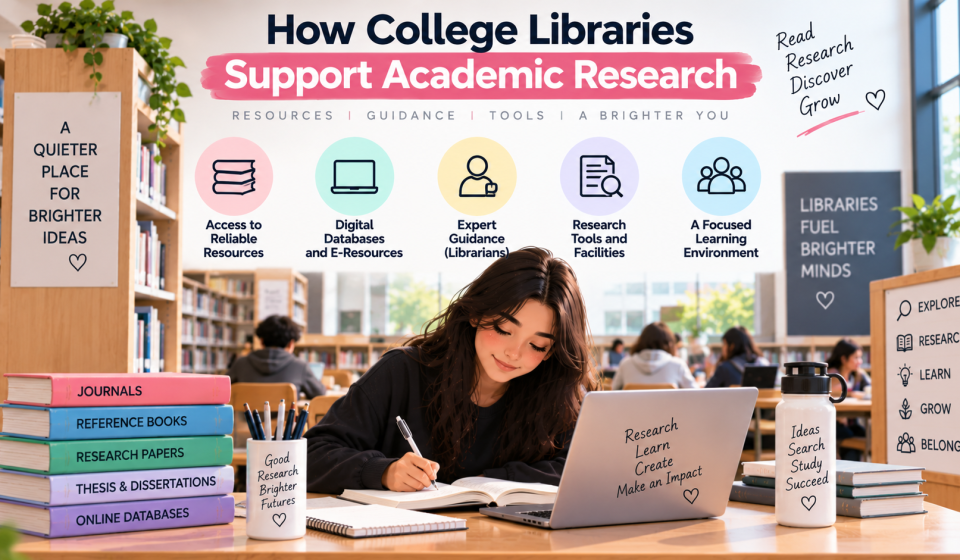

Discover how college libraries support academic research through books, journals, databases, research guides, librarians, digital resources, citation support, and scholarly research tools.
College libraries are much more than quiet places where students can read books or complete assignments. They are important academic environments that help students discover reliable information, understand scholarly resources, develop research skills, evaluate evidence, and complete academic projects. Whether a student is preparing a classroom presentation, writing a research paper, completing a dissertation, or working on a final-year project, the college library can provide valuable resources and guidance throughout the research process.
Academic research requires students to find information that is relevant, credible, and appropriate for their topic. Search engines can provide a huge amount of information, but students may need specialized databases, scholarly journals, books, research guides, and expert assistance to identify high-quality sources. College libraries bring many of these resources together and help students learn how to search, evaluate, organize, and correctly use information.
What Is an Academic Library?
An academic library is a library connected to a college or university that supports teaching, learning, and research.
Unlike a general public library, an academic library is designed specifically to support the educational and research needs of students, faculty, researchers, and other members of the institution.
A college library may provide access to:
- Textbooks
- Reference books
- Academic journals
- Research papers
- E-books
- Newspapers
- Magazines
- Theses and dissertations
- Research databases
- Digital archives
- Subject-specific resources
- Research guides
- Citation tools
- Online learning materials
These resources can help students move beyond basic information and develop deeper knowledge about their subjects.
Why College Libraries Are Important for Academic Research
Research requires more than simply finding information online. Students need to identify appropriate sources, understand the evidence, compare different viewpoints, and use information responsibly.
College libraries support this process by providing organized collections and research services.
For example, Cornell University Library recommends using library catalogs, databases, research guides, books, journals, and other specialized resources when beginning academic research. It also emphasizes evaluating sources and citing information properly.
A library therefore becomes a central research environment where students can develop both subject knowledge and research skills.
Access to Scholarly Books and Journals
One of the most important roles of a college library is providing access to scholarly materials.
Students may need academic books, journal articles, conference papers, research reports, and other specialized publications for assignments and research projects.
Library collections can make it easier for students to locate these materials through a catalog or discovery system.
Scholarly journals are particularly important because they often contain detailed research conducted by experts in specific fields.
Using scholarly literature allows students to understand existing research instead of depending only on general websites or informal online content.
Access to Academic Databases
Academic databases are powerful tools for college research.
Unlike a general web search, many academic databases are designed specifically to locate scholarly materials. They can provide filters for subjects, publication dates, document types, authors, and other criteria.
The University of Sydney Library explains that academic databases are organized repositories designed for scholarly research and often provide advanced search features that help users locate relevant academic materials.
Depending on the college and subject, students may have access to databases covering areas such as:
- Engineering
- Computer science
- Medicine
- Business
- Economics
- Psychology
- Education
- Law
- Social sciences
- Humanities
- Arts
- Environmental science
Learning how to use these databases can significantly improve the quality and efficiency of academic research.
Helping Students Find Peer-Reviewed Sources
Students are often asked to use peer-reviewed or scholarly sources in assignments.
However, beginners may not always understand what makes a source scholarly.
College libraries help students identify peer-reviewed journals and other academic materials. Library research guides can explain how peer review works, how to recognize scholarly publications, and how to distinguish academic sources from general online content.
Peer-reviewed research is valuable because scholarly work is evaluated by experts in the relevant field before publication.
Students should still critically evaluate sources rather than assuming that every academic publication is automatically suitable for every research question.
Research Guides Make Research Easier
Many college libraries create research guides for different subjects and courses.
These guides can recommend:
- Useful databases
- Academic journals
- Books
- Websites
- Reference materials
- Search strategies
- Citation resources
- Subject-specific research tools
Research guides can save students time because they provide a starting point instead of requiring students to search randomly.
For example, a student working on a computer engineering project may find a research guide containing recommended databases and technical resources related to engineering and computer science.
Librarians Provide Research Support
Librarians are an important part of academic research support.
Students sometimes hesitate to ask librarians for help because they think librarians only help with borrowing books. In reality, academic librarians can assist students with research questions, database selection, search strategies, source evaluation, and citation-related issues.
Cornell University Library specifically encourages students to ask a librarian when they cannot find the information they need.
A librarian may help a student:
- Develop search keywords
- Identify useful databases
- Find scholarly articles
- Narrow a broad research topic
- Evaluate sources
- Locate books
- Understand database filters
- Find full-text resources
- Learn citation methods
- Improve research strategies
This support can be particularly useful when students are working on complex assignments.
Helping Students Develop Better Search Skills
Finding useful academic information requires effective searching.
Students may begin with a broad keyword but receive thousands of unrelated results.
Libraries teach students how to improve searches by using:
- Specific keywords
- Synonyms
- Subject headings
- Boolean operators
- Filters
- Date ranges
- Publication types
- Author searches
- Advanced search options
Academic databases often provide advanced tools that help researchers narrow their results.
For example, instead of searching only for “artificial intelligence,” a student researching AI in healthcare might combine terms such as “artificial intelligence,” “healthcare,” “diagnosis,” and “machine learning.”
Better search strategies help students find more relevant information in less time.
Supporting Source Evaluation
Not every source found online is suitable for academic research.
Students need to consider whether information is accurate, current, relevant, authoritative, and supported by evidence.
Libraries help students develop information literacy skills that allow them to evaluate sources critically.
Students can ask questions such as:
- Who wrote the source?
- What are the author’s qualifications?
- Where was the information published?
- When was it published?
- Is the information supported by evidence?
- Does the source cite other reliable research?
- Is the information relevant to my research question?
- Could the source contain bias?
Boston University Libraries, for example, recommends considering expertise, accuracy, currency, documentation, purpose, relevance, and potential bias when evaluating information.
Access to E-Books and Digital Resources
Modern college libraries are increasingly digital.
Students may be able to access e-books, online journals, databases, digital archives, research reports, and other resources from their computers.
This can make research more convenient because students do not always need to visit the physical library to access academic materials.
Digital resources are especially useful for students who commute, study from home, or need to work on research outside normal library hours.
However, access may depend on institutional subscriptions and student login credentials.
Interlibrary Loan and Resource Sharing
Sometimes a college library may not have a particular book or article in its own collection.
In such situations, libraries may provide resource-sharing or interlibrary loan services.
These services allow students and researchers to request materials from other participating libraries.
This is particularly useful when students are working on specialized research topics where relevant resources may not be available in the local collection.
Supporting Literature Reviews
Literature reviews are an important part of academic research.
A literature review involves finding, reading, comparing, and organizing existing research on a particular topic.
College libraries can support literature reviews by helping students locate scholarly articles, books, databases, research guides, and citation resources.
Harvard Library provides specialized support for literature reviews and evidence synthesis, including assistance with search strategies and database selection.
Students can use library resources to identify existing research, understand major themes, compare findings, and identify areas where additional research may be needed.
Helping Students With Citations
Academic research requires students to give credit to the sources they use.
Proper citation helps readers identify where information came from and allows researchers to demonstrate academic integrity.
College libraries often provide citation guides and tools for styles such as:
- APA
- MLA
- Chicago
- IEEE
- Harvard
- Other discipline-specific styles
Libraries may also provide guidance on reference managers and citation-management tools.
Learning how to cite sources correctly can help students avoid accidental plagiarism and create stronger academic papers.
Supporting Final-Year Projects and Dissertations
College libraries can be especially valuable during final-year projects, dissertations, and research-intensive assignments.
Students working on major projects may need a combination of books, journal articles, technical papers, reports, statistics, databases, and previous research.
Library databases can help students locate background information and existing studies.
Students can also use research guides and librarian support to improve their search strategy.
For example, a computer engineering student developing an AI-based application may need research papers about artificial intelligence, software development, machine learning, databases, user experience, and related technologies.
A strong library research strategy can help the student build a more reliable academic foundation for the project.
Creating a Quiet Academic Environment
Physical library spaces also support research.
Students may use library reading rooms, study areas, group discussion rooms, computer facilities, and other academic spaces.
A dedicated research environment can help students concentrate and reduce distractions.
Many libraries also provide spaces designed for both individual study and collaborative work.
The availability of facilities varies from one institution to another, so students should check their own college library for specific services.
Supporting Group Research and Collaboration
Academic research is not always an individual activity.
Students may work together on presentations, group projects, research assignments, and practical projects.
Libraries can provide spaces where students can discuss research questions, review sources, organize information, and prepare presentations.
Some libraries also offer technology and multimedia facilities that support collaborative academic work.
Helping Students Become Independent Researchers
One of the biggest benefits of college libraries is that they can help students become independent researchers.
Instead of simply giving students information, library services can teach them how to find information themselves.
This skill becomes increasingly important as students progress from undergraduate study to postgraduate education, professional work, and lifelong learning.
A student who understands how to search databases, evaluate sources, identify scholarly literature, and cite information can continue using these skills long after graduation.
How Students Can Make Better Use of Their College Library
Students can get more value from their library by using it proactively.
Start by learning how the library website works. Explore the catalog, databases, research guides, e-books, journals, and other available resources.
Do not wait until the last day before an assignment is due.
Students should also learn how to contact librarians for research assistance.
When starting a project, create a clear research question and identify important keywords.
Keep track of useful sources while researching so that citations can be created more easily later.
Most importantly, students should learn to evaluate information rather than accepting every search result as reliable.
Common Mistakes Students Make With Library Research
Several common mistakes can reduce the effectiveness of academic research.
One mistake is relying entirely on general search engines.
Another is choosing the first few results without evaluating their credibility.
Students may also use outdated sources when newer research is available.
Failing to record citation information is another common problem.
Some students also search using very broad keywords and become overwhelmed by irrelevant results.
Learning basic library research skills can help students avoid these problems.
The Future of College Libraries
College libraries are continuing to evolve as education becomes increasingly digital.
Modern academic libraries are combining traditional collections with electronic databases, e-books, digital archives, research support, data services, technology, and information-literacy training.
Libraries are therefore becoming research and learning centers rather than simply places for storing books.
Students who learn to use these services effectively can gain an advantage in academic research and develop skills that remain useful throughout their careers.
Source
Cornell University Library – Getting Started with Library Research
University of Sydney Library – Using Academic Databases
Harvard Library – Get Started Using the Libraries
University of Toronto – How to Find Sources for Assignments
Conclusion
College libraries play an essential role in supporting academic research. They provide access to books, journals, databases, e-books, research guides, digital resources, and other scholarly materials while also helping students develop important research and information-literacy skills.
A library can support almost every stage of the research process, from choosing a topic and developing keywords to finding scholarly sources, evaluating evidence, organizing information, and citing references. Librarians can also provide personalized guidance when students have difficulty finding or evaluating research materials.
Students should therefore think of the college library as an academic research partner rather than simply a place to borrow books. By learning how to use library databases, research guides, digital collections, citation resources, and librarian support, students can improve the quality of their assignments and become more confident, independent researchers.
FAQ
1. How does a college library support academic research?
A college library supports research by providing books, journals, academic databases, e-books, research guides, digital resources, citation support, and assistance from librarians.
2. Why are academic databases important for students?
Academic databases help students find scholarly and subject-specific information more efficiently. They often include advanced search and filtering tools that make it easier to locate relevant research.
3. Can librarians help students with research?
Yes. Academic librarians can help students develop search strategies, select databases, find scholarly sources, evaluate information, and understand citation practices.
4. What types of research materials are available in college libraries?
Depending on the institution, students may find books, e-books, academic journals, research papers, newspapers, theses, dissertations, databases, digital archives, reports, and other scholarly resources.
5. How can students find peer-reviewed articles?
Students can use library databases that provide scholarly and peer-reviewed publications. Library research guides and librarians can also help students identify appropriate databases and search strategies.
6. Why should students use library databases instead of only Google?
Library databases provide specialized academic resources and search tools that can make it easier to locate scholarly materials. General search engines can still be useful, but students should evaluate the credibility and relevance of everything they use.
7. Can college libraries help with final-year projects?
Yes. Libraries can help students find research papers, books, journals, databases, technical information, and other resources needed for final-year projects and dissertations.
8. Do college libraries provide online resources?
Many college libraries provide access to digital resources such as e-books, online journals, academic databases, digital archives, and research guides. Availability depends on the institution’s subscriptions and services.
9. How do libraries help students avoid plagiarism?
Libraries often provide citation guides, academic-integrity resources, and information about properly acknowledging sources. These resources help students understand how to cite information correctly.
10. What is the best way to start research using a college library?
Start by clearly defining your research question. Then identify important keywords, search the library catalog and relevant databases, evaluate the sources you find, keep accurate citation information, and ask a librarian for help if needed.