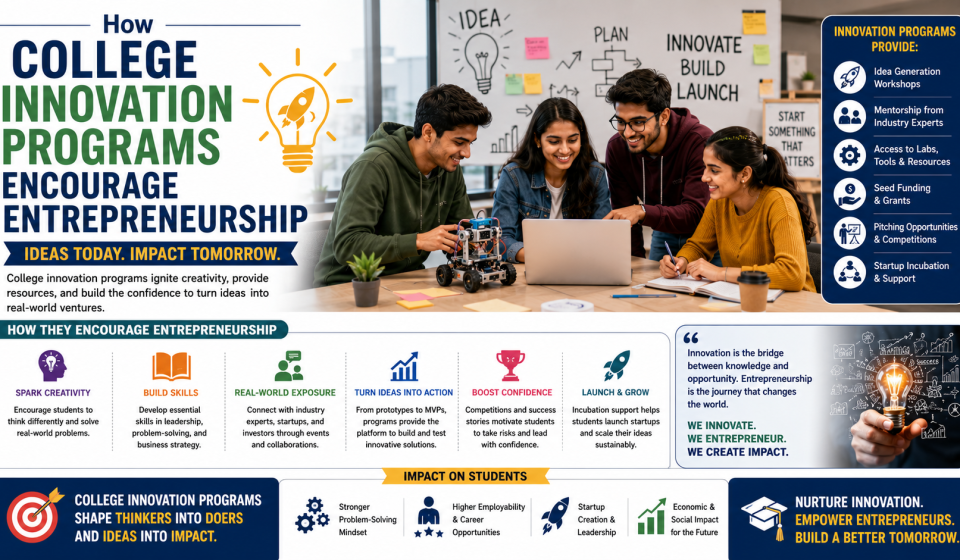
How College Innovation Programs Encourage Entrepreneurship: The Complete Guide to Building Future Business Leaders and Startup Success

Entrepreneurship has become one of the most sought-after career paths in today’s rapidly evolving economy. Instead of relying solely on traditional employment, many students now aspire to create innovative products, launch startups, solve real-world problems, and generate employment opportunities for others.
Modern college innovation programs go far beyond classroom teaching. They combine academic learning with practical experiences by allowing students to experiment, collaborate, conduct market research, develop prototypes, validate business ideas, and interact with experienced entrepreneurs and investors. Students gain exposure to emerging technologies, digital business models, financial planning, intellectual property, and startup management while strengthening essential skills such as leadership, communication, critical thinking, teamwork, and decision-making. Whether students eventually establish their own companies or contribute to innovative organizations, entrepreneurship education develops a mindset of creativity, resilience, and continuous learning. This comprehensive guide explores how college innovation programs encourage entrepreneurship and prepare students for long-term professional success.
What Are College Innovation Programs?
College innovation programs are structured initiatives that help students develop creative ideas, solve practical problems, and build entrepreneurial skills.
These programs often include:
- Entrepreneurship Development Cells (EDC)
- Startup incubation centers
- Innovation laboratories
- Business plan competitions
- Hackathons
- Design thinking workshops
- Faculty mentoring
- Industry collaborations
- Research commercialization
- Prototype development support
Their objective is to transform ideas into impactful solutions.
Why Innovation Programs Matter
Innovation has become an important driver of economic growth and career opportunities.
Innovation programs help students:
- Think creatively
- Identify business opportunities
- Develop leadership skills
- Solve real-world challenges
- Build entrepreneurial confidence
- Create employment opportunities
Students become future innovators.
Encouraging Creative Thinking
Entrepreneurship begins with identifying problems and creating valuable solutions.
Innovation programs encourage students to:
- Observe market needs
- Generate ideas
- Experiment with solutions
- Evaluate business potential
- Improve products continuously
Creative thinking drives innovation.
Learning Through Design Thinking
Many colleges introduce students to design thinking methodologies.
Students learn to:
- Understand customer needs
- Define challenges
- Brainstorm solutions
- Build prototypes
- Test and refine ideas
Human-centered innovation improves business success.
Startup Incubation Centers
Incubation centers provide structured support for student entrepreneurs.
Typical services include:
- Office space
- Mentorship
- Business coaching
- Technical guidance
- Funding assistance
- Investor networking
Incubators reduce startup risks.
Mentorship From Entrepreneurs
Experienced founders and business leaders guide students throughout the entrepreneurial journey.
Mentors help with:
- Business strategy
- Product development
- Marketing
- Financial planning
- Leadership
- Scaling businesses
Mentorship accelerates learning.
Business Competitions and Hackathons
Innovation events allow students to validate ideas in competitive environments.
Students develop skills in:
- Team collaboration
- Presentation
- Business pitching
- Rapid problem-solving
- Innovation management
Competitions build confidence.
Research and Innovation
Research often serves as the foundation for entrepreneurship.
Students may develop:
- New technologies
- Healthcare solutions
- Software applications
- Sustainable products
- Scientific innovations
Research supports commercialization.
Industry Collaboration
Strong partnerships with businesses improve entrepreneurial learning.
Students gain:
- Industry mentorship
- Live business challenges
- Internship opportunities
- Market insights
- Professional networking
Industry exposure strengthens startups.
Financial Literacy for Entrepreneurs
Innovation programs often teach business finance.
Students understand:
- Budgeting
- Business models
- Investment planning
- Cash flow management
- Funding strategies
- Risk assessment
Financial knowledge improves decision-making.
Building Leadership and Communication Skills
Entrepreneurs require excellent interpersonal abilities.
Innovation programs develop:
- Leadership
- Negotiation
- Public speaking
- Team management
- Decision-making
- Professional communication
These skills benefit every career.
Supporting Technology-Based Startups
Modern innovation centers encourage entrepreneurship in emerging fields such as Artificial Intelligence, Machine Learning, Biotechnology, Robotics, FinTech, HealthTech, Clean Energy, Cybersecurity, Cloud Computing, and Digital Commerce. Students gain access to advanced technologies and expert guidance that help transform innovative concepts into scalable businesses.
Career Benefits Beyond Entrepreneurship
Even students who do not launch startups benefit from innovation programs. Employers highly value entrepreneurial thinking because it demonstrates initiative, creativity, adaptability, resilience, project management, and the ability to solve complex problems independently.
Common Challenges
Starting a business involves uncertainty, financial constraints, market competition, and continuous learning. College innovation programs help students overcome these challenges by providing mentorship, networking opportunities, incubation support, funding guidance, legal awareness, and structured entrepreneurial education.
The Future of College Innovation Programs
Artificial intelligence, digital entrepreneurship, sustainable innovation, global startup ecosystems, virtual incubation platforms, blockchain technologies, green business models, social entrepreneurship, and international collaborations are shaping the future of entrepreneurship education. Colleges that invest in innovation ecosystems will continue producing graduates capable of driving economic growth and technological advancement.
Source
https://www.aicte-india.org
https://www.startupindia.gov.in
https://www.ugc.gov.in
https://www.niti.gov.in
Conclusion
College innovation programs play a transformative role in encouraging entrepreneurship by providing students with the knowledge, mentorship, resources, and practical experiences needed to build successful businesses. Through startup incubation, design thinking, research opportunities, industry collaborations, business competitions, and entrepreneurial skill development, students gain the confidence to transform innovative ideas into sustainable ventures. These programs not only support startup creation but also develop leadership, creativity, communication, and problem-solving abilities that are valuable across every profession. As innovation continues to drive economic and technological progress, colleges with strong entrepreneurship ecosystems will remain essential in preparing students to become future business leaders, innovators, and change-makers.
FAQ
1. What are college innovation programs?
College innovation programs are initiatives that promote creativity, entrepreneurship, research, startup development, design thinking, and problem-solving through incubation centers, mentorship, workshops, and industry collaborations.
2. How do innovation programs encourage entrepreneurship?
They provide students with business mentoring, startup incubation, funding guidance, practical training, networking opportunities, and access to resources that help transform ideas into successful businesses.
3. What skills do students develop through innovation programs?
Students develop leadership, creativity, communication, teamwork, critical thinking, business planning, financial literacy, problem-solving, decision-making, and project management skills.
4. What is the role of startup incubation centers?
Startup incubation centers offer office space, mentorship, technical support, business coaching, investor connections, funding guidance, and networking opportunities to help early-stage startups succeed.
5. Do innovation programs benefit students who do not start businesses?
Yes. Entrepreneurial skills such as innovation, adaptability, leadership, initiative, and problem-solving are highly valued by employers across multiple industries.
6. How can students choose a college with strong innovation programs?
Students should evaluate entrepreneurship cells, startup incubators, innovation laboratories, industry partnerships, mentorship programs, research facilities, funding opportunities, business competitions, and successful alumni entrepreneurs before selecting a college.