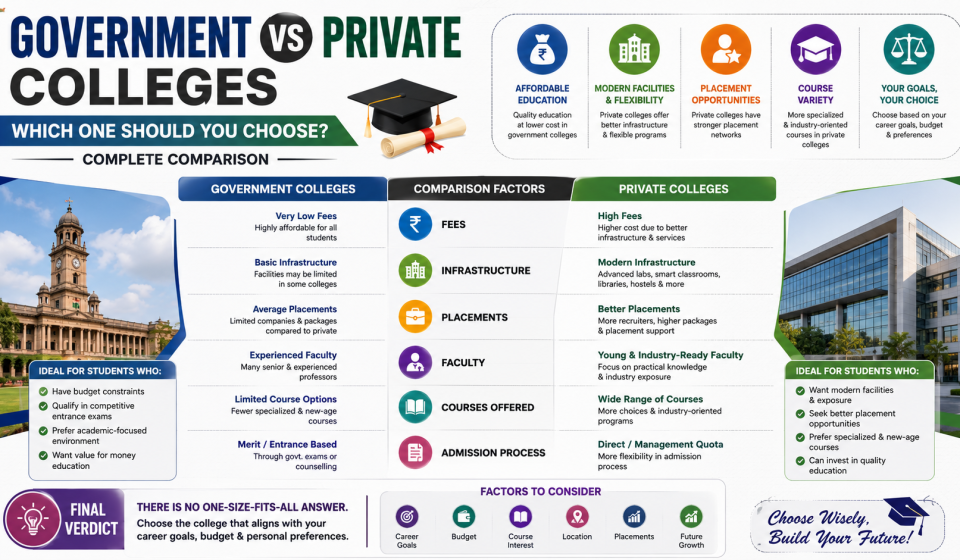
Government vs Private Colleges in India 2026: Complete Comparison of Fees, Placements, Admissions, Facilities & Career Opportunities

Choosing between a government college and a private college is one of the biggest decisions students face after completing Class 12 or graduation.
There is no universal answer to whether a government or private college is better because the right choice depends on your career goals, budget, preferred course, academic performance, and future aspirations. A student preparing for civil services may prioritise affordability and academic excellence, while another aiming for corporate careers may value industry exposure, internships, and placement opportunities. This comprehensive guide compares government and private colleges across every important factor, including admissions, fees, rankings, infrastructure, placements, faculty, scholarships, return on investment (ROI), campus life, and career prospects to help students make an informed decision in 2026.
Understanding Government Colleges
Government colleges are established and funded by the Central Government, State Governments, or public universities. These institutions generally receive financial support from the government, allowing them to provide quality education at comparatively lower tuition fees.
Examples include:
- Indian Institutes of Technology (IITs)
- National Institutes of Technology (NITs)
- All India Institute of Medical Sciences (AIIMS)
- Indian Institutes of Management (IIMs)
- Delhi University colleges
- Government Engineering Colleges
- State Universities
These institutions are recognised for their academic standards and competitive admission process.
Understanding Private Colleges
Private colleges are established and managed by private trusts, educational societies, or corporate organisations. Many private universities have significantly invested in modern campuses, advanced laboratories, international collaborations, and industry-oriented education.
Examples include:
- BITS Pilani
- VIT University
- SRM Institute of Science and Technology
- Amity University
- Manipal Academy of Higher Education
- Shiv Nadar University
- Symbiosis International University
- Ashoka University
Private institutions vary widely in terms of quality, fees, and placement outcomes.
Admission Process Comparison
Government Colleges
Admission to government colleges is generally based on highly competitive entrance examinations or merit.
Popular entrance examinations include:
- JEE Main
- JEE Advanced
- NEET
- CUET
- CAT
- GATE
- CLAT
- State CETs
Seats are limited, making admissions highly competitive.
Private Colleges
Private colleges usually accept:
- National entrance examination scores
- University-specific entrance tests
- Merit-based admissions
- Direct admissions for eligible candidates (where permitted under regulations)
Students often have more admission opportunities compared to government institutions.
Fee Structure Comparison
One of the biggest differences is tuition cost.
Government Colleges
Annual tuition fees are generally affordable.
Approximate ranges:
- Arts: ₹5,000–₹30,000
- Commerce: ₹5,000–₹40,000
- Science: ₹10,000–₹60,000
- Engineering: ₹20,000–₹2,50,000
- Medical: ₹20,000–₹2,00,000
Private Colleges
Private institutions generally charge higher fees due to infrastructure, technology, and additional facilities.
Approximate annual tuition fees:
- Arts: ₹40,000–₹2,00,000
- Commerce: ₹50,000–₹3,00,000
- Science: ₹60,000–₹3,50,000
- Engineering: ₹1,50,000–₹5,00,000
- Medical: ₹8,00,000–₹30,00,000
Students should also account for hostel, examination, and other living expenses.
Infrastructure Comparison
Government Colleges
Many established government colleges have:
- Large campuses
- Research laboratories
- Libraries
- Sports facilities
- Hostel accommodation
However, infrastructure quality varies across institutions.
Private Colleges
Private universities often provide:
- Smart classrooms
- Modern laboratories
- Digital libraries
- Wi-Fi-enabled campuses
- Innovation centres
- Startup incubation hubs
- Air-conditioned classrooms
- International-standard hostels
Many invest continuously in campus development.
Faculty and Academic Quality
Government colleges often employ highly experienced professors selected through rigorous recruitment processes. Many faculty members are involved in research, publications, and funded projects.
Private colleges also recruit qualified faculty, especially reputed universities. Some institutions invite industry professionals and international faculty to provide practical exposure. The quality of teaching depends more on the individual institution than on whether it is government or private.
Curriculum and Industry Exposure
Government institutions generally follow structured curricula approved by regulatory authorities. Many are updating programmes to align with the National Education Policy (NEP) and emerging technologies.
Private colleges often revise curricula more frequently and introduce industry-focused certifications, live projects, internships, and skill-based learning. Some collaborate with global universities and technology companies to keep students industry-ready.
Placements Comparison
Placement opportunities differ significantly across institutions.
Government Colleges
Top government institutions attract leading recruiters such as:
- Microsoft
- Amazon
- Tata Consultancy Services
- Infosys
- Deloitte
- Accenture
- Larsen & Toubro
Premier institutes often report excellent average salary packages and strong alumni networks.
Private Colleges
Many reputed private universities also maintain impressive placement records with multinational companies. Institutions with established industry partnerships provide internships, placement training, and campus recruitment drives.
Students should compare:
- Average package
- Median package
- Placement percentage
- Internship opportunities
- Recruiter diversity
rather than focusing only on the highest salary offered.
Research and Innovation
Government institutions generally receive more funding for research and innovation, making them attractive for students interested in higher studies and academic careers.
Leading private universities have also established research centres, innovation labs, startup incubators, and entrepreneurship programmes to encourage innovation and commercialisation of ideas.
Scholarships and Financial Assistance
Government colleges offer several scholarships funded by:
- Central Government
- State Governments
- Minority departments
- SC/ST welfare departments
- OBC welfare schemes
- EWS schemes
Private colleges also provide scholarships based on:
- Merit
- Entrance examination scores
- Sports achievements
- Financial need
- Special talent
Students should always review available scholarship options before admission.
Campus Life Comparison
Government colleges often provide vibrant student communities, cultural festivals, sports competitions, and academic clubs. Their diverse student population creates a rich learning environment.
Private colleges usually focus on modern campus experiences with student clubs, entrepreneurship cells, international exchange programmes, professional societies, hackathons, cultural events, and leadership activities.
Campus life ultimately depends on the institution rather than its ownership.
Return on Investment (ROI)
ROI is an important factor when comparing colleges.
Government colleges generally offer excellent ROI because of lower tuition fees combined with competitive placements.
Private colleges may require a larger financial investment, but reputed institutions with strong placement records can also provide excellent long-term returns.
Students should evaluate:
- Total course cost
- Placement statistics
- Average salary
- Career growth opportunities
instead of comparing tuition fees alone.
Which Students Should Prefer Government Colleges?
Government colleges may be the right choice for students who:
- Perform well in competitive entrance examinations
- Seek affordable education
- Want strong academic foundations
- Plan to pursue research
- Intend to prepare for government services
- Prefer high ROI
Which Students Should Prefer Private Colleges?
Private colleges may be suitable for students who:
- Want modern infrastructure
- Prefer industry-oriented education
- Seek international collaborations
- Value flexible learning opportunities
- Miss admission to highly competitive government institutions
- Want specialised programmes not widely available elsewhere
Common Myths About Government and Private Colleges
Myth 1: Every government college is better than every private college.
Reality: Several private universities outperform many government institutions in infrastructure, curriculum, industry exposure, and placements.
Myth 2: Private colleges do not offer good placements.
Reality: Many leading private institutions consistently attract top recruiters and achieve strong placement outcomes.
Myth 3: Government colleges guarantee jobs.
Reality: Employment depends on student performance, skills, internships, communication abilities, and market demand.
Myth 4: Higher fees always mean better education.
Reality: Expensive tuition does not necessarily translate into superior academic quality or career outcomes.
Tips for Making the Right Decision
Before selecting a college, compare:
- Accreditation and approvals
- Faculty quality
- Infrastructure
- Placement statistics
- Alumni success
- Industry collaborations
- Internship opportunities
- Scholarship availability
- Course curriculum
- Return on investment
- Student reviews
- Campus safety
- Hostel facilities
- Location and accessibility
Visit campuses if possible and attend counselling sessions or open houses to gain first-hand insights.
Future Trends in Higher Education
The distinction between government and private colleges is gradually narrowing as both sectors adopt technology-driven learning, multidisciplinary education, online resources, industry partnerships, and innovation-focused teaching. The National Education Policy (NEP) encourages flexibility, research, entrepreneurship, and skill development across institutions.
Students should therefore focus on choosing the college that best aligns with their academic interests, financial capacity, and career objectives rather than assuming one category is always superior.
Source
https://www.nirfindia.org
https://www.ugc.gov.in
https://www.aicte-india.org
https://www.education.gov.in
Conclusion
The choice between a government and a private college should be based on your personal goals, academic performance, financial situation, and preferred field of study. Government colleges generally offer affordable education, strong academic credibility, and excellent return on investment, while reputed private colleges provide modern infrastructure, industry-focused curricula, global exposure, and strong placement support. Rather than deciding based on ownership alone, students should carefully compare accreditation, faculty, placements, infrastructure, scholarships, internships, and long-term career outcomes. Making an informed decision after thorough research will help ensure a rewarding educational experience and a successful professional future.
FAQ
1. Which is better, a government college or a private college?
Neither is universally better. The ideal choice depends on factors such as your budget, entrance exam performance, course preference, placement expectations, and career goals.
2. Are government colleges more affordable than private colleges?
Yes. Government colleges generally charge much lower tuition fees because they receive government funding.
3. Do private colleges offer good placements?
Many reputed private colleges have excellent placement records and partnerships with leading national and international companies.
4. Is admission to government colleges more difficult?
Yes. Seats in government colleges are usually limited, and admissions are highly competitive through national or state-level entrance examinations.
5. Are scholarships available in private colleges?
Yes. Many private institutions offer scholarships based on academic merit, entrance exam scores, sports achievements, and financial need.
6. Which type of college has better infrastructure?
Many private colleges provide newer infrastructure and modern facilities, while several government institutions also have excellent campuses, especially the premier ones.
7. Should I choose a college based only on rankings?
No. Rankings are useful, but you should also compare faculty, placements, curriculum, internships, campus facilities, accreditation, and return on investment.
8. How can I make the best college choice?
Research multiple colleges, review official placement reports, verify accreditation, compare fees and scholarships, and select the institution that best matches your academic interests and long-term career plans.