Future-Proof Careers in 2026 and Beyond: Top High-Growth Fields That Will Thrive Over the Next Decade

The world of work is evolving faster than ever before. Technological innovation, artificial intelligence, automation, digital transformation, climate initiatives, and changing global economic trends are reshaping industries across the globe. Many traditiona.
Future-proof careers are professions expected to maintain strong demand despite technological disruption and economic changes. These careers often involve skills that are difficult to automate, require human creativity, strategic thinking, emotional intelligence, technical expertise, or specialized knowledge. Choosing a future-ready career path can provide long-term job security, career growth, and opportunities for continuous professional development.
What Are Future-Proof Careers?
Future-proof careers are professions likely to remain valuable and in demand despite technological advancements, automation, and changing market conditions.
These careers typically involve:
- Advanced technical expertise.
- Human-centered skills.
- Creative problem-solving.
- Strategic decision-making.
- Continuous innovation.
- Adaptability.
Professionals in these fields often benefit from strong employment prospects, competitive salaries, and long-term career stability.
Why Career Planning Matters More Than Ever
The modern workforce is changing rapidly.
Several factors are influencing employment trends:
- Artificial Intelligence.
- Automation.
- Globalization.
- Digital transformation.
- Sustainability initiatives.
- Demographic changes.
Students entering the workforce today may experience multiple career transitions throughout their lives.
Choosing future-ready fields can help ensure long-term professional relevance.
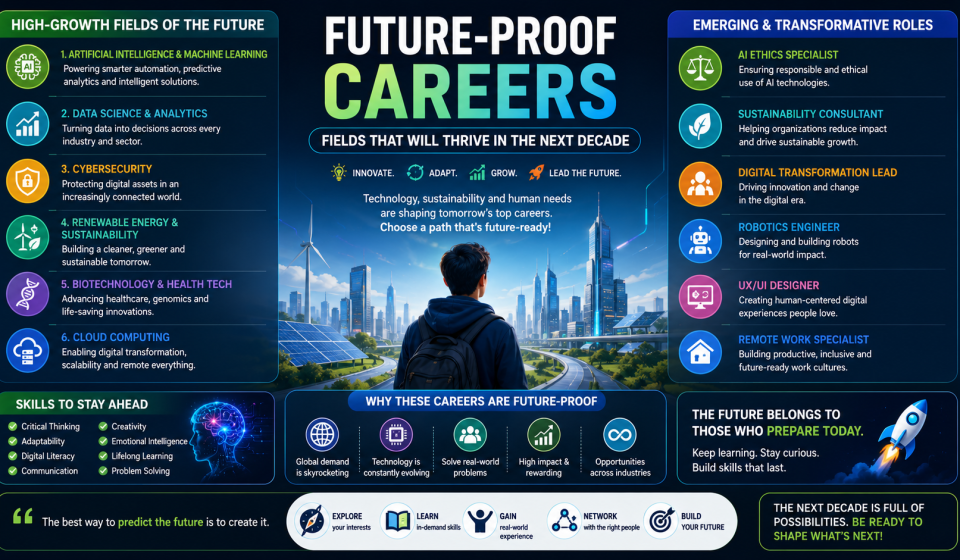
Artificial Intelligence and Machine Learning
Artificial Intelligence (AI) is transforming nearly every industry.
Organizations use AI to:
- Automate processes.
- Analyze data.
- Improve customer experiences.
- Support decision-making.
As AI adoption expands, demand for skilled professionals continues growing.
Popular careers include:
- AI Engineer.
- Machine Learning Specialist.
- AI Research Scientist.
- Natural Language Processing Engineer.
- Computer Vision Specialist.
These roles are expected to remain highly valuable throughout the next decade.
Data Science and Analytics
Data has become one of the world’s most valuable resources.
Organizations rely on data professionals to:
- Identify trends.
- Support business decisions.
- Improve efficiency.
- Predict future outcomes.
Future-focused careers include:
- Data Scientist.
- Data Analyst.
- Business Intelligence Analyst.
- Data Engineer.
- Analytics Consultant.
As businesses become increasingly data-driven, demand for analytics expertise will continue rising.
Cybersecurity Careers
Digital transformation has increased cybersecurity risks worldwide.
Organizations need experts who can protect:
- Sensitive information.
- Digital infrastructure.
- Customer data.
- Business systems.
High-demand cybersecurity careers include:
- Cybersecurity Analyst.
- Information Security Specialist.
- Ethical Hacker.
- Security Engineer.
- Cyber Risk Consultant.
Because cyber threats continue evolving, cybersecurity is widely considered one of the most future-proof career sectors.
Cloud Computing Professionals
Cloud technology powers modern businesses and digital services.
Organizations depend on cloud platforms for:
- Data storage.
- Application hosting.
- Collaboration.
- Infrastructure management.
Growing career opportunities include:
- Cloud Engineer.
- Cloud Architect.
- DevOps Engineer.
- Cloud Security Specialist.
As cloud adoption expands globally, skilled professionals remain in high demand.
Healthcare and Medical Technology
Healthcare is one of the most resilient industries in the world.
Factors driving growth include:
- Aging populations.
- Medical innovation.
- Increased healthcare access.
- Preventive care initiatives.
Future-proof healthcare careers include:
- Healthcare Administrator.
- Medical Technologist.
- Telehealth Specialist.
- Health Informatics Professional.
- Biomedical Engineer.
Healthcare professionals play a critical role in supporting global well-being.
Mental Health and Wellness Careers
Awareness of mental health has increased significantly in recent years.
Organizations and communities are investing more resources in:
- Counseling services.
- Psychological support.
- Wellness programs.
- Employee well-being initiatives.
Growing careers include:
- Mental Health Counselor.
- Wellness Consultant.
- Behavioral Health Specialist.
- Employee Well-being Manager.
Human-centered support roles are expected to remain highly valuable.
Renewable Energy and Sustainability Careers
Climate change and environmental concerns are accelerating investment in sustainable solutions.
Growth areas include:
- Solar Energy.
- Wind Energy.
- Green Hydrogen.
- Sustainable Infrastructure.
- Environmental Consulting.
Future-focused careers include:
- Renewable Energy Engineer.
- Sustainability Consultant.
- Environmental Scientist.
- Climate Risk Analyst.
- Green Technology Specialist.
These professions support global sustainability goals while offering strong employment prospects.
Software Development and Engineering
Software continues to power modern life.
Businesses require software professionals to develop:
- Applications.
- Digital platforms.
- Enterprise systems.
- Mobile solutions.
High-growth careers include:
- Software Engineer.
- Full-Stack Developer.
- Mobile App Developer.
- Systems Architect.
- Platform Engineer.
Software development remains one of the most reliable and future-ready career choices.
Robotics and Automation
Automation technologies continue transforming manufacturing, logistics, healthcare, and many other sectors.
Professionals in this field help design, build, and maintain automated systems.
Career opportunities include:
- Robotics Engineer.
- Automation Specialist.
- Industrial Systems Designer.
- Robotics Programmer.
As automation expands, demand for professionals who develop and manage these technologies will increase.
Digital Marketing and E-Commerce
The digital economy continues growing rapidly.
Organizations require professionals who can:
- Build online visibility.
- Generate leads.
- Manage customer engagement.
- Drive e-commerce growth.
Future-proof careers include:
- SEO Specialist.
- Digital Marketing Manager.
- E-Commerce Strategist.
- Content Marketing Expert.
- Growth Marketing Analyst.
Businesses will continue investing heavily in digital channels.
User Experience and Product Design
As technology becomes more integrated into daily life, user experience is increasingly important.
Companies seek professionals who can create intuitive and engaging products.
Career opportunities include:
- UX Designer.
- UI Designer.
- Product Designer.
- User Researcher.
Human-centered design skills remain difficult to automate and highly valuable.
Financial Technology (FinTech)
Technology is revolutionizing financial services.
Innovations in:
- Digital payments.
- Blockchain.
- Online banking.
- Investment platforms.
Are creating new career opportunities.
Popular roles include:
- FinTech Analyst.
- Blockchain Developer.
- Financial Data Specialist.
- Digital Payments Consultant.
The continued growth of digital finance supports long-term demand.
Education Technology and Online Learning
Learning is becoming increasingly digital.
Educational institutions and businesses rely on technology-driven learning solutions.
Future-ready careers include:
- Instructional Designer.
- Learning Experience Designer.
- Educational Technology Specialist.
- Online Learning Consultant.
As lifelong learning becomes more important, education technology careers will continue expanding.
Supply Chain and Logistics Management
Global commerce depends on efficient supply chains.
Organizations require professionals who can:
- Optimize operations.
- Manage logistics.
- Improve efficiency.
- Reduce costs.
Future-proof careers include:
- Supply Chain Analyst.
- Logistics Manager.
- Operations Strategist.
- Procurement Specialist.
Technology and globalization continue driving growth in this sector.
Human Resources and Talent Management
People remain the most valuable asset for organizations.
Future-focused HR professionals help companies:
- Recruit talent.
- Develop employees.
- Build workplace culture.
- Support organizational growth.
Emerging roles include:
- Talent Acquisition Specialist.
- Employee Experience Manager.
- Learning and Development Consultant.
- Workforce Planning Analyst.
Human-centered professions continue offering strong long-term opportunities.
Skills That Future Employers Will Value
Regardless of industry, certain skills are expected to remain valuable.
Key future-ready skills include:
- Critical Thinking.
- Problem-Solving.
- Communication.
- Emotional Intelligence.
- Adaptability.
- Leadership.
- Digital Literacy.
- Creativity.
Professionals who continuously strengthen these abilities will remain competitive.
Lifelong Learning: The Key to Career Resilience
The concept of learning no longer ends with graduation.
Successful professionals embrace:
- Continuous education.
- Professional certifications.
- Industry training.
- Skill development.
Lifelong learning allows individuals to adapt to evolving industry requirements and technological advancements.
How Students Can Prepare for Future-Proof Careers
Students can improve career readiness by:
- Exploring emerging industries.
- Building digital skills.
- Completing certifications.
- Gaining practical experience.
- Developing professional networks.
- Participating in internships.
Preparation today can significantly influence future career success.
The Future Workforce Will Reward Adaptability
Perhaps the most future-proof skill of all is adaptability.
Technology, business models, and workforce expectations will continue changing.
Professionals who remain flexible, curious, and committed to growth will be best positioned to thrive regardless of industry disruptions.
The careers of tomorrow will belong to individuals who embrace innovation and continuously evolve with changing opportunities.
Source
https://www.weforum.org
https://www.oecd.org
https://www.mckinsey.com
https://www.linkedin.com
https://www.coursera.org
Conclusion
The next decade will bring significant changes to the global workforce, creating exciting opportunities in technology, healthcare, sustainability, cybersecurity, digital business, and emerging industries. While automation and artificial intelligence will transform many traditional roles, they will also create demand for professionals with advanced technical expertise, human-centered skills, and innovative thinking. Students who focus on future-proof careers, develop in-demand competencies, and embrace lifelong learning will be better prepared to navigate a rapidly evolving job market. By staying adaptable and continuously upgrading their skills, individuals can build successful and resilient careers that thrive well into the future.
FAQ
What are future-proof careers?
Future-proof careers are professions expected to remain in demand despite technological advancements, automation, and economic changes.
Which careers will grow the most over the next decade?
Artificial Intelligence, cybersecurity, data science, healthcare, renewable energy, cloud computing, and digital marketing are among the fastest-growing fields.
Is Artificial Intelligence a good career choice?
Yes. AI continues expanding across industries and offers strong demand, competitive salaries, and long-term career growth opportunities.
Why is cybersecurity considered future-proof?
As digital systems become increasingly important, organizations require cybersecurity professionals to protect data, infrastructure, and business operations.
What skills are most valuable for future careers?
Critical thinking, problem-solving, communication, adaptability, leadership, emotional intelligence, and digital literacy are highly valuable.
Can non-technical students pursue future-proof careers?
Yes. Fields such as digital marketing, sustainability, human resources, wellness, education technology, and talent management offer strong opportunities.
How important is lifelong learning?
Lifelong learning is essential because industries and technologies evolve rapidly, requiring professionals to continuously update their knowledge and skills.
How can students prepare for future-ready careers?
Students should focus on skill development, certifications, internships, networking, practical experience, and staying informed about industry trends.