Emerging Career Opportunities for Today’s Students: Future-Proof Careers to Watch in the Digital Age

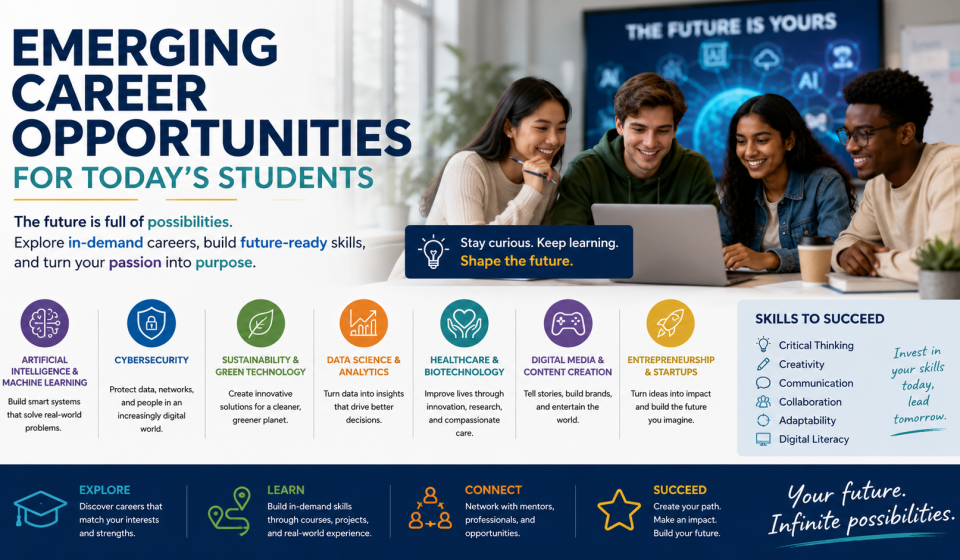
The world of work is evolving faster than ever before. Technological advancements, globalization, artificial intelligence, automation, sustainability initiatives, and changing consumer demands are transforming industries across the globe. As a result, traditional career paths are evolving while entirely new professions are emerging. For today’s students, understanding these changes is crucial for making informed educational and career decisions.
Unlike previous generations, modern students must prepare for careers that may not have existed a decade ago. Employers increasingly seek professionals who possess technical expertise, adaptability, critical thinking, and digital skills. Students who identify emerging career opportunities early can gain a significant competitive advantage by developing relevant knowledge and competencies before entering the workforce.
This article explores some of the most promising emerging career opportunities for today’s students, the skills required for success, and how students can prepare for future workforce demands.
Why Emerging Careers Matter
The future job market will be shaped by rapid innovation and technological disruption. Many routine tasks are being automated, while new industries continue to create opportunities for highly skilled professionals.
Understanding emerging careers helps students:
- Choose relevant educational programs
- Develop future-ready skills
- Improve employability
- Stay competitive in the workforce
- Align education with market demand
- Explore high-growth industries
Students who proactively prepare for future careers often enjoy greater professional success and job satisfaction.
Artificial Intelligence (AI) Specialist
Artificial Intelligence is transforming virtually every industry, from healthcare and finance to education and transportation.
AI specialists work on:
- Machine learning systems
- Predictive analytics
- Natural language processing
- Computer vision
- AI-powered applications
Key skills include:
- Programming
- Data analysis
- Mathematics
- Machine learning frameworks
- Problem-solving
As AI adoption continues to grow, demand for AI professionals is expected to remain strong for years to come.
Data Scientist
Data has become one of the most valuable assets in the modern economy.
Organizations collect vast amounts of information and require experts who can analyze and interpret data effectively.
Data scientists:
- Analyze complex datasets
- Identify patterns
- Generate business insights
- Support decision-making
- Develop predictive models
Required skills often include:
- Statistics
- Programming
- Data visualization
- Machine learning
- Analytical thinking
Data science continues to rank among the fastest-growing and highest-paying career fields.
Cybersecurity Professional
As businesses become increasingly digital, cybersecurity has emerged as a critical priority.
Cybersecurity professionals protect systems, networks, and data from cyber threats.
Career roles include:
- Security Analyst
- Ethical Hacker
- Security Engineer
- Information Security Manager
- Digital Forensics Specialist
Important skills include:
- Network security
- Risk assessment
- Ethical hacking
- Incident response
- Cybersecurity frameworks
The growing frequency of cyberattacks ensures strong demand for cybersecurity experts worldwide.
Cloud Computing Specialist
Cloud technology has revolutionized how organizations manage data and applications.
Cloud specialists help businesses:
- Migrate systems to the cloud
- Manage cloud infrastructure
- Optimize cloud performance
- Ensure security and reliability
Popular cloud platforms include:
- Amazon Web Services (AWS)
- Microsoft Azure
- Google Cloud Platform
Students interested in technology and infrastructure management may find significant opportunities in cloud computing.
Digital Marketing Specialist
Businesses increasingly rely on digital channels to reach customers.
Digital marketing professionals manage:
- Search Engine Optimization (SEO)
- Social media campaigns
- Content marketing
- Email marketing
- Online advertising
Required skills include:
- Marketing strategy
- Analytics
- Communication
- Creativity
- Digital tools
Digital marketing continues to expand as companies prioritize online visibility and customer engagement.
UX/UI Designer
User Experience (UX) and User Interface (UI) design focus on creating intuitive and engaging digital products.
UX/UI designers work on:
- Websites
- Mobile applications
- Software platforms
- Digital services
Important skills include:
- Design thinking
- User research
- Wireframing
- Prototyping
- Visual design
As digital products become increasingly important, demand for skilled designers continues to grow.
Renewable Energy Specialist
The transition toward sustainable energy solutions is creating numerous career opportunities.
Renewable energy professionals work in areas such as:
- Solar energy
- Wind energy
- Energy storage
- Sustainable infrastructure
- Environmental consulting
Students interested in environmental sustainability and engineering may find rewarding careers in this sector.
Healthcare Technology Professional
Healthcare is experiencing significant technological transformation.
Emerging healthcare careers include:
- Health Informatics Specialist
- Telemedicine Coordinator
- Medical Data Analyst
- Healthcare Technology Consultant
These professionals help integrate technology into healthcare systems to improve patient outcomes and operational efficiency.
Robotics Engineer
Robotics combines engineering, artificial intelligence, and automation technologies.
Robotics engineers design and develop:
- Industrial robots
- Autonomous systems
- Smart manufacturing solutions
- Service robots
Required skills often include:
- Mechanical engineering
- Programming
- Electronics
- Artificial intelligence
Automation trends continue to drive growth in robotics-related careers.
Blockchain Developer
Blockchain technology extends beyond cryptocurrencies and is increasingly used across industries.
Applications include:
- Financial services
- Supply chain management
- Healthcare
- Digital identity verification
Blockchain developers create secure and transparent digital systems that support decentralized operations.
Sustainability Consultant
Organizations are increasingly focused on environmental responsibility and sustainable business practices.
Sustainability consultants help businesses:
- Reduce environmental impact
- Improve energy efficiency
- Meet sustainability goals
- Comply with regulations
This field offers exciting opportunities for students interested in environmental science and corporate strategy.
Content Creator and Digital Media Professional
The growth of digital platforms has created entirely new career opportunities.
Content creators develop:
- Videos
- Podcasts
- Blogs
- Social media content
- Educational resources
Success in this field requires creativity, communication skills, branding knowledge, and digital marketing expertise.
Financial Technology (FinTech) Professional
Financial technology is transforming banking and financial services.
FinTech careers include:
- Product Management
- Financial Data Analysis
- Digital Payments Development
- Financial Software Engineering
Students with interests in finance and technology can benefit from growing opportunities in this industry.
E-Commerce Specialist
Online shopping continues to expand globally.
E-commerce professionals manage:
- Online stores
- Customer experiences
- Product listings
- Digital sales strategies
- Marketplace optimization
Strong digital commerce skills are increasingly valuable across industries.
Skills Needed for Future Careers
While technical skills vary by profession, several competencies are valuable across emerging industries:
Critical Thinking
The ability to analyze situations and make informed decisions.
Adaptability
A willingness to learn and adjust to changing technologies and environments.
Communication Skills
Clear communication remains essential in every profession.
Digital Literacy
Understanding digital tools and technologies is increasingly important.
Problem-Solving
Employers value individuals who can identify challenges and develop effective solutions.
Collaboration
Teamwork remains crucial in modern workplaces.
How Students Can Prepare for Emerging Careers
Students can prepare for future opportunities by:
- Exploring industry trends
- Choosing relevant academic programs
- Developing technical skills
- Completing internships
- Building professional networks
- Earning certifications
- Participating in online learning programs
- Practicing continuous learning
Preparation should begin early to maximize career readiness.
The Importance of Lifelong Learning
The future workforce will require continuous skill development.
Students should embrace lifelong learning by:
- Staying updated on industry developments
- Pursuing certifications
- Learning new technologies
- Expanding professional knowledge
Continuous learning helps individuals remain competitive throughout their careers.
Source
https://www.weforum.org
https://www.coursera.org
https://www.edx.org
https://www.oecd.org
https://www.unesco.org
https://www.indeed.com/career-advice
Conclusion
Emerging career opportunities are reshaping the future of work and creating exciting possibilities for today’s students. Fields such as Artificial Intelligence, Data Science, Cybersecurity, Cloud Computing, Renewable Energy, Healthcare Technology, and Digital Marketing offer significant growth potential and long-term career prospects. Students who understand industry trends, develop relevant skills, and embrace continuous learning will be better positioned to thrive in an increasingly competitive and technology-driven workforce. By preparing today for the careers of tomorrow, students can build successful, rewarding, and future-ready professional journeys.
FAQ
1. What are emerging careers?
Emerging careers are new or rapidly growing professions created by technological advancements, changing industries, and evolving market demands.
2. Which emerging career has the highest demand?
Artificial Intelligence, Data Science, Cybersecurity, and Cloud Computing are among the most in-demand emerging career fields.
3. Why should students learn about future careers?
Understanding future careers helps students choose relevant educational programs and develop skills aligned with workforce needs.
4. Are technical skills necessary for emerging careers?
Many emerging careers require technical skills, but communication, adaptability, and problem-solving are also highly valuable.
5. How can students prepare for future job opportunities?
Students can gain relevant education, certifications, internships, practical experience, and industry knowledge.
6. What role does technology play in emerging careers?
Technology drives innovation, automation, and digital transformation, creating many new career opportunities.
7. Is lifelong learning important for future careers?
Yes, continuous learning helps professionals adapt to changing industries and remain competitive in the workforce.
8. Which industries are expected to grow significantly in the future?
Artificial Intelligence, renewable energy, healthcare technology, cybersecurity, cloud computing, and digital marketing are expected to experience substantial growth.