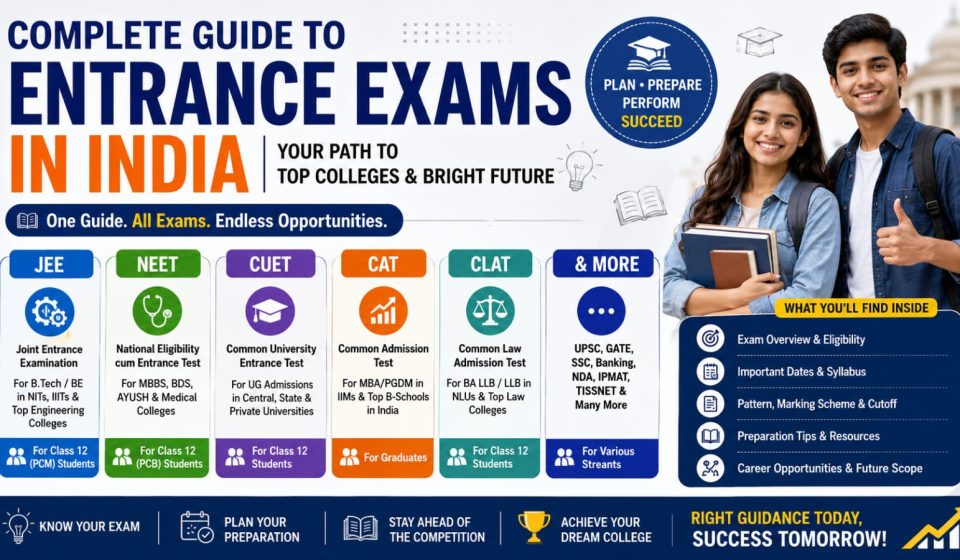
Complete Guide to Entrance Exams in India 2026: JEE, NEET, CUET, CAT, CLAT, GATE & Top Competitive Exams Explained

India’s higher education system offers countless opportunities for students, but securing admission to top colleges and universities often begins with clearing a competitive entrance examination.
With increasing competition and evolving admission policies, students need a structured roadmap to choose the right entrance examination based on their career goals. Some exams, such as JEE Main, NEET, CUET, CAT, CLAT, and GATE, are accepted by hundreds of prestigious institutions across India, while others are specific to particular universities or professional courses. This comprehensive guide explains the major entrance exams in India for 2026, including eligibility, exam pattern, admission process, preparation strategies, career opportunities, and expert tips to help students make informed academic decisions.
Why Entrance Exams Are Important
Entrance examinations ensure a transparent and merit-based admission process for higher education institutions. They help universities evaluate students using a common assessment system rather than relying solely on board examination marks.
Major advantages include:
- Merit-based admissions
- Equal opportunities for students
- Access to top-ranked institutions
- Standardised evaluation
- Better career opportunities
- Scholarships based on performance
- National-level competition
- Improved academic standards
Preparing strategically for entrance examinations increases the likelihood of securing admission to preferred colleges.
Types of Entrance Exams in India
Entrance examinations are broadly classified into different categories.
Undergraduate Entrance Exams
These are conducted for admission after Class 12.
Examples include:
- JEE Main
- JEE Advanced
- NEET UG
- CUET UG
- CLAT
- NIFT Entrance Exam
- NID DAT
- UCEED
Postgraduate Entrance Exams
These examinations are conducted after graduation.
Examples include:
- CAT
- GATE
- CUET PG
- XAT
- CMAT
- MAT
- GPAT
State-Level Entrance Exams
Many states conduct their own admission examinations.
Popular examples include:
- MHT CET
- KCET
- WBJEE
- KEAM
- AP EAMCET
- TS EAMCET
University-Level Entrance Exams
Several universities conduct independent entrance tests for specialised programmes.
JEE Main
Joint Entrance Examination (Main) is one of India’s largest engineering entrance examinations.
Courses Covered
- BTech
- BE
- BArch
- BPlanning
Accepted By
- National Institutes of Technology (NITs)
- Indian Institutes of Information Technology (IIITs)
- Government Funded Technical Institutions (GFTIs)
- Numerous private engineering universities
Eligibility
Students who have completed or are appearing for Class 12 with Physics, Chemistry, and Mathematics can apply according to the applicable eligibility rules.
Subjects
- Physics
- Chemistry
- Mathematics
JEE Main also serves as the qualifying examination for JEE Advanced.
JEE Advanced
Students qualifying JEE Main become eligible for JEE Advanced.
Admission Through JEE Advanced
- Indian Institutes of Technology (IITs)
JEE Advanced is known for testing analytical thinking, conceptual understanding, and advanced problem-solving skills.
NEET UG
National Eligibility cum Entrance Test (Undergraduate) is the mandatory examination for undergraduate medical admissions.
Courses Covered
- MBBS
- BDS
- BAMS
- BHMS
- BSMS
- BUMS
- Veterinary courses (where applicable)
- Nursing programmes (as per current regulations)
Subjects
- Physics
- Chemistry
- Biology
NEET remains one of the most competitive examinations in India.
CUET UG
The Common University Entrance Test (CUET UG) is conducted for admission to undergraduate programmes in participating universities.
Popular Courses
- BA
- BSc
- BCom
- BBA
- Integrated programmes
Benefits
- Single entrance examination
- Admission to multiple universities
- Standardised selection process
- Reduced dependence on board examination marks
CUET has become an important gateway to many central and participating universities.
CAT
The Common Admission Test (CAT) is the most popular MBA entrance examination in India.
Accepted By
- Indian Institutes of Management (IIMs)
- Leading business schools
- Management institutes
Sections
- Quantitative Aptitude
- Data Interpretation
- Logical Reasoning
- Verbal Ability
- Reading Comprehension
A high CAT percentile significantly improves admission opportunities to premier management institutions.
CLAT
The Common Law Admission Test is conducted for admission to National Law Universities and several other participating institutions.
Courses
- Integrated BA LLB
- BBA LLB
- LLM
Sections
- English Language
- Current Affairs
- Legal Reasoning
- Logical Reasoning
- Quantitative Techniques
Students interested in legal careers should begin preparation early.
GATE
Graduate Aptitude Test in Engineering is conducted for postgraduate engineering admissions and recruitment.
Accepted For
- MTech
- ME
- PhD
- Public Sector Undertakings (PSUs)
GATE evaluates technical knowledge and engineering concepts.
XAT
Xavier Aptitude Test is another leading MBA entrance examination.
Accepted by numerous management institutions including XLRI and other reputed business schools.
CMAT
Common Management Admission Test provides admission opportunities in AICTE-approved management institutions.
MAT
Management Aptitude Test is conducted multiple times every year and accepted by several MBA colleges.
Other Popular Entrance Exams
Students may also consider:
- NIFT Entrance Exam
- NID DAT
- UCEED
- CEED
- ICAR Entrance Examination
- NCHM JEE
- GPAT
- AFCAT
- NDA
- CDS
The appropriate examination depends on the student’s career aspirations.
How to Choose the Right Entrance Exam
Before registering for an examination, students should consider:
- Career goals
- Preferred course
- Eligibility criteria
- College preferences
- Exam difficulty
- Competition level
- Syllabus
- Admission opportunities
Choosing the right examination saves time and improves preparation efficiency.
General Eligibility Requirements
Although eligibility differs by examination, common requirements include:
- Indian citizenship or applicable nationality criteria
- Educational qualification
- Minimum qualifying marks where applicable
- Age requirements (for specific examinations)
- Subject-specific eligibility
Students should always read the official information bulletin before applying.
Entrance Exam Preparation Strategy
A structured preparation plan increases the probability of success.
Build Strong Fundamentals
Understand concepts thoroughly before solving advanced questions.
Follow Standard Study Material
Use reliable textbooks and official syllabus documents.
Solve Previous Year Papers
Practising previous papers helps understand exam patterns and frequently asked questions.
Take Mock Tests
Regular mock tests improve:
- Speed
- Accuracy
- Time management
- Confidence
Revise Regularly
Revision strengthens memory retention and reduces examination stress.
Time Management Tips
Effective preparation requires disciplined planning.
Students should:
- Prepare a daily timetable
- Allocate time for every subject
- Revise weak topics
- Practise mock tests weekly
- Analyse mistakes
- Maintain consistency
Quality study hours are more effective than lengthy but unproductive sessions.
Common Mistakes Students Should Avoid
Many aspirants reduce their chances of success by making avoidable mistakes.
Common errors include:
- Ignoring the official syllabus
- Studying without a timetable
- Avoiding mock tests
- Neglecting revision
- Missing application deadlines
- Filling incorrect application details
- Depending only on coaching without self-study
- Ignoring mental and physical health
Avoiding these mistakes improves overall performance.
Documents Required for Entrance Exams
Students should generally keep the following documents ready:
- Aadhaar Card or valid identity proof
- Passport-size photographs
- Class 10 Certificate
- Class 12 Marksheet (where applicable)
- Graduation Certificate (for PG examinations)
- Category Certificate
- Income Certificate (where applicable)
- Domicile Certificate (if required)
- Signature scan
- Valid email address
- Mobile number
Requirements differ across examinations.
Scholarships Based on Entrance Exams
Excellent performance in entrance examinations may help students receive:
- Merit scholarships
- Institutional scholarships
- Government scholarship schemes
- Tuition fee waivers
- Corporate scholarships
Students should verify scholarship policies of individual institutions.
Career Opportunities After Entrance Exams
Clearing the appropriate entrance examination opens opportunities across multiple fields.
Popular career paths include:
- Engineering
- Medicine
- Management
- Law
- Architecture
- Agriculture
- Design
- Pharmacy
- Research
- Civil Services preparation
- Entrepreneurship
Selecting the right examination is the first step toward a successful professional journey.
Future of Competitive Entrance Exams in India
India’s entrance examination system is gradually becoming more technology-driven, transparent, and student-friendly. Computer-based testing, digital counselling, online application systems, AI-powered evaluation tools, and centralised admission processes are improving efficiency and accessibility. Institutions are also placing greater emphasis on conceptual understanding, analytical thinking, and problem-solving skills rather than rote memorisation.
Students preparing for entrance exams in 2026 should focus on building strong fundamentals, practising regularly, staying updated with official notifications, and developing a balanced study routine. Consistent preparation, effective time management, and awareness of changing examination patterns will remain the key factors for long-term success.
Source
https://nta.ac.in
https://jeemain.nta.nic.in
https://neet.nta.nic.in
https://cuet.nta.nic.in
Conclusion
Entrance examinations are the gateway to some of India’s most prestigious colleges and universities, making early preparation and informed decision-making essential for every student. Whether your goal is engineering through JEE, medicine through NEET, undergraduate admissions through CUET, management through CAT, law through CLAT, or postgraduate studies through GATE, understanding the eligibility criteria, syllabus, examination pattern, and counselling process can significantly improve your chances of success. Instead of focusing only on competition, students should build conceptual clarity, practise consistently, manage their time effectively, and stay updated through official notifications. With the right strategy and dedication, every aspirant can move one step closer to achieving their academic and professional goals.
FAQ
1. Which is the most popular entrance exam in India?
Some of the most popular entrance examinations include JEE Main, NEET UG, CUET UG, CAT, CLAT, and GATE, depending on the course and career path.
2. Can I appear for multiple entrance exams in the same year?
Yes. Many students apply for multiple entrance examinations to maximise their admission opportunities, provided they meet the eligibility criteria for each exam.
3. Is coaching compulsory to crack competitive entrance exams?
No. Coaching can provide guidance, but many students successfully clear competitive examinations through disciplined self-study, quality study material, and regular mock test practice.
4. How early should I start preparing for entrance exams?
Ideally, students should begin preparation at least one to two years before the examination, depending on its difficulty level and syllabus.
5. Which entrance exam is required for MBBS admission?
NEET UG is the mandatory entrance examination for admission to recognised MBBS programmes in India.
6. Which entrance exam is required for MBA admission?
CAT is the most widely accepted MBA entrance examination, although many institutions also accept XAT, CMAT, MAT, NMAT, SNAP, and other management entrance tests.
7. How important are mock tests during preparation?
Mock tests are extremely important because they improve speed, accuracy, confidence, time management, and familiarity with the examination pattern.
8. Where can students find official information about entrance examinations?
Students should always rely on the official websites of the National Testing Agency (NTA), examination authorities, participating universities, and relevant government organisations for authentic updates and notifications.