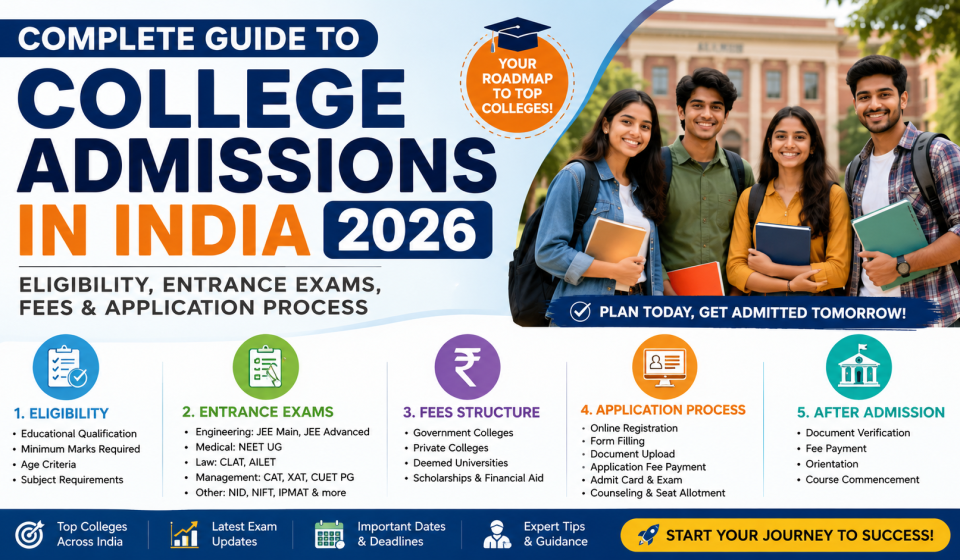
Complete Guide to College Admissions in India 2026: Eligibility, Entrance Exams, Fees, Application Process & Career Planning

Choosing the right college is one of the most important decisions in a student’s academic journey. With thousands of universities, colleges, and professional institutes across India, understanding the admission process for 2026 is essential for securing a seat in the best institution.
The Indian higher education system continues to evolve with digital admission processes, national-level entrance examinations, centralized counselling, and increasing opportunities through scholarships and government initiatives. This comprehensive guide covers everything you need to know about college admissions in India in 2026, including eligibility requirements, entrance exams, application process, fee structure, counselling, scholarships, required documents, expert tips, and frequently asked questions to help students and parents make informed decisions.
Why College Admissions in India 2026 Are Important
India has one of the world’s largest higher education systems, offering education through central universities, state universities, deemed universities, private universities, IITs, NITs, IIITs, AIIMS, IIMs, law universities, and numerous autonomous institutions.
Admission to these institutions is based on different criteria, including:
- Class 12 board examination marks
- National-level entrance examinations
- State-level entrance examinations
- University-specific entrance tests
- Merit-based admissions
- Counselling and seat allocation
Understanding the admission process beforehand helps students avoid mistakes that could cost them a valuable seat.
Types of Colleges in India
Students can choose from multiple categories of higher education institutions.
Central Universities
Central universities are funded by the Government of India and offer quality education with affordable fees.
Examples include:
- Delhi University
- Jawaharlal Nehru University
- Banaras Hindu University
- Aligarh Muslim University
State Universities
Each state operates its own universities offering undergraduate and postgraduate courses at reasonable fees.
Private Universities
Private universities offer modern infrastructure, international collaborations, and industry-focused education but usually have higher tuition fees.
Institutes of National Importance
These institutions include:
- IITs
- NITs
- AIIMS
- IIITs
- IISERs
- IIMs
Admissions are generally based on national entrance examinations.
Eligibility Criteria for College Admissions 2026
Eligibility varies depending on the course and institution.
Undergraduate Courses
Most undergraduate programmes require:
- Completion of Class 12 from a recognised board
- Minimum qualifying percentage
- Subject-specific eligibility
- Entrance examination where applicable
Engineering Courses
Students should have studied:
- Physics
- Chemistry
- Mathematics
Most engineering colleges require JEE Main or state entrance examinations.
Medical Courses
Students must have completed Class 12 with:
- Physics
- Chemistry
- Biology
Admission is primarily through the NEET examination.
Law Courses
For integrated law programmes:
- Completion of Class 12
- CLAT or university-specific entrance examination
Management Courses
Many BBA programmes consider:
- Class 12 marks
- University entrance examinations
- Personal interviews
Major Entrance Exams for College Admissions 2026
Different courses require different entrance examinations.
Engineering
Popular engineering entrance examinations include:
- JEE Main
- JEE Advanced
- State CET examinations
- BITSAT
- VITEEE
- SRMJEEE
Medical
Medical admissions primarily depend on:
- NEET UG
Law
Popular law entrance tests include:
- CLAT
- AILET
- SLAT
- LSAT India (if applicable)
Agriculture
Students may appear for:
- ICAR AIEEA
- State agriculture entrance examinations
Design
Design aspirants can apply through:
- NID DAT
- UCEED
- CEED
- NIFT Entrance Exam
Hotel Management
Popular examinations include:
- NCHM JEE
- University entrance tests
Step-by-Step College Admission Process
Step 1: Research Colleges
Prepare a list of colleges based on:
- Ranking
- Accreditation
- Placement records
- Infrastructure
- Faculty
- Fee structure
- Location
Step 2: Check Eligibility
Read the admission brochure carefully to understand:
- Minimum marks
- Subject requirements
- Entrance examination eligibility
- Reservation criteria
Step 3: Register for Entrance Exams
Register online before deadlines and keep copies of:
- Application form
- Fee receipt
- Admit card
Step 4: Prepare for Entrance Exams
Focus on:
- Previous year question papers
- Mock tests
- Time management
- Revision
Step 5: Apply to Colleges
Complete online application forms carefully.
Upload:
- Photograph
- Signature
- Academic certificates
- Category certificate (if applicable)
Step 6: Attend Counselling
Students qualifying entrance examinations participate in counselling for seat allocation.
Seat allotment depends on:
- Rank
- Category
- Preferences
- Seat availability
Step 7: Document Verification
Carry original documents for verification.
Step 8: Fee Payment
Pay admission fees within the prescribed deadline to confirm admission.
Documents Required for Admission
Students should keep multiple copies of:
- Class 10 Marksheet
- Class 12 Marksheet
- Passing Certificate
- Transfer Certificate
- Migration Certificate
- Character Certificate
- Aadhaar Card
- Passport-size photographs
- Category Certificate
- Income Certificate
- Entrance Exam Scorecard
- Counselling Letter
- Domicile Certificate (if applicable)
Reservation Policy
Government institutions follow reservation policies for eligible categories.
Reservations may include:
- SC
- ST
- OBC
- EWS
- PwD
- Defence Quota
- Sports Quota
- State Quota
Students should verify eligibility before applying.
College Admission Timeline 2026
Although dates vary by institution, the general timeline is:
January–April:
Entrance examination registrations begin.
April–June:
Entrance examinations are conducted.
June–July:
Results are declared.
July–August:
Counselling and seat allotment.
August–September:
Admission confirmation and commencement of classes.
Average College Fees in India
Fee structures vary significantly.
Government colleges generally charge lower tuition fees compared to private universities.
Approximate annual fee range:
- Arts: ₹5,000–₹1,00,000
- Commerce: ₹10,000–₹1,50,000
- Science: ₹10,000–₹2,00,000
- Engineering: ₹40,000–₹4,00,000
- MBBS: ₹20,000–₹25,00,000
- Law: ₹25,000–₹3,00,000
- BBA: ₹30,000–₹3,50,000
Students should also consider hostel, transportation, books, and miscellaneous expenses.
Scholarships Available
Students can reduce educational expenses through scholarships offered by:
- Government of India
- State Governments
- Universities
- Private organisations
- NGOs
- Corporate foundations
Scholarships may be merit-based, need-based, category-based, or talent-based.
Tips to Secure Admission in Top Colleges
Begin preparation early.
Research multiple colleges instead of focusing on only one institution.
Appear for multiple entrance examinations whenever possible.
Keep all documents updated.
Track official admission notifications regularly.
Practice mock tests to improve exam performance.
Participate actively during counselling.
Pay admission fees before deadlines.
Common Mistakes Students Should Avoid
Missing application deadlines.
Uploading incorrect documents.
Ignoring eligibility criteria.
Choosing colleges without research.
Depending only on one entrance examination.
Failing to attend counselling sessions.
Ignoring scholarship opportunities.
Providing incorrect information in application forms.
Career Planning After Admission
Admission is only the beginning of your higher education journey. Students should start building their careers from the first year by participating in internships, certifications, workshops, research projects, extracurricular activities, and skill development programmes. Developing communication skills, digital literacy, analytical thinking, leadership, and industry-specific expertise significantly improves employability after graduation. Networking with professors, alumni, and industry professionals also creates valuable career opportunities.
Students should regularly update their resumes, maintain a strong academic record, and prepare for competitive examinations or campus placements based on their career goals. Whether planning for higher studies, government jobs, entrepreneurship, or private sector employment, consistent learning and practical exposure play a vital role in achieving long-term success.
Future Trends in Indian Higher Education
The education landscape in India is becoming more technology-driven and student-centric. Universities are adopting digital admissions, online learning platforms, multidisciplinary education, industry collaborations, and flexible academic programmes aligned with the National Education Policy (NEP). Artificial Intelligence, Data Science, Cybersecurity, Healthcare, Renewable Energy, and Digital Business are among the fastest-growing fields attracting students.
International collaborations between Indian and foreign universities are also expanding, offering exchange programmes, dual degrees, and global research opportunities. Students planning admissions in 2026 should look beyond rankings and evaluate institutions based on academic quality, placements, innovation, faculty expertise, and career outcomes.
Source
https://nta.ac.in
https://www.ugc.gov.in
https://www.aicte-india.org
https://www.nmc.org.in
https://www.education.gov.in
Conclusion
College admissions in India for 2026 require careful planning, timely preparation, and informed decision-making. Understanding eligibility criteria, selecting the right entrance examinations, completing applications accurately, participating in counselling, and arranging the necessary documents can greatly improve your chances of securing admission to your preferred institution. Students should also compare colleges based on accreditation, placement records, faculty, infrastructure, fees, and career opportunities rather than relying solely on rankings. By staying updated with official announcements and preparing strategically, aspiring students can confidently navigate the admission process and build a strong foundation for a successful academic and professional future.
FAQ
1. When does the college admission process for 2026 begin?
Most entrance examination registrations and university application forms begin between January and April, although schedules vary by institution.
2. Is Class 12 percentage enough for college admission?
Some universities offer merit-based admissions using Class 12 marks, while many professional courses require entrance examinations.
3. Which entrance exam is required for engineering admissions?
Most engineering colleges accept JEE Main scores, while certain universities conduct their own entrance examinations.
4. Is NEET compulsory for MBBS admission?
Yes. NEET is mandatory for admission to MBBS and several other undergraduate medical programmes in India.
5. Can I apply to multiple colleges simultaneously?
Yes. Students are encouraged to apply to multiple colleges to increase their admission opportunities.
6. What documents are mandatory during counselling?
Students generally need Class 10 and 12 certificates, entrance exam scorecards, identity proof, photographs, category certificates (if applicable), and other documents specified by the counselling authority.
7. Are scholarships available for college students?
Yes. Various government departments, universities, and private organisations provide merit-based, need-based, and category-based scholarships.
8. How can I avoid mistakes during the admission process?
Read official admission notifications carefully, verify eligibility, keep documents ready, submit applications before deadlines, and regularly check counselling updates on official websites.