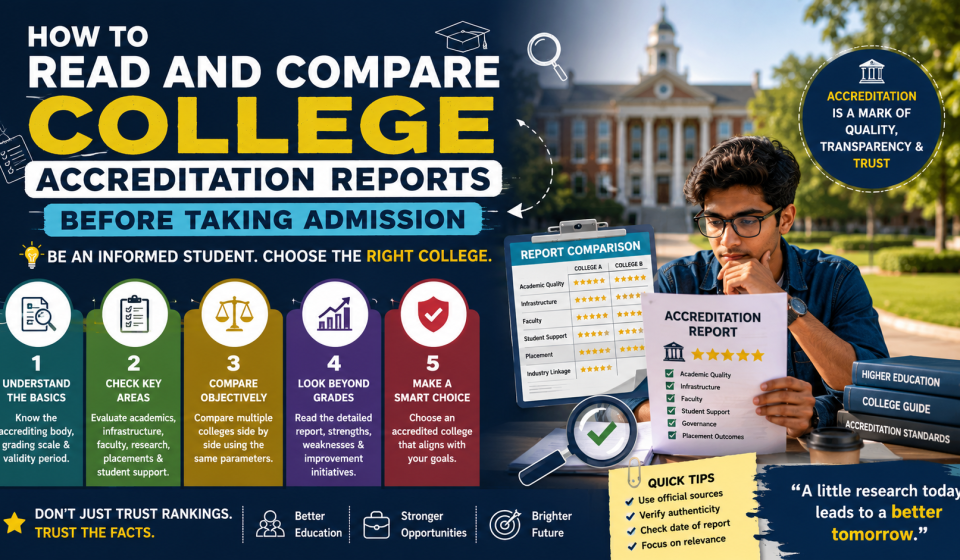
College Accreditation Reports Explained: How Students Can Read, Compare, and Choose the Right College Before Admission

Choosing the right college is one of the most important decisions for any student. Most students check course fees, location, placements, college ranking, hostel facilities, and campus photos before taking admission. These factors are useful, but one very important factor is often ignored: the college accreditation report.
A college accreditation report gives students a deeper understanding of the quality of an institution. It can show whether a college follows proper academic standards, has qualified faculty, provides good infrastructure, supports research, offers student services, and maintains transparent governance. In India, agencies like NAAC and NBA play an important role in assessing colleges, universities, and professional programs.
What Is College Accreditation?
College accreditation is a quality evaluation process. In this process, an authorized agency reviews a college, university, or academic program to check whether it meets required standards of education, infrastructure, faculty, governance, research, student support, and learning outcomes.
Accreditation does not simply mean that a college exists. It means the institution has been assessed on quality parameters. In India, NAAC usually assesses higher education institutions such as colleges and universities, while NBA accredits specific technical and professional programs such as engineering, management, pharmacy, architecture, and other professional courses.
Accreditation helps students know whether the institution is serious about quality education. It also helps colleges improve their systems and maintain academic accountability.
Why Accreditation Reports Matter Before Admission
Accreditation reports matter because they provide verified information about a college’s academic quality and institutional performance. Many colleges promote themselves using attractive brochures, high placement claims, modern campus photos, and social media campaigns. However, accreditation reports offer a more structured and reliable way to judge quality.
A good accreditation report can help students understand whether the college has proper teaching systems, student support, learning resources, research activity, infrastructure, examination practices, and placement assistance.
Accreditation can also affect higher education, scholarships, job opportunities, and degree recognition in some cases. For professional courses, program-level accreditation can be important because employers and higher education institutions may value accredited programs more.
Difference Between Recognition, Affiliation, and Accreditation
Students often confuse recognition, affiliation, and accreditation. These three terms are related, but they are not the same.
Recognition means the institution is legally accepted by an official authority. For example, universities in India must be recognized by the UGC to award valid degrees.
Affiliation means a college is connected with a university and follows that university’s academic rules, syllabus, exams, and degree system.
Accreditation means the institution or program has been evaluated for quality by an authorized accreditation agency. A recognized college may not always have high accreditation quality, and an accredited college should still be checked for course approval and affiliation.
Before admission, students should verify all three: recognition, affiliation, and accreditation.
Important Accreditation Bodies in India
India has different bodies for different types of institutions and courses. NAAC, the National Assessment and Accreditation Council, evaluates and accredits higher education institutions such as colleges and universities. NAAC was established by the UGC in 1994 to assess and accredit higher education institutions in India.
NBA, the National Board of Accreditation, accredits specific technical and professional programs. This is especially important for engineering, management, pharmacy, architecture, computer applications, hospitality, and similar courses.
UGC, the University Grants Commission, is important for checking whether a university is recognized. AICTE is important for technical education approval. For professional courses like law, medical, nursing, pharmacy, architecture, and teacher education, students should also check the relevant regulatory body.
What Is a NAAC Accreditation Report?
A NAAC accreditation report gives details about the overall quality of a college or university. It usually evaluates the institution across multiple criteria such as curriculum, teaching-learning process, research, infrastructure, student support, governance, innovation, and institutional values.
NAAC grades can help students understand the broad performance level of an institution. However, students should not look only at the grade. They should also read the report details, score distribution, strengths, weaknesses, and recommendations.
For example, two colleges may both have good grades, but one may perform better in research while another may perform better in student support. Reading the full report helps students understand the real difference.
What Is NBA Accreditation?
NBA accreditation is mainly program-based. This means NBA may accredit a specific course or program, not necessarily the entire college. For example, an engineering college may have NBA accreditation for Computer Science Engineering but not for Civil Engineering or Mechanical Engineering.
This is very important for students. If you are taking admission in a technical course, do not only ask whether the college has NBA accreditation. Ask whether your specific program or branch is accredited.
NBA accreditation focuses on outcomes, curriculum, faculty, facilities, continuous improvement, and professional readiness. It can be especially valuable for students pursuing technical and professional education.
How to Find Accreditation Reports Online
Students should always check accreditation information from official websites. For NAAC accreditation, students can visit the official NAAC website and search for accredited institutions. Many colleges also upload their NAAC certificates and peer team reports on their own websites.
For NBA accreditation, students can visit the official NBA website and check accredited programs. Students should verify the program name, accreditation status, validity period, and institution details.
For university recognition, students should visit the UGC website. For technical approval, students can check AICTE. Students should avoid trusting only screenshots, posters, or admission counselors. Always verify from official sources.
How to Read the Accreditation Grade
The accreditation grade is usually the first thing students notice. A higher grade generally indicates stronger institutional quality. However, the grade alone is not enough.
Students should check the grade, score, accreditation cycle, and validity date. An old accreditation grade may not reflect the current quality of the college. A college may have improved or declined after the last assessment.
Also check whether the accreditation is valid for the current admission year. If accreditation has expired, ask the college whether reassessment is completed or pending.
Check the Validity Period Carefully
Accreditation is given for a specific period. Students must check the validity period before taking admission. A college may advertise an old accreditation grade even after it has expired.
This is a common mistake students make. They see “NAAC A Grade” on a brochure but do not check whether it is still valid. Always check the latest accreditation certificate or official database.
For NBA accreditation, validity is especially important because individual programs may have different accreditation periods. One branch may be accredited, while another may not be. Therefore, checking validity is necessary.
Read the Criteria-Wise Score
A good accreditation report usually gives criteria-wise scores. This is one of the most useful parts of the report. Instead of looking only at the final grade, students should check how the college performed in different areas.
Important areas include curriculum, teaching and learning, research, infrastructure, student support, governance, innovation, extension activities, and institutional values. A college with high infrastructure score but low teaching quality may not be ideal. A college with strong academics but weak placement support may also need careful consideration.
Criteria-wise scores help students compare colleges more intelligently.
Check Teaching and Learning Quality
Teaching and learning quality should be one of the most important sections in an accreditation report. Students should check faculty qualifications, student-teacher ratio, teaching methods, mentoring system, academic calendar, examination reforms, and learning outcomes.
A good college should have qualified faculty, regular classes, practical learning, project work, digital learning support, and fair assessment methods.
If the report mentions weak teaching systems, poor academic planning, or lack of faculty, students should take it seriously. Faculty and teaching quality directly affect your education.
Review Faculty Details
Faculty quality is a major factor in college selection. Accreditation reports may include information about permanent faculty, faculty qualifications, research publications, training programs, faculty development, and student mentoring.
Students should check whether the college has enough full-time faculty for the course. Some colleges depend too much on guest faculty or temporary teachers. This can affect academic consistency.
Also check whether faculty members are involved in research, industry interaction, and student projects. Strong faculty can help students with internships, higher studies, competitions, and career planning.
Check Infrastructure and Learning Resources
Infrastructure is more than buildings. Accreditation reports can reveal whether the college has proper classrooms, laboratories, libraries, computer facilities, internet, seminar halls, sports facilities, hostels, medical support, and accessibility services.
For science, engineering, pharmacy, nursing, architecture, media, and design courses, labs and practical facilities are very important. A college with weak infrastructure may not provide proper practical training.
Students should also check library resources, digital databases, e-learning facilities, and student access to technology. These resources can improve learning quality.
Understand Research and Innovation Performance
Research and innovation are important indicators of academic quality, especially for universities and postgraduate institutions. Accreditation reports may mention research publications, funded projects, patents, consultancy, innovation cells, incubation centers, and student research activities.
If you are planning higher studies, research, startups, or academic careers, this section is very important. A college with strong research culture can provide better mentorship, project exposure, and academic opportunities.
However, for purely undergraduate career-focused programs, research may not be the only deciding factor. Balance it with teaching quality, internships, and career support.
Look at Student Support and Progression
Student support is one of the most useful sections for admission decisions. It may include scholarships, mentoring, career counseling, placement support, skill development, grievance redressal, anti-ragging measures, health services, sports, clubs, and student welfare activities.
Progression means what students do after completing the course. Do they get jobs? Do they go for higher studies? Do they qualify competitive exams? Do they become entrepreneurs?
A college with strong student support can help students grow academically and personally. Students should compare this section carefully before admission.
Compare Placement Claims With Accreditation Data
Many colleges advertise placement numbers, but accreditation reports may give a more balanced view of student outcomes. Check whether the report includes placement data, higher education data, skill training, internship support, and alumni engagement.
Do not trust only the highest package. Check placement percentage, median salary, average salary, job relevance, company quality, and number of students placed.
If a college claims excellent placements but the accreditation report shows weak student progression, ask more questions before admission.
Identify Red Flags in Accreditation Reports
Students should watch for red flags while reading accreditation reports. These may include expired accreditation, missing report, low grade, weak faculty strength, poor infrastructure, limited student support, low research activity, weak governance, poor placement data, or unclear program approval.
Another red flag is when a college refuses to share accreditation details or gives confusing answers. A transparent college should clearly show accreditation status, approval, affiliation, and validity.
Also be careful if a college uses misleading words like “accredited-like,” “approved partner,” or “international standard” without official proof.
How to Compare Two Colleges Using Reports
To compare two colleges, create a simple table. Add factors such as accreditation grade, validity, criteria-wise score, faculty strength, infrastructure, student support, placements, research, governance, and course-specific approval.
Give each factor a score based on your priorities. For example, if you are choosing an engineering college, NBA accreditation for your specific branch may be very important. If you are choosing a general degree college, NAAC grade and teaching quality may matter more.
The best college is not always the one with the highest grade. It is the one that performs strongly in the areas that matter most for your course and career goals.
Questions to Ask the College Before Admission
Before taking admission, ask the college direct questions. Is the college recognized by UGC or affiliated with a recognized university? Is the course approved by the relevant regulatory body? Does the college have valid NAAC accreditation? Does my specific program have NBA accreditation? What is the validity period? Where can I see the latest report?
Also ask about faculty, internships, placements, scholarships, student support, hostel safety, and grievance redressal. A good college will answer clearly and provide official documents.
Do Not Depend Only on Accreditation
Accreditation is important, but it should not be the only factor. Students should also consider course curriculum, fees, location, campus culture, internships, alumni network, safety, student reviews, and personal fit.
A college with good accreditation may still not be right for every student. Similarly, a college with average accreditation may offer strong support in a specific course. Use accreditation reports as a powerful decision tool, but combine them with campus visits, student feedback, and career planning.
Source
https://naac.gov.in/index.php/en
https://www.ugc.gov.in/Aboutus/NAAC
https://www.nbaind.org
https://www.ugc.gov.in
https://www.aicte-india.org
Conclusion
Reading and comparing college accreditation reports before admission can help students make smarter and safer decisions. Accreditation reports give verified information about academic quality, faculty, infrastructure, research, governance, student support, and institutional performance. Instead of depending only on advertisements, rankings, or placement claims, students should check official accreditation status and report details.
Before taking admission, students should verify recognition, affiliation, accreditation grade, validity period, criteria-wise scores, faculty quality, program approval, and student outcomes. For technical courses, students should also check whether their specific program has NBA accreditation. For general colleges and universities, NAAC accreditation can provide useful quality insights.
A good college decision should be based on facts, not only popularity. Accreditation reports help students compare colleges more confidently and choose an institution that supports their education, career, and long-term growth.
FAQ
1. What is a college accreditation report?
A college accreditation report is an official quality assessment document that evaluates a college or university based on academic standards, faculty, infrastructure, research, governance, and student support.
2. Why should students check accreditation before admission?
Students should check accreditation to understand whether the institution meets recognized quality standards and provides reliable education, facilities, and academic support.
3. What is the difference between NAAC and NBA?
NAAC mainly accredits colleges and universities as institutions, while NBA accredits specific technical and professional programs such as engineering, management, pharmacy, and architecture.
4. Is accreditation the same as UGC recognition?
No, accreditation and recognition are different. UGC recognition means a university is legally recognized, while accreditation means the institution or program has been assessed for quality.
5. How can I check if a college has valid NAAC accreditation?
You can check the official NAAC website or the college’s official website for the latest accreditation certificate, grade, report, and validity period.
6. Why is NBA accreditation important for engineering students?
NBA accreditation is important because it evaluates specific technical programs. Engineering students should check whether their chosen branch is NBA accredited.
7. Can a college advertise an expired accreditation grade?
Some colleges may show old accreditation grades in promotional material. Students should always verify the current validity period from official sources.
8. What should I compare in accreditation reports?
Students should compare accreditation grade, validity, criteria-wise scores, faculty quality, infrastructure, student support, placements, research, governance, and course approval.
9. Is a higher accreditation grade always better?
A higher grade is usually a positive sign, but students should also read detailed scores and check whether the college is strong in areas important for their course.
10. Should accreditation be the only factor in college selection?
No, accreditation is important, but students should also consider course quality, fees, location, internships, placements, campus culture, safety, and personal goals.