Career Pathways Beyond Traditional Degrees: High-Growth Alternatives for Future Success in 2026

For generations, earning a traditional college degree has been considered the primary route to career success. Students were often encouraged to complete a bachelor’s or master’s degree before entering the workforce, with the belief that academic qualifications.
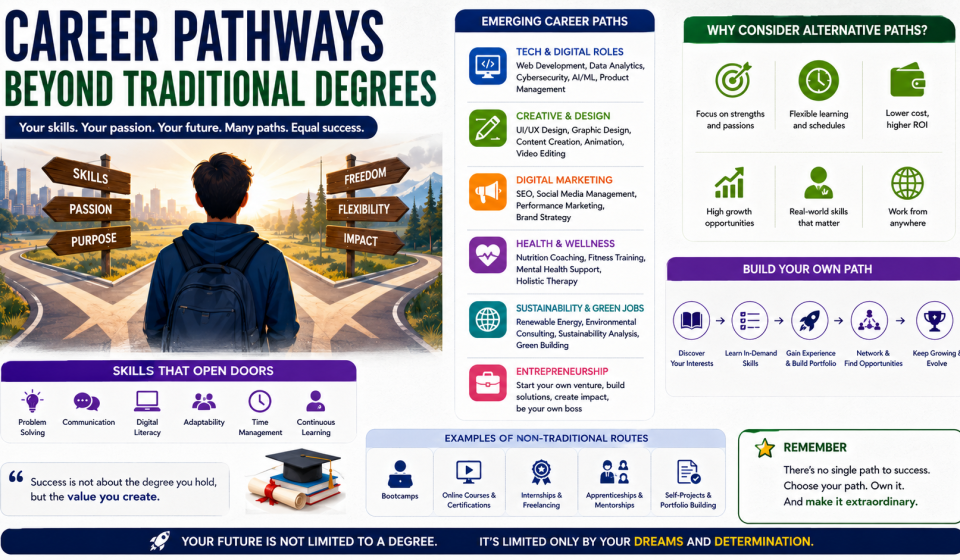
Technological innovation, digital transformation, changing employer expectations, and the rise of skills-based hiring have reshaped the employment landscape. Today, many organizations prioritize practical skills, industry certifications, real-world experience, and demonstrated capabilities over traditional academic credentials. As a result, students and professionals now have access to diverse career pathways that can lead to rewarding opportunities without necessarily following a conventional university route.
The Shift Toward Skills-Based Hiring
One of the biggest changes in the modern workforce is the growing emphasis on skills rather than degrees.
Employers increasingly focus on:
- Practical abilities.
- Technical expertise.
- Problem-solving skills.
- Industry knowledge.
- Work experience.
- Professional certifications.
Companies recognize that candidates can acquire valuable skills through multiple learning pathways, including online courses, bootcamps, apprenticeships, and self-directed learning.
As a result, individuals who demonstrate competence and results often compete successfully with degree holders.
Why Traditional Degrees Are No Longer the Only Option
A university degree still provides significant benefits, but it is no longer the sole gateway to professional success.
Several factors contribute to this shift:
- Rapid technological change.
- Growing demand for specialized skills.
- Expansion of online learning.
- Industry-recognized certifications.
- Increased access to digital education.
- Employer focus on performance.
Many industries now value practical expertise and continuous learning more than formal academic credentials alone.
Professional Certifications as Career Accelerators
Professional certifications have become powerful alternatives to traditional degrees.
Certifications validate specific skills and demonstrate expertise in targeted areas.
Popular certification fields include:
- Cloud Computing.
- Cybersecurity.
- Project Management.
- Data Analytics.
- Digital Marketing.
- Artificial Intelligence.
Industry-recognized certifications often help candidates secure employment more quickly while reducing educational costs and time commitments.
Technology Careers Without a Traditional Degree
The technology sector is one of the most accessible industries for individuals pursuing alternative career pathways.
Many technology companies prioritize skills and portfolios over academic qualifications.
Popular non-degree technology careers include:
- Web Developer.
- Software Tester.
- UX Designer.
- Data Analyst.
- Cybersecurity Specialist.
- Cloud Support Engineer.
Practical projects, certifications, and technical portfolios often carry significant weight during hiring processes.
Coding Bootcamps and Intensive Training Programs
Coding bootcamps have emerged as popular alternatives to traditional computer science degrees.
These programs focus on practical, job-ready skills in areas such as:
- Software Development.
- Web Development.
- Mobile App Development.
- Data Science.
- User Experience Design.
Many graduates secure technology roles after completing intensive training programs lasting only a few months.
Digital Marketing Careers
Digital marketing offers excellent opportunities for individuals without traditional degrees.
Organizations require professionals who can help them grow their online presence and reach customers effectively.
Career options include:
- SEO Specialist.
- Content Marketer.
- Social Media Manager.
- Performance Marketing Executive.
- Email Marketing Specialist.
Many successful digital marketers build careers through certifications, practical experience, and portfolio development rather than formal academic programs.
Content Creation and Media Careers
The creator economy has generated entirely new career opportunities.
Individuals can build successful careers as:
- Content Creators.
- YouTubers.
- Podcasters.
- Bloggers.
- Influencers.
- Video Editors.
Success in these fields often depends on creativity, consistency, audience engagement, and content quality rather than educational credentials.
Freelancing as a Career Path
Freelancing allows professionals to offer specialized services independently.
Popular freelance services include:
- Graphic Design.
- Writing.
- Programming.
- Digital Marketing.
- Consulting.
- Virtual Assistance.
Freelancers can work with clients globally and often develop highly flexible and rewarding careers.
Platforms and digital tools have made freelance opportunities more accessible than ever before.
Entrepreneurship and Startups
Entrepreneurship represents one of the most significant alternatives to traditional career paths.
Entrepreneurs create businesses by identifying opportunities and solving problems.
Success depends on:
- Innovation.
- Leadership.
- Business understanding.
- Risk management.
- Customer focus.
Many successful entrepreneurs achieved remarkable outcomes without completing traditional degree programs.
Skilled Trades and Technical Careers
Skilled trades continue to offer strong employment opportunities and financial stability.
Examples include:
- Electricians.
- Technicians.
- HVAC Specialists.
- Automotive Technicians.
- Industrial Mechanics.
These professions often require vocational training, apprenticeships, or certifications rather than university degrees.
Many skilled trade careers provide excellent earning potential and long-term job security.
Apprenticeships and Learn-and-Earn Models
Apprenticeships combine education with hands-on work experience.
Participants gain:
- Practical skills.
- Industry exposure.
- Professional mentorship.
- Paid training.
This approach allows individuals to earn income while developing valuable expertise.
Many industries increasingly support apprenticeship programs to address talent shortages.
Careers in Artificial Intelligence and Emerging Technologies
Emerging technologies are creating entirely new employment opportunities.
Fields experiencing rapid growth include:
- Artificial Intelligence.
- Machine Learning.
- Blockchain.
- Automation.
- Robotics.
Many professionals enter these sectors through online learning, certifications, and project-based experience rather than traditional academic routes.
Creative and Design Careers
Creative industries often prioritize portfolios over formal educational qualifications.
Popular careers include:
- Graphic Designer.
- Motion Designer.
- UI Designer.
- UX Designer.
- Animator.
- Brand Consultant.
A strong portfolio showcasing practical work frequently matters more than academic credentials.
E-Commerce and Online Business Opportunities
The growth of online commerce has created diverse career options.
Individuals can pursue:
- E-commerce Management.
- Dropshipping.
- Marketplace Consulting.
- Online Store Operations.
- Product Marketing.
Many professionals build successful online businesses through self-learning and practical experimentation.
Financial and Investment Careers
Certain finance-related careers can be accessed through specialized certifications and training.
Examples include:
- Financial Advisor.
- Investment Analyst.
- Insurance Consultant.
- Wealth Management Associate.
Professional credentials often play a significant role in establishing credibility within these fields.
Healthcare Support Careers
While physicians and nurses require formal education, many healthcare support roles offer alternative entry pathways.
Examples include:
- Medical Coding Specialist.
- Healthcare Administrator.
- Medical Billing Professional.
- Health Information Technician.
Certification programs can help individuals access these growing healthcare sectors.
The Importance of Lifelong Learning
One defining characteristic of successful professionals today is a commitment to continuous learning.
Industries evolve rapidly, making ongoing skill development essential.
Learning opportunities include:
- Online courses.
- Workshops.
- Certifications.
- Industry conferences.
- Mentorship programs.
Continuous learning helps professionals remain competitive regardless of their educational background.
Building a Strong Professional Portfolio
For many alternative career pathways, a portfolio serves as proof of competence.
A strong portfolio may include:
- Projects.
- Case studies.
- Certifications.
- Client work.
- Personal initiatives.
Employers often value demonstrated skills more than theoretical knowledge.
A compelling portfolio can significantly improve career prospects.
Soft Skills Remain Essential
Regardless of career path, employers consistently value transferable skills.
Important soft skills include:
- Communication.
- Teamwork.
- Adaptability.
- Leadership.
- Problem-solving.
- Time management.
These competencies support success across industries and career levels.
Choosing the Right Career Path
Selecting the right pathway requires careful consideration of:
- Personal interests.
- Career goals.
- Financial resources.
- Learning preferences.
- Industry demand.
Students should focus on long-term opportunities and choose pathways aligned with their strengths and aspirations.
There is no single formula for success.
Different individuals achieve professional fulfillment through different routes.
The Future of Careers Beyond Degrees
The future workforce is expected to become increasingly skills-driven.
Employers are recognizing that talent can emerge from diverse educational backgrounds.
As technology continues transforming industries, professionals who combine practical expertise, adaptability, and continuous learning will be best positioned for success.
Traditional degrees will remain valuable, but they will increasingly coexist alongside alternative pathways that offer flexibility, accessibility, and career growth opportunities.
Source
https://www.weforum.org
https://www.linkedin.com
https://www.coursera.org
https://www.indeed.com/career-advice
https://www.forbes.com
Conclusion
Career success in 2026 and beyond is no longer defined solely by traditional university degrees. The rise of skills-based hiring, digital learning platforms, professional certifications, entrepreneurship, freelancing, and emerging technologies has created numerous pathways to rewarding careers. While higher education remains valuable, students now have greater flexibility in choosing educational and professional routes that align with their goals and strengths. By focusing on practical skills, continuous learning, real-world experience, and professional development, individuals can build successful careers across a wide range of industries. The future belongs to adaptable learners who are willing to embrace new opportunities and evolve alongside changing workforce demands.
FAQ
What are alternative career pathways?
Alternative career pathways are professional routes that do not rely solely on traditional university degrees and may include certifications, apprenticeships, bootcamps, freelancing, and entrepreneurship.
Can I have a successful career without a college degree?
Yes. Many industries now prioritize skills, experience, certifications, and demonstrated abilities over formal academic qualifications.
Which industries offer careers without traditional degrees?
Technology, digital marketing, design, freelancing, skilled trades, e-commerce, content creation, and entrepreneurship are among the sectors offering strong opportunities.
Are professional certifications valuable?
Yes. Industry-recognized certifications can validate expertise, improve employability, and accelerate career growth in many fields.
What is skills-based hiring?
Skills-based hiring focuses on evaluating candidates based on practical abilities, competencies, and work experience rather than academic credentials alone.
How can students prepare for alternative career pathways?
Students can develop practical skills, complete certifications, build portfolios, gain experience through projects, and engage in continuous learning.
Do employers value portfolios?
In many industries, especially technology, design, and marketing, portfolios serve as important evidence of skills and professional capabilities.
Is continuous learning important for career success?
Absolutely. As industries evolve rapidly, ongoing skill development helps professionals remain competitive and adaptable throughout their careers.