
Pursuing a Master of Business Administration (MBA) remains one of the most rewarding career decisions for graduates aspiring to build leadership, management, and entrepreneurial skills.
Choosing the right MBA college involves much more than comparing rankings. Students should evaluate faculty quality, curriculum, industry exposure, internships, alumni network, international collaborations, placement performance, return on investment (ROI), and career opportunities after graduation. This comprehensive guide explains everything about the best MBA colleges in India for 2026, including eligibility, entrance examinations, CAT cutoffs, fees, admission process, placements, scholarships, popular MBA specialisations, career opportunities, and expert tips to help you make an informed decision.
Why Pursue an MBA in India?
An MBA equips students with practical business knowledge and leadership skills required in today’s competitive corporate world. Graduates gain expertise in finance, marketing, operations, human resources, business analytics, strategy, entrepreneurship, and digital transformation.
Key benefits of pursuing an MBA include:
- Better career opportunities
- Higher salary potential
- Leadership and management skills
- Strong professional network
- Global business exposure
- Entrepreneurial knowledge
- Career switching opportunities
- Faster career growth
Types of MBA Colleges in India
India offers several categories of management institutions.
Indian Institutes of Management (IIMs)
The IIMs are considered India’s premier business schools and are globally recognised for academic excellence, research, and placements.
Popular IIMs include:
- IIM Ahmedabad
- IIM Bangalore
- IIM Calcutta
- IIM Lucknow
- IIM Kozhikode
- IIM Indore
- IIM Shillong
- IIM Udaipur
- IIM Trichy
- IIM Raipur
Government Business Schools
Government institutions provide quality education with comparatively affordable tuition fees.
Examples include:
- Faculty of Management Studies (FMS), Delhi
- Department of Management Studies, IIT Delhi
- SJMSOM IIT Bombay
- DoMS IIT Madras
Private Business Schools
Leading private institutions offer excellent infrastructure, international collaborations, and impressive placement records.
Popular examples include:
- XLRI Jamshedpur
- SPJIMR Mumbai
- MDI Gurgaon
- IMT Ghaziabad
- Great Lakes Institute of Management
- TAPMI
- IMI New Delhi
- FORE School of Management
International Business Schools
Some institutions provide globally recognised MBA programmes with international exchange opportunities.
Best MBA Colleges in India 2026
Among the leading MBA institutions expected to remain highly ranked are:
- Indian Institute of Management Ahmedabad
- Indian Institute of Management Bangalore
- Indian Institute of Management Calcutta
- Indian Institute of Management Lucknow
- Indian Institute of Management Kozhikode
- XLRI Jamshedpur
- Faculty of Management Studies (FMS), Delhi
- SPJIMR Mumbai
- MDI Gurgaon
- ISB Hyderabad
- SJMSOM IIT Bombay
- DoMS IIT Delhi
- IIFT Delhi
- IMT Ghaziabad
- Great Lakes Chennai
Students should always verify the latest official rankings before applying.
Eligibility Criteria for MBA Admission
Eligibility requirements vary across institutions, but generally include:
- Bachelor’s degree from a recognised university
- Minimum qualifying marks (usually 50% or equivalent)
- Relaxation for reserved categories where applicable
- Valid entrance examination score
- Personal Interview (PI)
- Group Discussion (GD) or Written Ability Test (WAT), depending on the institute
Final-year undergraduate students can also apply, subject to fulfilling eligibility requirements.
MBA Entrance Exams in India
CAT (Common Admission Test)
CAT is the most widely accepted entrance examination for admission to IIMs and many leading business schools.
XAT
Conducted by XLRI and accepted by numerous management institutes.
CMAT
Accepted by AICTE-approved institutions across India.
MAT
Conducted multiple times a year and accepted by several colleges.
NMAT
Required for admission to NMIMS and accepted by various institutions.
SNAP
Conducted for admission to Symbiosis institutes.
MICAT
Required for admission to MICA Ahmedabad.
Some universities also conduct their own admission tests.
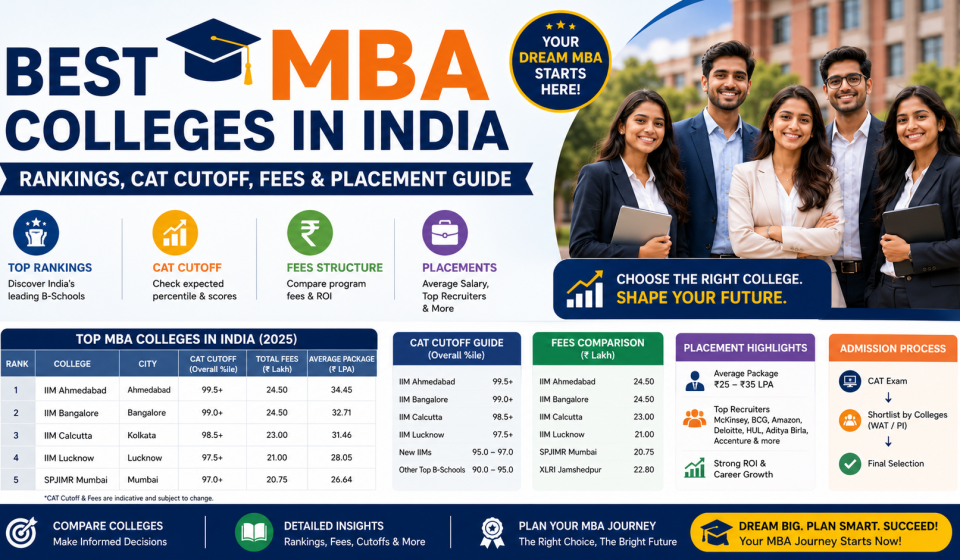
Expected CAT Cutoffs for Top MBA Colleges
CAT cutoffs vary each year based on competition and available seats.
Approximate percentile expectations:
- IIM Ahmedabad: 99+ percentile
- IIM Bangalore: 99+ percentile
- IIM Calcutta: 99+ percentile
- FMS Delhi: 98–99 percentile
- SPJIMR Mumbai: 95–98 percentile
- MDI Gurgaon: 94–97 percentile
- IIM Lucknow: 97–99 percentile
- IIM Kozhikode: 97–99 percentile
- IIT Management Schools: 90–98 percentile
Actual cutoffs may differ depending on category, academic profile, work experience, and institute-specific selection criteria.
MBA Admission Process
Step 1: Select Target Colleges
Prepare a shortlist based on:
- Rankings
- Fees
- Placements
- ROI
- Faculty
- Location
- Specialisations
Step 2: Register for Entrance Exams
Complete applications before deadlines and retain:
- Application confirmation
- Fee receipt
- Admit card
Step 3: Prepare for the Entrance Test
Focus on:
- Quantitative Aptitude
- Logical Reasoning
- Data Interpretation
- Verbal Ability
- Reading Comprehension
- Mock tests
- Previous year papers
Step 4: Apply to MBA Colleges
Many institutes require separate application forms in addition to entrance exam registration.
Step 5: Shortlisting Process
Institutes shortlist candidates based on:
- Entrance score
- Academic performance
- Work experience
- Diversity profile
Step 6: GD, PI and WAT
Shortlisted candidates participate in interviews and assessment rounds.
Step 7: Final Admission Offer
Successful candidates receive admission offers after the final merit list.
MBA Fee Structure
MBA tuition fees vary considerably.
Approximate total programme fees:
- IIMs: ₹12 lakh – ₹30 lakh
- Government Institutions: ₹1 lakh – ₹5 lakh
- IIT Management Schools: ₹8 lakh – ₹15 lakh
- Private Business Schools: ₹8 lakh – ₹28 lakh
Students should also budget for accommodation, books, travel, and personal expenses.
MBA Placements
Placement records are among the most important factors while selecting a business school.
Leading recruiters include:
- McKinsey & Company
- Boston Consulting Group (BCG)
- Bain & Company
- Deloitte
- Accenture
- Amazon
- Microsoft
- Tata Group
- Reliance Industries
- HDFC Bank
- ICICI Bank
- Aditya Birla Group
- PwC
- EY
- KPMG
Placement packages depend on institute reputation, specialisation, market conditions, prior work experience, and student performance.
Popular MBA Specialisations
Students can choose from various specialisations, including:
- Finance
- Marketing
- Human Resource Management
- Operations Management
- Business Analytics
- Information Technology
- International Business
- Healthcare Management
- Supply Chain Management
- Digital Marketing
- Entrepreneurship
- Retail Management
- Hospitality Management
- Sustainability Management
Selecting a specialisation aligned with career goals improves long-term prospects.
Scholarships for MBA Students
Financial assistance is available through:
- Government scholarship schemes
- Merit scholarships
- Need-based scholarships
- Corporate sponsorships
- Alumni-funded scholarships
- Educational loans with flexible repayment options
Eligible candidates should review scholarship criteria before admission.
Career Opportunities After MBA
MBA graduates enjoy opportunities across industries.
Popular job roles include:
- Management Consultant
- Business Analyst
- Marketing Manager
- Financial Analyst
- Investment Banker
- Product Manager
- HR Manager
- Operations Manager
- Supply Chain Manager
- Brand Manager
- Project Manager
- Sales Manager
- Entrepreneur
- Strategy Consultant
Many graduates also pursue leadership roles after gaining industry experience.
How to Choose the Best MBA College
Consider the following factors before making your decision:
- Accreditation and approvals
- National rankings
- Placement statistics
- Average salary package
- ROI
- Faculty expertise
- Alumni network
- Industry collaborations
- Internship opportunities
- Campus facilities
- International exposure
- Specialisations offered
A balanced evaluation is more valuable than relying solely on rankings.
Common Mistakes MBA Aspirants Should Avoid
- Applying only to top-ranked institutes
- Ignoring ROI
- Overlooking average placement packages
- Missing application deadlines
- Poor interview preparation
- Not researching specialisations
- Ignoring scholarship opportunities
- Choosing a college based only on advertisements
Future Trends in MBA Education
Business education is evolving rapidly to meet changing industry demands. MBA programmes now emphasise digital transformation, Artificial Intelligence, sustainability, data-driven decision-making, entrepreneurship, and global business strategy. Institutions are integrating live industry projects, international immersion programmes, startup incubators, and experiential learning into their curriculum.
Recruiters increasingly value practical skills, adaptability, leadership, communication, and technological awareness alongside academic performance. Students planning MBA admissions in 2026 should look for colleges that offer strong industry connections, updated curricula, internship opportunities, and excellent career support to remain competitive in the modern business landscape.
Source
https://www.nirfindia.org
https://www.iimindia.ac.in
https://iimcat.ac.in
https://www.aicte-india.org
Conclusion
Choosing the best MBA college in India for 2026 requires careful consideration of rankings, CAT cutoffs, fee structure, placement performance, return on investment, faculty quality, and career opportunities. While premier institutions such as the IIMs and other leading business schools offer exceptional academic environments and strong placement records, students should select a college that aligns with their career aspirations, financial situation, and preferred specialisation. Preparing thoroughly for entrance examinations, researching colleges in detail, and staying informed through official admission notifications will significantly improve the chances of securing admission to a reputed management institute and building a successful career in business and leadership.
FAQ
1. Which is the best MBA college in India?
The Indian Institutes of Management (IIMs), especially IIM Ahmedabad, IIM Bangalore, and IIM Calcutta, are widely recognised among the best MBA institutions in India.
2. Is CAT compulsory for MBA admission?
CAT is mandatory for admission to the IIMs and accepted by many top business schools. However, several institutions also accept XAT, NMAT, SNAP, CMAT, MAT, and other entrance examinations.
3. What CAT percentile is required for top MBA colleges?
Leading institutes generally require very high percentiles. The most competitive colleges often shortlist candidates with scores above the 98–99 percentile, though selection also depends on academics, work experience, and interview performance.
4. What is the average fee for an MBA in India?
MBA programme fees vary widely, ranging from around ₹1 lakh at some government institutions to over ₹30 lakh at certain premier business schools.
5. Which MBA specialisation offers the best career opportunities?
Finance, Marketing, Business Analytics, Operations, Product Management, and Human Resource Management remain among the most popular and rewarding specialisations, depending on individual career goals.
6. Are internships important during an MBA?
Yes. Internships provide practical industry exposure, strengthen professional skills, improve employability, and often lead to pre-placement offers.
7. Can fresh graduates pursue an MBA?
Yes. Many MBA colleges admit fresh graduates, while some programmes also value candidates with prior work experience.
8. How should I choose the right MBA college?
Compare colleges based on accreditation, faculty, curriculum, placements, ROI, internships, alumni network, industry partnerships, campus facilities, and long-term career outcomes instead of relying only on rankings.