Academic Flexibility Under NEP 2020: What Every Student Should Know to Build a Future-Ready Career

The National Education Policy (NEP) 2020 is one of the most significant educational reforms introduced in India in recent decades. Designed to transform the country’s education system, NEP 2020 aims to make learning more flexible, multidisciplinary, skill-oriented, and aligned with global standards.
One of the most revolutionary aspects of NEP 2020 is its focus on academic flexibility. Students are no longer expected to remain confined within fixed streams such as Science, Commerce, or Arts. Instead, they can combine subjects based on their interests, career aspirations, and strengths. This flexibility encourages creativity, innovation, critical thinking, and lifelong learning while preparing students for rapidly changing career opportunities.
What Is Academic Flexibility?
Academic flexibility allows students to customize their educational journey according to their interests, abilities, and career goals.
Instead of following rigid academic structures, students can:
- Choose interdisciplinary subjects
- Earn transferable academic credits
- Exit and re-enter degree programs
- Explore vocational education
- Learn through multiple modes
The objective is to create learner-centered education.
Understanding NEP 2020
NEP 2020 seeks to modernize India’s education system by focusing on:
- Holistic learning
- Skill development
- Multidisciplinary education
- Innovation
- Research
- Digital learning
- Employability
The policy encourages both academic excellence and practical knowledge.
Freedom to Choose Subjects
One of the biggest reforms is allowing students to combine subjects across disciplines.
For example, a student may study:
- Computer Science with Psychology
- Economics with Artificial Intelligence
- Physics with Music
- Mathematics with Design
- Commerce with Data Analytics
This encourages broader learning experiences.
Multidisciplinary Education
NEP promotes education beyond traditional academic boundaries.
Students are encouraged to develop knowledge in:
- Humanities
- Sciences
- Commerce
- Arts
- Technology
- Social Sciences
Multidisciplinary learning improves creativity and adaptability.
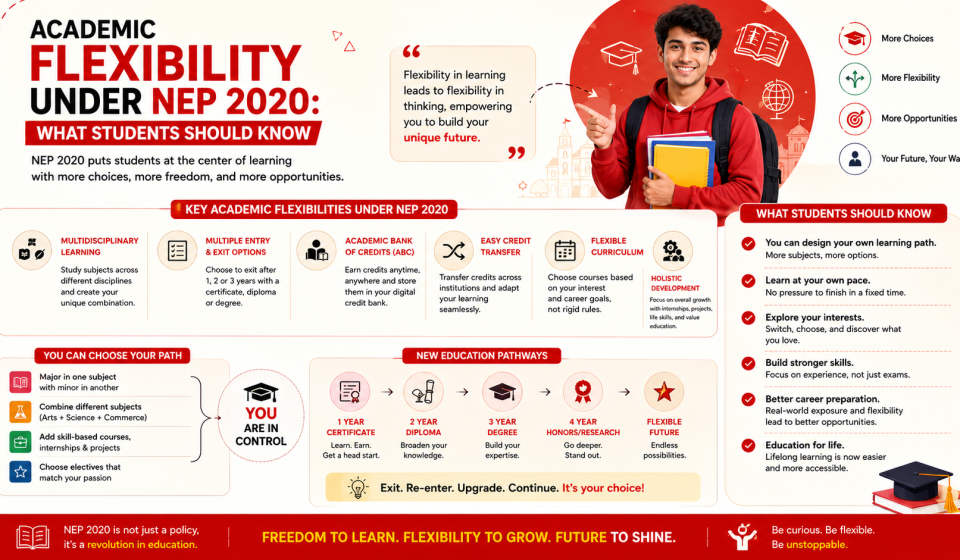
Multiple Entry and Exit Options
Students now have greater flexibility if personal or financial circumstances interrupt their studies.
Depending on completed years, they may receive:
- Certificate after one year
- Diploma after two years
- Bachelor’s Degree after three years
- Bachelor’s Degree with Research after four years (where applicable)
Students can later continue their education without losing earlier academic progress.
Academic Bank of Credits (ABC)
The Academic Bank of Credits enables students to digitally store academic credits earned from recognized institutions.
Benefits include:
- Credit transfer
- Flexible learning
- Easier mobility between institutions
- Recognition of completed coursework
- Support for lifelong learning
ABC provides greater educational freedom.
Skill-Based Learning
NEP emphasizes practical knowledge alongside theory.
Students are encouraged to develop:
- Digital skills
- Communication
- Critical thinking
- Entrepreneurship
- Leadership
- Problem-solving
Employability becomes a central objective.
Vocational Education
The policy integrates vocational learning into higher education.
Students may explore fields such as:
- Healthcare
- Agriculture
- Tourism
- Information Technology
- Electronics
- Manufacturing
- Media
- Retail
Vocational education improves job readiness.
Internship Opportunities
Practical exposure is encouraged through:
- Industry internships
- Community projects
- Research opportunities
- Field visits
- Skill-based training
Experiential learning strengthens career preparation.
Digital Learning
Technology plays a major role under NEP 2020.
Students benefit from:
- Online learning platforms
- Virtual classrooms
- Digital assessments
- E-learning resources
- Hybrid education models
Technology increases accessibility and flexibility.
Research and Innovation
Students are encouraged to participate in:
- Research projects
- Innovation challenges
- Startup initiatives
- Hackathons
- Scientific investigations
Research promotes analytical thinking and creativity.
Holistic Development
Education extends beyond academics.
Students are encouraged to participate in:
- Sports
- Cultural activities
- Community service
- Leadership programs
- Student clubs
- Entrepreneurship initiatives
Overall personality development becomes equally important.
Career Advantages
Academic flexibility prepares students for diverse careers by improving:
- Adaptability
- Interdisciplinary knowledge
- Technical expertise
- Soft skills
- Creativity
- Lifelong learning habits
These qualities are highly valued by employers.
Challenges Students Should Understand
Although beneficial, students should prepare for:
- Careful subject selection
- Long-term career planning
- Understanding credit systems
- Managing interdisciplinary workloads
- Staying informed about institutional policies
Proper guidance helps students maximize the benefits.
Tips to Make the Most of NEP 2020
Students should:
- Explore career interests early.
- Consult academic advisors.
- Build multidisciplinary skills.
- Participate in internships.
- Earn relevant certifications.
- Develop digital literacy.
- Take advantage of flexible learning opportunities.
- Maintain strong academic performance.
Strategic planning leads to better educational outcomes.
Future Impact of NEP 2020
As implementation continues, NEP 2020 is expected to:
- Improve employability
- Encourage innovation
- Increase global competitiveness
- Strengthen research culture
- Promote entrepreneurship
- Make higher education more flexible and inclusive
These reforms are expected to shape India’s future workforce.
Source
https://www.education.gov.in
https://www.ugc.gov.in
https://www.abc.gov.in
https://www.aicte-india.org
https://www.niti.gov.in
Conclusion
Academic flexibility under NEP 2020 marks a transformative shift in India’s higher education system by giving students greater freedom to shape their academic and professional journeys. Through multidisciplinary education, flexible subject choices, the Academic Bank of Credits, multiple entry and exit options, vocational training, internships, digital learning, and skill-based education, the policy prepares learners for the demands of a rapidly evolving global economy. Rather than limiting students to traditional academic pathways, NEP 2020 encourages creativity, innovation, adaptability, and lifelong learning. Students who understand these opportunities, plan their education strategically, and actively develop both academic and practical skills will be better positioned to achieve career success in the modern world.
FAQ
1. What is academic flexibility under NEP 2020?
Academic flexibility allows students to choose subjects across disciplines, transfer academic credits, pursue multidisciplinary education, and follow personalized learning pathways based on their interests and career goals.
2. What is the Academic Bank of Credits (ABC)?
The Academic Bank of Credits is a digital system that stores academic credits earned by students from recognized higher education institutions, allowing them to transfer credits and continue their education more flexibly.
3. What are the multiple entry and exit options in NEP 2020?
Students may receive a certificate after one year, a diploma after two years, a bachelor’s degree after three years, or a bachelor’s degree with research after four years (where applicable), with the flexibility to return later and continue their studies.
4. Can students choose subjects from different streams under NEP 2020?
Yes. NEP 2020 allows students to combine subjects from Science, Commerce, Arts, Humanities, Technology, and other disciplines according to their interests and career objectives.
5. How does NEP 2020 improve employability?
The policy emphasizes skill development, internships, vocational education, digital literacy, multidisciplinary learning, entrepreneurship, communication, and problem-solving, making graduates better prepared for modern careers.
6. Does NEP 2020 encourage internships and practical learning?
Yes. Experiential learning through internships, industry collaborations, research projects, community engagement, and vocational training is a major focus of the policy.
7. Is multidisciplinary education beneficial?
Absolutely. Multidisciplinary education broadens knowledge, enhances creativity, improves adaptability, and prepares students for careers that increasingly require cross-functional skills.
8. How can students make the best use of academic flexibility?
Students should explore their interests, seek academic guidance, choose subjects strategically, build practical skills, complete internships, earn certifications, stay informed about institutional policies, and continuously develop both technical and soft skills throughout their education.